
Exploring Cádiz Cathedral: Where Baroque Meets the Atlantic
Set along the shimmering blue of the Atlantic, Cádiz Cathedral is where sunlight and sea meet stone in perfect harmony. Locals call it La Catedral Nueva — “The New Cathedral” — though it has graced this coastal skyline since the 18th century. It’s a treasure for travelers who crave a mix of history, art, and sea air — a place where every lens finds its light and every bell echoes across centuries.
You need to see Cádiz Cathedral for yourself — especially in May or early June, when the weather is warm but the summer crowds haven’t yet filled the plazas. The nearest airport is Jerez de la Frontera (XRY), just a scenic hour’s drive away through vineyards and villages. Plan on two to three hours to explore the cathedral’s golden nave, climb its bell tower, and linger on the rooftop terrace as the sun melts into the ocean. Cádiz is small, charming, and deeply photogenic — and this cathedral is its beating heart.
🏛️ Story & Significance: The Soul of Cádiz Cathedral
Birthed from the boom years of Spanish trade with the Americas, Cádiz Cathedral was intended to show off a city at the peak of its maritime glory. When work began in 1722, Cádiz was one of Europe’s wealthiest ports — ships from Havana and Veracruz unloaded silver and spices right across from where the cathedral stands. Architect Vicente Acero, already known for Granada’s cathedral, was commissioned to design something equally magnificent but more attuned to light and sea. The golden limestone façade and the cathedral’s glowing dome were chosen deliberately to reflect the sun and salt air — a radiance that would mirror the fortunes of Cádiz itself.
Construction, however, stretched across 116 years, passing through the hands of several architects and evolving stylistically from exuberant Baroque to balanced Neoclassicism. Financial troubles, shifting trade winds, and wars delayed progress, but the citizens of Cádiz never gave up on their “Cathedral of the Americas.” Each generation added something new — a chapel, a dome, a tower — leaving behind a living architectural diary of Spain’s colonial and cultural ambitions. When it was finally consecrated in 1838, its mixture of styles wasn’t a flaw; it was a testament to endurance.
Today, the cathedral’s rhythm continues — bells marking fishermen’s returns, choirs echoing through its cool stone corridors, and pilgrims lighting candles in quiet side chapels. It’s not just a monument to faith, but a symbol of Cádiz’s resilience, standing tall through storms, wars, and economic shifts, still gleaming gold at sunset as if to remind the city that beauty endures even when fortunes fade.
Notable People & Patrons
Among the key figures behind the cathedral’s rise was Bishop Lorenzo Armengual de la Mota, whose vision and financing launched construction in the early 18th century. Wealthy merchants of Cádiz, flush from New World trade, poured in donations, eager to immortalize their prosperity in stone and marble. Later, King Ferdinand VII helped restart the stalled project in the early 1800s after decades of war and debt. The tomb of Manuel de Falla, the beloved Spanish composer born in Cádiz, rests within its crypt — a lyrical connection between faith, art, and homeland that still resonates with visitors today.
Architecture in a Nutshell
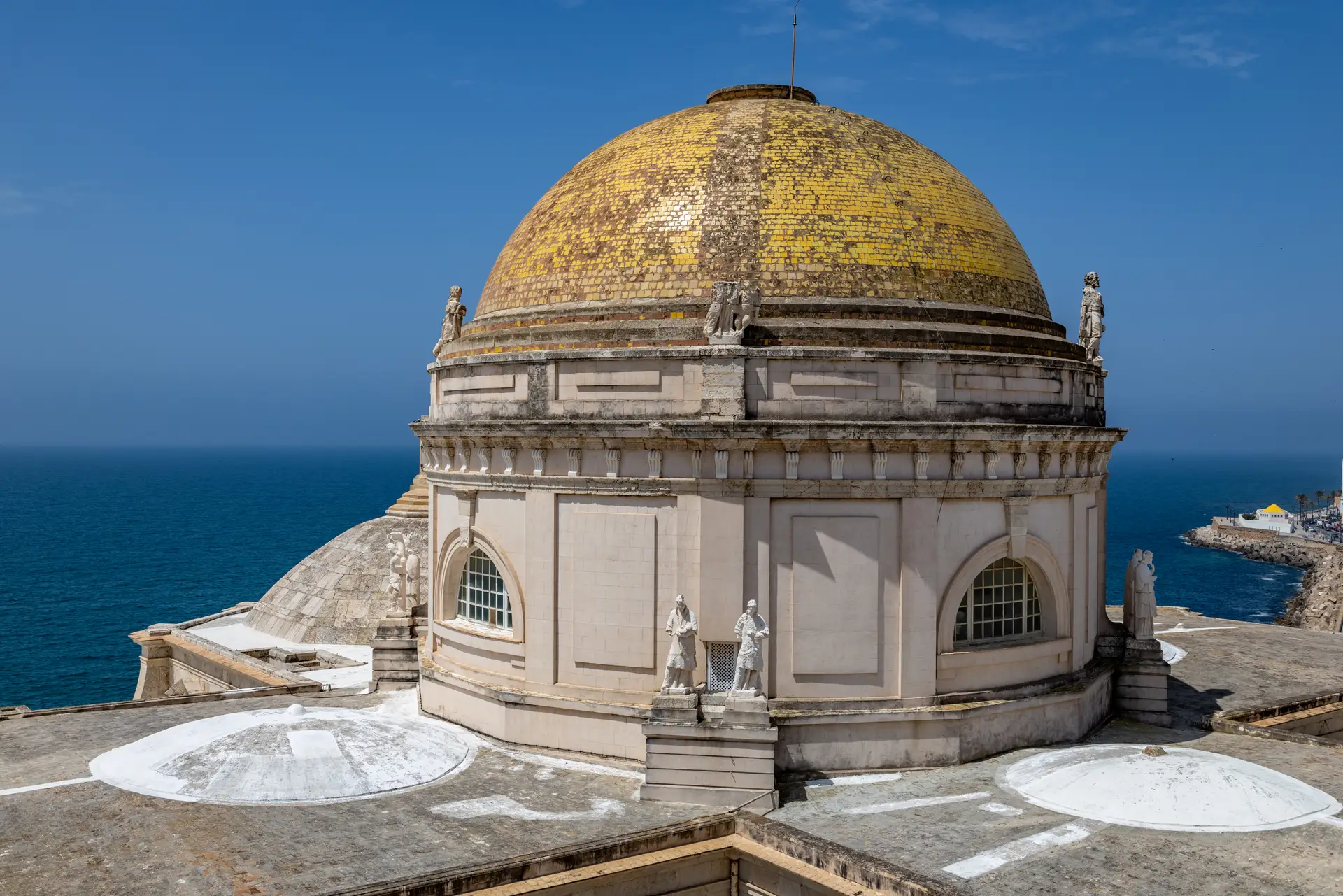
Cádiz Cathedral is a stunning blend of Baroque exuberance and Neoclassical restraint, with a touch of Moorish influence in its ornamentation. The façade bursts with carved saints and twisted columns that seem to dance in the light, while the interior flows with calm symmetry and pale stone, designed to enhance natural brightness from the seaside. The golden-tiled dome, visible from miles away, was added later and gives the cathedral its nickname: La Catedral Dorada (The Golden Cathedral). The bell towers, accessible to visitors, offer panoramic views of Cádiz’s rooftops, beaches, and harbor — one of the best photography vantage points in all Andalusia.
Living Traditions Today
Cádiz Cathedral still anchors daily life in this coastal city. Its Holy Week processions, with candlelit floats moving to the sound of brass and drums, fill the streets with solemn grace. The Corpus Christi celebrations bring flower carpets and banners fluttering under the same golden dome that’s watched generations pass. Locals stop by for brief prayers between errands, and children play on the steps after school — proof that this cathedral isn’t just a relic, but part of Cádiz’s living heartbeat. At dusk, when light glows honey-warm across its façade, photographers and believers alike find themselves quietly awed — proof that time, faith, and craftsmanship can indeed create something eternal.
🧠 Fascinating Facts & Hidden Meanings
There’s more to Cádiz Cathedral than golden stone and sea views — its builders hid layers of symbolism beneath the shimmer. Every arch, statue, and dome carries a whisper from an age obsessed with celestial order and maritime destiny. Stand beneath the great dome and you’ll notice how light pours through at precise angles, illuminating different altars as the day unfolds — a quiet choreography of faith and sun. For photographers and wanderers alike, these details transform the cathedral from a mere landmark into a puzzle box of art, science, and superstition.
Five Quick “Did-You-Knows”
The cathedral is nicknamed “La Catedral de las Américas” because its construction was financed largely by trade with Spain’s New World colonies.
Its gold-tiled dome was designed to catch sunlight from ships approaching Cádiz Bay — a beacon for sailors long before lighthouses ruled the coast.
The crypt floor lies below sea level, and you can actually hear the faint hum of waves reverberating through the stone during quiet services.
One tower is slightly shorter than the other — locals joke it “leans toward Havana,” nodding to the city’s long-lost trading partner across the Atlantic.
The cathedral’s pipe organ boasts more than 4,000 pipes; legend says its deepest note was tuned to echo a passing storm to remind worshippers of divine power.
A few links and ads here are affiliate portals. If you click through and snag something, you’ll be fueling my next photo-quest at no extra cost to you. Thanks for keeping the adventure rolling!
If you want to understand Cádiz Cathedral in context — not just as a masterpiece of stone, but as the soul of an ancient seaport — join one of the city’s guided walks or cycling adventures. The narrow lanes and sea-washed plazas of old Cádiz deserve more than a quick glance, and these tours are perfect for tracing how faith, trade, and daily life intertwine under Andalusia’s blinding sun.
For history buffs, the 2-Hour Tour around Cádiz: History, Anecdotes and Curiosities feels like stepping into a living museum. You’ll stroll the same waterfronts where galleons once unloaded silver and spices, hear tales of pirates and plague survivors, and peek into tucked-away courtyards where the cathedral’s bells once guided sailors home. It’s a short, rich immersion that pairs beautifully with your cathedral visit — ideally done just before climbing the tower for those sweeping harbor views.
Prefer something breezier? Try the Cádiz 2:30h Bike Tour. Glide past the golden dome, along oceanfront promenades, and through shaded parks where sea pines whisper over cobblestones. Guides share quirky local legends, introduce artisan neighborhoods, and point out photo angles even most residents miss. It’s part sightseeing, part storytelling, and the perfect way to connect the dots between the cathedral’s grandeur and the easy coastal rhythm that defines Cádiz.
📌 Plan Your Visit: Hours, Tickets & What to Expect
Budget 2–3 unrushed hours for Cádiz Cathedral: time to wander the nave and chapels, descend to the echoey crypt, and climb the bell tower for those Atlantic-to-rooftop panoramas. Crowds swell late morning to mid-afternoon when day-trippers arrive; the calmest light and space are right at opening and again late day. Tickets are checked at the main entrance and again at the tower/crypt access points, so keep them handy. Some small side spaces and occasional exhibitions may be staff-supervised or guided-only, and chapels can close briefly during services.
🎫 Ticketing Tips — where to buy, skip-the-line notes, refund quirks.
Buy on-site at the cathedral kiosk or prebook online (handy on cruise/peak days). Tower access is often a separate add-on; confirm combo options to save time. “Skip-the-line” helps most in late morning, less so at opening or late afternoon. Many online tickets are time-slotted and non-refundable within 24 hours—double-check your window before you click.
🎉 Festival/Peak Day Watch — how local events impact access and crowds.
During Holy Week, Corpus Christi, and summer music/cultural festivals, expect capacity controls, partial closures, and lines that form before opening. Weekend cruise calls can spike foot traffic from 10:30 a.m.–2:30 p.m. If a major procession routes by the plaza, openings may shift or pause—plan to visit early morning or near last entry and be flexible. Photographers: processions are gold for storytelling, but interior time may be shorter—capture exteriors first, then return for the tower when crowds thin.
| Site | Cádiz Cathedral (La Catedral Nueva), Old Town Cádiz, Spain |
| Plan on | 2–3 hours for nave + chapels, crypt, and bell tower (add time for blue hour views). |
| When It’s Busiest | Late morning–mid-afternoon (day-trippers & cruise calls). Calmest at **opening** and **late day**. |
| Hours | Vary by season and liturgical calendar; typical opening is late morning to early evening. Last entry ~30–45 min before close. |
| Tickets & Checks | Tickets scanned at main entrance; separate checks at the crypt and tower access points. Keep your ticket handy. |
| Typical Cost (USD) | $6–$12 adult; tower often a combo add-on. Concessions/children discounted; prices may vary by season. |
| Photography | Handheld allowed in most areas; be discreet during services. Tripods/flash typically not permitted. |
| Dress & Comfort | Casual-modest; hats off in sacred areas. Grippy footwear for stone floors and the tower steps. |
| Accessibility | Nave/chapels mostly level; surfaces are stone/cobble. Crypt and tower require stairs (no elevator). Quiet seating along side aisles. |
| Nearest Transit | Cádiz train/bus station, flat 12–15 min walk. Taxis/ride-hails to Plaza de la Catedral (may drop one block out on event days). |
| Facilities | Restrooms near ticketed areas (ask staff if not visible). Small gift desk; occasional exhibits may be guided-only. |
| Best Light | Opening hour for quiet interiors; late afternoon → blue hour for façades and golden dome; tower views at sunset are superb. |
🚶 Getting There, Entry & Accessibility
Most travelers arrive in Old Town Cádiz on foot from the train/bus station (about a 12–15 minute flat walk) or via a short taxi/ride-hail to Plaza de la Catedral. If you’re parking, expect a brief stroll through cobbled lanes—leave a few extra minutes for photo-induced detours and café temptations. Entry is through the signed main doors facing the plaza; tickets are checked just inside, with bag/security glances before you head toward the nave, crypt, or tower. Pacing for mobility: do the nave and side chapels first (mostly level), then the crypt (broad stairs down), and save the bell-tower climb for last so you can gauge energy and crowds.
Parking & Drop-offs
Closest options are paid garages on the fringes of Old Town with well-marked pedestrian exits toward the cathedral area; street parking is scarce and time-limited. Typical garage fees run hourly, with extended hours into the evening. Taxis/ride-hails can usually drop at the edge of the plaza; ask for “Plaza de la Catedral” to minimize walking. On festival or cruise-busy days, drop-offs may be one block away due to barricades—plan a two-minute extra walk.
Accessibility Notes
Surfaces around the cathedral are stone and cobblestone, generally level but sometimes uneven at thresholds—low-profile ramps are present at main entries when services aren’t underway. The nave and most chapels are accessible; the crypt requires stairs and the tower is stairs-only (narrow, handrails, no elevator). Look for quiet seating along the side aisles if you need a pause; restrooms are signed near ticketed areas (ask staff if you don’t spot them quickly). Dress is casual-modest; hats off inside sacred spaces, and grippy footwear is smart for stone floors.
Wayfinding Inside
The layout is intuitive: a long central nave with side chapels, sacristy/treasures off signed corridors, crypt access down a broad stair, and tower access via a clearly marked door near the transept. Expect some one-way segments around exhibits or during services—follow the arrows and rope lines. If your party splits, good “meet-back” spots are the large central pillar near the main crossing or the cathedral steps by the plaza fountain. For photographers, work clockwise from the right-hand chapels to catch shifting light, then finish with the tower for blue-hour views.
🧭 How to Explore: Smart Routes for Any Timeline
Start in the sunlit Plaza de la Catedral, letting the façade and twin towers set the mood before you slip through the main doors into the cool hush of the nave. Move along the side chapels to feel the rhythm of candles, altars, and sculpted saints, then descend to the crypt for echoing acoustics and that briny hum from the sea. Return upstairs and aim for the treasures/sacristy corridor if open, then make your way to the bell tower for the grand crescendo: rooftops tilting to the Atlantic and a golden dome catching late light. If time and energy allow, step back outside to orbit the plaza arcades for street-life candids and façade studies before finishing with a slow spin around the exterior for symmetry, texture, and shadow play.
60-Minute “Essentials”
Enter, pause under the crossing for the scale shot, then do a right-hand loop of the side chapels (work clockwise for consistent light). Pop down to the crypt for five minutes of cool stone and details, then head straight to the bell tower—the line moves faster early or late. Cap it by circling the plaza for façade angles and a final wide establishing frame. You’ll leave with one hero interior, one moody crypt detail, and one skyline sweep.
90–120 Minutes “Deeper Look”
Repeat the Essentials loop, but linger: spend 10–15 minutes in the treasures/sacristy (if open) for reliquaries, vestments, and close-up craft. Add a measured study of three chapels—one wide, one medium, one detail—then return to the nave to catch a choir warm-up or ambient sound before climbing the tower. Finish with a slow exterior walk around the cathedral’s base to photograph stone textures, side portals, and the dome rising between alleys.
Cruise Clock (2–3 Hours)
00:00–00:20 — Plaza arrival & façade: one wide establishing shot + quick architectural detail (carved saint or column capital).
00:20–01:00 — Interior loop: nave wide from the center aisle, two chapels (medium/close), then descend to the crypt for a reflective minute in the hush.
01:00–01:40 — Tower climb: bank your first hero view over tiled roofs; wait a few beats for gulls and passing clouds to add motion.
01:40–02:00 — Snack reset at the plaza edge: grab a tortillita de camarones or a tuna tapa and a water/espresso; note the dome catching light between arcades.
02:00–02:30/03:00 — Exterior wrap: walk one block out for a compressed tele shot of the golden dome, then a final reflective moment on the cathedral steps—compose the human scale (locals chatting, a child with balloons) against centuries of stone. You’ll leave with 2 hero views, 1 crafted detail, 1 quiet moment, and a taste of Cádiz in your pocket.
🖼️ Spaces & Highlights You’ll Love
Cádiz Cathedral is one of those places where every turn feels like a new chapter in an old story — not just for photographers, but for anyone who loves atmosphere, history, and that salty edge of the sea. The spaces flow naturally: sunlight on the plaza, cool marble quiet inside, and the breathtaking sweep of the tower above it all. Each area has its own rhythm — sacred calm, echoing songs, or cheerful chatter drifting in from the square. Take your time here; it’s not a place to rush, but one to experience with your senses fully open.
The Nave & Crossing Light — the cathedral’s soul and grand introduction.
Step through the main doors and you’re greeted by soaring stone columns, intricate carvings, and a soft glow that feels almost alive. The vast nave immediately quiets the outside world — even children stop whispering in awe. Pause beneath the central dome, where sunlight streams through high windows and dances across the marble floor. This is the perfect moment to simply look up, breathe, and feel the centuries of faith and craftsmanship surrounding you.
The Crypt & Manuel de Falla — where silence tells its own story.
Descend the wide staircase to the crypt, a serene and slightly mysterious space that feels worlds away from the bustle above. Here lies Manuel de Falla, the famous Cádiz-born composer, resting beneath elegant vaulted ceilings. The acoustics are remarkable — soft and echoing, often used for small concerts that make the space hum with emotion. Take a slow walk through, reading the inscriptions and letting the calm linger; it’s a quiet reminder that Cádiz has always been a city of deep soul, not just bright sun.
The Bell Tower & Golden Dome — Cádiz from every angle.
Saving the bell tower for last is like dessert after a feast. The gentle spiral climb rewards you with sweeping views across the city’s whitewashed rooftops, the sparkling Atlantic, and the cathedral’s shimmering golden dome. The sea breeze hits you as the bells hang overhead, and suddenly you understand why locals call this the “Cathedral of the Americas” — it feels both European and oceanic. Stay a few extra minutes to spot landmarks, listen to street musicians far below, and savor that unforgettable view before heading back down to the lively plaza cafés.
🍽️ Nearby Pairings & Pleasant Pauses
A deep breath outside the cathedral opens up a handful of low-stress add-ons within a few easy blocks. Drift to a plaza café with a line of tables facing the façade for people-watching and a breezy espresso; late afternoon light skims the stone beautifully while the square warms up with street music. Slip into artisan lanes around Calle Compañía for ceramics, leatherwork, and tiny ateliers that still smell of dye and wood polish. If you crave a view, head to a modest rooftop perch near Plaza de las Flores—perfect for golden hour when rooftops blush and gulls cruise the thermals. Blue hour is best back at the cathedral steps or along the waterfront ramparts, where the dome glows and the Atlantic turns indigo. Keep the pace gentle: wander, nibble, listen, and let Cádiz come to you.
Family-Friendly Stops
Grab ice cream at a gelato counter off Plaza de la Catedral and park on the broad cathedral steps or a shady bench along the side aisles of the square. The flat, mostly car-free lanes make it stroller-friendly, though old stones can be a bit bumpy—opt for larger wheels if you have them. Duck into Plaza de las Flores for flowers, quick snacks, and space for little legs to roam in sight. Restrooms are easier to find at cafés—order something small and kindly ask.
Rain/Heat Refuge
When the sun bites or rain taps the paving stones, slide into arcaded streets around the market for breezy cover and casual tapas bars. Nearby indoor galleries and small museums (check hours) offer calm rooms, benches, and welcome shade. Many cafés keep misted terraces in summer and wind-sheltered corners in winter—look for awnings that face away from the sea breeze. If all else fails, a slow stroll through the covered market aisles buys you time, snacks, and a dry path back toward the plaza.
🎥 Reels on the Road
Cádiz Cathedral is a dream playground for short-form video — it’s all about rhythm, movement, and light that shifts as fast as your lens can follow. The golden stone catches every hue of the day, from pale dawn silver to deep amber sunset, giving endless transition shots. The interior offers cinematic acoustics — bells tolling, footsteps echoing, quiet murmurs under the dome — perfect for atmospheric sound bites. Symmetrical aisles, spiral climbs, and seaside breezes make natural transitions: start in close, pull back to the dome, and let the sea wind or choir hum finish your clip. Keep your clips short and steady, letting the city’s sensory layers tell the story without filters or over-editing — Cádiz’s light does the work for you.
🎬 Quick Prompts for Reels
🎥 Sunrise walk-in down the nave — doors opening from plaza to interior glow as bells fade in the background.
🎥 Balustrade sweep at golden hour — slow pan from tower edge to the shimmering Atlantic horizon.
🎥 Reflection lock-off after rain — puddle shot of the golden dome framed in the plaza stones.
🎥 Crypt candle flicker close-up — soft focus shift from flame to vaulted ceiling.
🎥 Plaza time-lapse — café tables filling and emptying as day turns to night under the lit façade.
🎥 Blue hour bell toll — static frame as the first bells ring, light transitioning from amber to indigo.
This one-minute video captures the sunlit rhythm of Cádiz, Spain, a coastal gem where ancient history and Andalusian charm meet the shimmer of the Atlantic. The journey begins on a quiet cobblestone street, golden buildings crowding close with wrought-iron balconies and bright shutters catching the morning light. The camera glides toward the seaside promenade, where the turquoise water sparkles beneath a clear sky and small fishing boats bob lazily in the harbor. From there, it transitions into the lush heart of Parque Genovés, with its massive ficus trees and marble fountains framed by bursts of purple bougainvillea — a serene oasis of shade and color.
Cádiz Cathedral, the golden-crowned masterpiece that watches over Spain’s southern coast. The clip opens with a slow pan across the exterior façade, its Baroque and Neoclassical curves glowing against the deep blue sky. The scene transitions through the massive bronze doors into the cool stillness of the interior. Midway through, the focus moves deeper into the crypt, where time slows. The camera then ascends the bell tower, spiraling upward through narrow passages before emerging into open sky. The final shots reveal a panoramic sweep across Cádiz’s old town, terracotta rooftops and the endless Atlantic beyond. The bells begin to chime as sunlight dances across the ocean.
Take a sensory stroll through the streets of Cádiz, winding your way from sun-washed alleys into the beating heart of the city — the Mercado Central de Abastos. The camera follows the rhythm of daily life as locals on bicycles, shopkeepers sweeping thresholds, and the aroma of roasted coffee guide you toward the market’s arched entrance. Inside, the pace quickens. The lens glides past rows of glistening lubinas, brecas, squid, octopus, anchovies, and the morning’s deep-sea treasures — all still shimmering with salt spray from the Atlantic, which quite literally arrives here on ice every dawn. Vendors shout greetings and jokes over the clatter of knives and the hum of conversation, handwritten price cards curling slightly in the damp air.
🧳 What to Pack for Picture-Perfect Memories
Water, a brimmed hat, and light layers will keep you comfy walking the breezy seafront before you step into the cathedral’s cool stone hush. Dress respectfully (covered shoulders/knees), and toss a spare pair of socks in your bag just in case you encounter any shoes-off chapels on your wider Cádiz wander. For camera comfort, bring a soft microfiber cloth—marble pillars, gilt altars, and stained-glass glow deserve smudge-free glass. Stabilization should be low-key: think discreet support where permitted, steady elbows on railings, and slow, careful breathing for those dusky interior exposures.
👉 The Nomad’s Kit: Gear That Earns Its Miles
Canon RF 15–35mm f/2.8L — Ultra-wide for the cathedral’s nave, domes, and tight old-town streets where stepping back means “hola, wall.”
Canon RF 24–105mm f/2.8L — Your plaza-to-altar workhorse: portraits in Plaza de la Catedral, mid-tele carvings, stained-glass details, and café vignettes at Calle Compañía.
Canon RF 100–500mm f/4.5–7.1L IS USM — From the Poniente Tower or Campo del Sur promenade, compress the dome against the bay; isolate sculptures, bells, and roof tiles gilded in sunlight.
Lowepro ProTactic BP 350 AW III — Compact, crowd-friendly, and salt-resistant; keeps filters, scarf, and tickets organized between the crypt and the tower.
Peak Design Travel Tripod — Best for blue-hour exteriors in Plaza de la Catedral; full tripods are not allowed inside but perfect outside for reflections after rain.
JOBY GorillaPod 3K Kit — Clamp to railings or benches along the plaza for silky night shots and long exposures—tiny footprint, big payoff when the wind off the Atlantic picks up.
Cut Glare. Shape Time. Make Every Frame Sing.
Cádiz is pure reflection—white marble, polished pews, and sea-washed light bouncing into the aisles. A circular polarizer tames glare and enriches the cathedral’s honey-gold tones, while a variable ND lets you slow the rhythm—smooth fountain water in the plaza, blur worshippers in motion, and capture light filtering through stained glass like a moving fresco.
🌊 Control Reflections & Punch Up Color
Circular Polarizer Filter — Knock glare off marble columns and tiled floors, deepen sky blues over the dome, and pull subtle pinks from the sandstone façade. Pro tip: rotate gently—too much polarization can flatten that radiant Mediterranean warmth.
⏱️ Drag the Shutter by the Sea
Neutral Density Variable Filter — Drop 3–6 stops to smooth plaza fountains, blur strolling visitors under arcades, and catch the cathedral reflecting warm twilight over Campo del Sur. Pro tip: start around 1/4–1 s for people blur; go 2–10 s for silky water and glowing clouds.
Pack both for any Andalusian adventure: the polarizer reveals Cádiz’s baroque glow; the ND sculpts its ocean-lit calm. Together, they make stone and sea sing in harmony.
Photo Policy Reminders — No flash or tripods/stands inside the cathedral or crypt; handheld only. Drones are prohibited over the historic center. Respect Mass hours and worshippers, and avoid blocking narrow aisles. Dress modestly and mind slick floors after rain. For the best golden light, visit mid-morning or just before sunset—when Cádiz’s dome truly becomes the “Cupola of the Sun.”
💰 On-Site Costs Snapshot
Most visitors spend modestly at Cádiz Cathedral: a base entry plus the tower add-on, then a coffee or cold drink on the plaza and a small souvenir. If you like context, the audio guide is a smart, low-cost upgrade; for richer storytelling and time-saving, a small-group guided tour is the premium move. Photographers and view-chasers should spring for the tower combo—it’s the best-value “wow” per dollar. Expect a light day to land well under a casual lunch, and a guided visit to feel like money well spent.
| Item | Typical Cost (USD) | Notes & Value |
| Cathedral Entry | $6–$12 | Includes nave & chapels; hours vary by season and services. |
| Tower Add-On / Combo | $3–$5 | Best upgrade for views over rooftops & the golden dome; lines shortest early/late. |
| Audio Guide | $4–$7 | Clear context without a group; easy pace for families. |
| Guided Tour (Small Group) | $20–$35 | Adds stories, skip-line efficiency on busy days; great for first-timers. |
| Plaza Drink/Snack | $4–$9 | Coffee, water, or a quick bite between interior and tower. |
| Souvenir (Small) | $6–$15 | Postcard set, magnet, or pocket prayer card from nearby shops. |
| Typical Total — Self-Guided | $15–$40 | Entry + tower + audio guide + drink; add souvenir as desired. |
| Typical Total — With Guide | $35–$60 | Guided tour value on peak days or for deeper history & efficient pacing. |
🤝 Etiquette & Respectful Visiting
Visiting Cádiz Cathedral means stepping into both a historical treasure and an active house of worship, so a little mindfulness goes a long way. Dress comfortably but modestly — shoulders covered, hats off inside, and avoid beachwear even if you’ve just come from the promenade. Keep voices low, especially near chapels where locals may be praying or lighting candles; if a service or choir rehearsal begins, pause your visit or quietly move to the back until it concludes. Photography is welcome in most areas, but do it discreetly and without flash — no one enjoys a sudden burst of light in a sacred moment. Step aside for worshippers, avoid leaning on artwork or railings, and resist the urge to touch sculptures or altars. A friendly nod or “gracias” to attendants or clergy is always appreciated — small courtesies that keep the cathedral’s calm intact for everyone.
🕰️ Historical Timeline at a Glance
The story of Cádiz Cathedral unfolds across trade booms, stylistic shifts, and community devotion — and each milestone still shapes what you see today. Early Baroque exuberance gives way to Neoclassical calm, storm-tested stone sits beside later gilded finishes, and a modern cultural memory rests quietly in the crypt. As you walk, notice how materials, motifs, and room uses evolve — it’s a timeline you can literally step through.
| Year | Milestone | What to Notice On-Site |
| 1722 | Foundations laid under Architect Vicente Acero | Early Baroque ambition—richer ornament on the façade base and dynamic column work aimed at catching coastal light. |
| 1730s–1760s | Project passes to Gaspar & Torcuato Cayón and others | Refinements and pauses as funding ebbs; look for a blend of styles in chapels and structural transitions. |
| 1755 | Lisbon earthquake felt across the region | Construction methods harden; notice the solid piers and conservative massing that favor durability over flourish. |
| Late 1700s | Neoclassical direction takes hold | A calmer, brighter interior with balanced proportions and restrained decoration replaces earlier Baroque exuberance. |
| 1838 | Consecration of the Cathedral | Coexistence of phases becomes the signature: walk from ornate façades to serene nave and feel the centuries in between. |
| 19th Century | Golden dome finishes & tower works | The now-iconic gold-tinted dome becomes a maritime beacon; tower views frame Cádiz’s white roofs and sea lanes. |
| 1947 | Composer Manuel de Falla interred in the crypt | In the cool, echoing crypt, a modern cultural chapter: look for Falla’s tomb and the space’s gentle acoustics. |
| Present Day | Active worship & community landmark | Regular services, festivals, and music sustain the cathedral as a living space—expect occasional route changes and quiet zones. |

📓 Through My Lens: Field Notes from the Road
The cathedral lines snaked across the plaza and we waited nearly half an hour under the Andalusian sun, but it gave me time to take in the city’s rhythm: the scent of espresso, gulls circling over the golden dome, and bells tolling somewhere above us. Once inside, the cathedral’s sheer scale took our breath away — vaulted ceilings, towering columns, and a luminosity that made the stone feel alive. We lingered under the dome, walked quietly through side chapels, and descended into the crypt, where echoes seemed to carry centuries of prayer. But the highlight came last: the bell tower climb. Step after spiraling step led to a 360° sweep of Cádiz — rooftops, harbor, and sea blending together under the Atlantic sun. By the time we reached the top, wind in our hair and bells overhead, it was clear the wait had been more than worth it.
☀️ When to Go & Weather Sweet-Spots
Cádiz rewards travelers who time their visit for spring or early autumn, when sunshine is gentle and sea breezes drift through the old town’s narrow lanes. Summer (June–August) brings intense heat and heavier cruise crowds — the plaza can feel like a sun trap by midday, though the cathedral’s cool marble interior offers perfect refuge. In winter, temperatures stay mild but days are shorter and occasional rain showers add mood and reflections for photographers.
Spring (March–May) is the city’s sweet spot: warm enough for outdoor cafés and tower climbs, yet calm enough to wander the nave in near silence. The Atlantic breeze keeps humidity manageable year-round, and those cobblestone corridors between the cathedral and the waterfront act like natural air tunnels. Whether you come for light, calm, or rhythm, Cádiz greets you differently each season — always golden, never rushed.
| 🌞 Season | 🧘♂️ Vibe Check | 🌦 Rain Factor | 🏛 Tourist Traffic |
| 🌴 Winter (December–February) | Mild days, quiet interiors, moody skies; great for lingering in the nave and crypt without crowds. | Occasional Atlantic showers; breezy but manageable. Pack a light layer and waterproof shell. | Low–moderate except holidays; easy tower access near opening and late afternoon. |
| 🌸 Spring (March–May) | Sweet spot: warm sun, sea breeze, comfortable climbs to the bell tower; plazas lively but not packed. | Light, passing showers; quick to clear. Stone dries fast in the plaza. | Moderate; spikes around Holy Week/Corpus Christi. Prebook if visiting festival days. |
| ☀️ Summer (June–August) | Hot, bright, and festive; use the cathedral interior as a cool refuge midday; tower best near sunset. | Driest season; strong sun and glare. Bring hat, water, and sunglasses. | Peak crowds (cruise & day-trippers). Go at opening or late day for calmer flow. |
| 🍂 Fall (September–November) | Warm days taper to gentle evenings; golden hour on the façade is fantastic; cafés mellow after summer. | Mostly dry with occasional fronts; occasional Levante winds add breeze on the tower. | Moderate early fall → lighter by November; easy same-day tickets outside events. |
🎯 Peak Tourist Season Months: June–August, plus Semana Santa (Holy Week, dates vary Mar/Apr.
🏖️ Off-Season Sweet Spot Months: March–early June (avoid Holy Week) and September–October for warm days and calmer crowds.
💡 Insider Pro Tip: Time the tower for late afternoon into sunset/blue hour; on Levante wind days bring a thin windbreaker and arrive at opening for the quietest interiors.
Ready to wander past the cathedral steps? Our full Cádiz Travel Guide maps out easy Old Town strolls, oceanfront ramparts, markets bursting with life, and the sunset corners locals love. Get practical tips on when to go, smart pacing between sights, and relaxed cafés for golden-hour breaks. It’s the breezy, no-stress way to turn a short port call into a day you’ll remember. Dive in and let Cádiz’s sea air, plazas, and golden stone set the tone.
View Our Full Cádiz Guide
🛡️ Practical & Safety Notes
Cádiz is generally very safe, and Cádiz Cathedral sits in one of the city’s most visitor-friendly areas, but a few smart habits make your day smoother. Keep an eye on bags and cameras in the plaza and at ticket queues — pickpockets sometimes mingle when cruise groups disembark. After rain, the plaza stones and tower steps can be slick, so walk carefully and use the handrails during your climb. When the cathedral closes for mid-day breaks or services, there’s a brief crowd surge at exits — step aside and re-group near the fountain or ice-cream kiosk until it clears. Inside, maintain a calm pace and keep to one side of the aisles to let worshippers pass; Cádiz moves at its own rhythm, and that’s part of its charm.
🗣️ Cheat Sheet for Friendly Encounters while in CITY
A few local words can turn a polite visit into a warm exchange — and in Cádiz, friendliness comes easy when you try. Locals speak with a lilting Andalusian accent that drops certain consonants, so don’t worry if it sounds different from textbook Spanish. Learning a handful of phrases helps with everything from ordering coffee to thanking a cathedral attendant or chatting with a taxi driver. Even simple greetings earn smiles — and maybe an extra tip on where to find the best churros or sea-view bench.
| 🇺🇸 English | 🇪🇸 Spanish (Andalusia) | 📖 Phonetic Spelling |
| Hello / Good morning | Hola / Buenos días | OH-lah / BWEH-nos DEE-as |
| Good afternoon / evening | Buenas tardes / noches | BWEH-nas TAR-des / NOH-ches |
| Please | Por favor | POR fah-VOR |
| Thank you | Gracias | GRAH-syahs |
| You’re welcome | De nada | Deh NAH-dah |
| Excuse me / Sorry | Perdón / Lo siento | Pehr-DOHN / Lo SYEN-toh |
| How much does it cost? | ¿Cuánto cuesta? | KWAN-toh KWEHS-tah |
| Where is the cathedral? | ¿Dónde está la catedral? | DON-day es-TAH lah kah-teh-DRAL |
| I would like a coffee | Quisiera un café | Kee-SYEH-rah oon kah-FEH |
| Very beautiful! | ¡Muy bonito! | MOO-ee boh-NEE-toh |
| Can I take a photo? | ¿Puedo tomar una foto? | PWEH-doh toh-MAR oo-nah FOH-toh |
| Where is the restroom? | ¿Dónde está el baño? | DON-day es-TAH el BAH-nyoh |
| Goodbye / See you later | Adiós / Hasta luego | Ah-dee-OHS / AHS-tah LWEH-goh |

Behind the Lens
I’m Steve—a retired Army vet who traded ruck sacks for camera bags and now chases light across every latitude I can reach. From 110 point & shoot film camera beginnings to a Canon R5 Mark II and Mavic Pro II drone, I’ve logged shots in 36 countries and all 50 states, squeezing solo photo runs between corporate flights and longer adventures with my wife. Shutter Nomadica is where I share the hits, misses, and field notes so fellow roamers can skip the guesswork and grab the shot!