Blue Ridge Parkway Fall Foliage Guide – North Carolina’s Ultimate Scenic Drive
The Blue Ridge Parkway in North Carolina is autumn’s greatest runway—mile after mile of flame-orange ridgelines, wind-polished boardwalks, and waterfalls rehearsing their roar for the big show. Picture the Linn Cove Viaduct unfurling like a stone ribbon around Grandfather Mountain, the Tanawha Trail threading golden beech leaves underfoot, and camera-friendly overlooks where every pull-off begs for “just one more shot.” We’ll spend our prime hours chasing light across Rough Ridge, composing silky cascades at Linville Falls, and dipping into DuPont State Recreational Forest for the three-act marvels of High Falls, Triple Falls, and Hooker Falls. Between scenes, expect blue-smoke horizons, leaf-strewn streams, and that crisp, apple-cider air that makes wide-angle glass feel like a superpower. Whether you’re road-tripping for romance, corralling the family for a leaf-peeping classic, or packing a serious photo kit, this route delivers color-drenched frames from sunrise mist to blue-hour glow.
In this Niche Click guide, you’ll get a photographer-friendly route with traveler comforts baked in—where to time your stops, how to work around weekend crowds, and exactly which overlooks and trail junctions pay off when the sun hits at the right angle. We’ll focus on the NC stretch that shines in peak foliage—Rough Ridge, Tanawha Trail, Linn Cove Viaduct, Linville Falls, DuPont’s waterfall trifecta—plus a stream-hopping interlude for reflections and leaf swirls. Bring layers, bring patience, and bring a big memory card; these hills don’t do subtle in October.
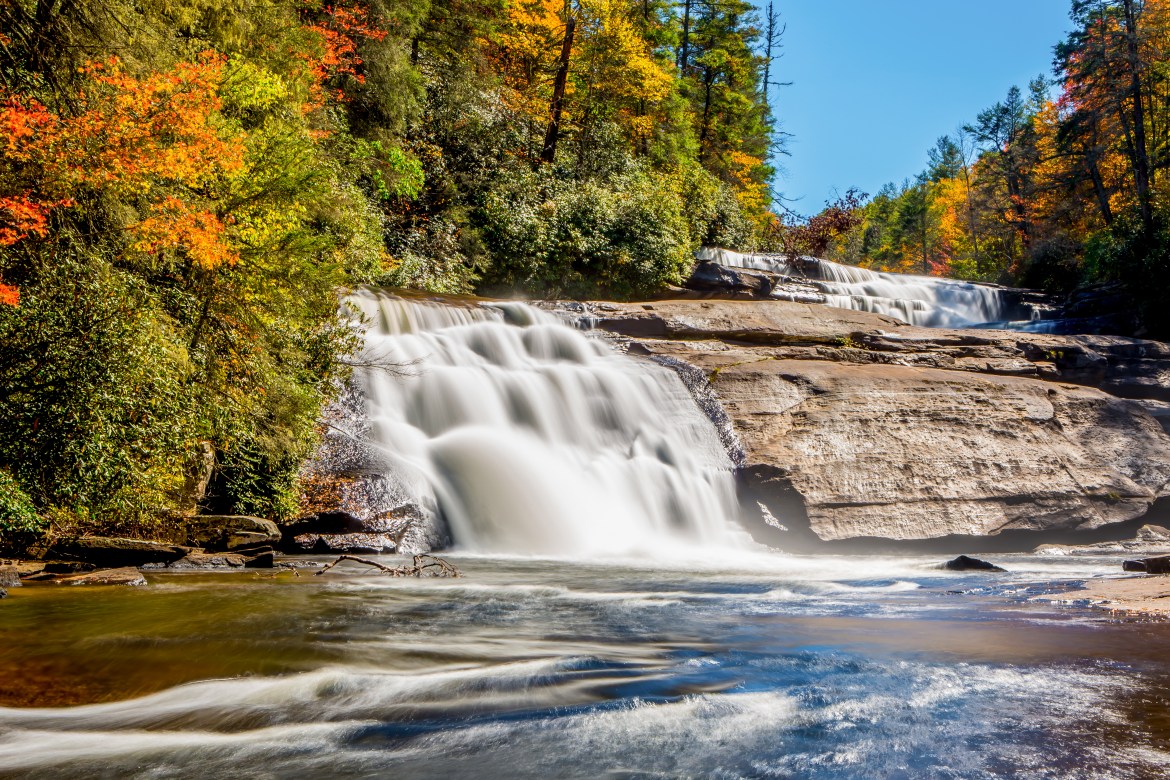
High Falls in DuPont State Recreational Forest drops in a silky white curtain into a calm pool, framed by laurel and a splash of maple red. Midday shine makes the water glow while keeping the rock texture crisp.
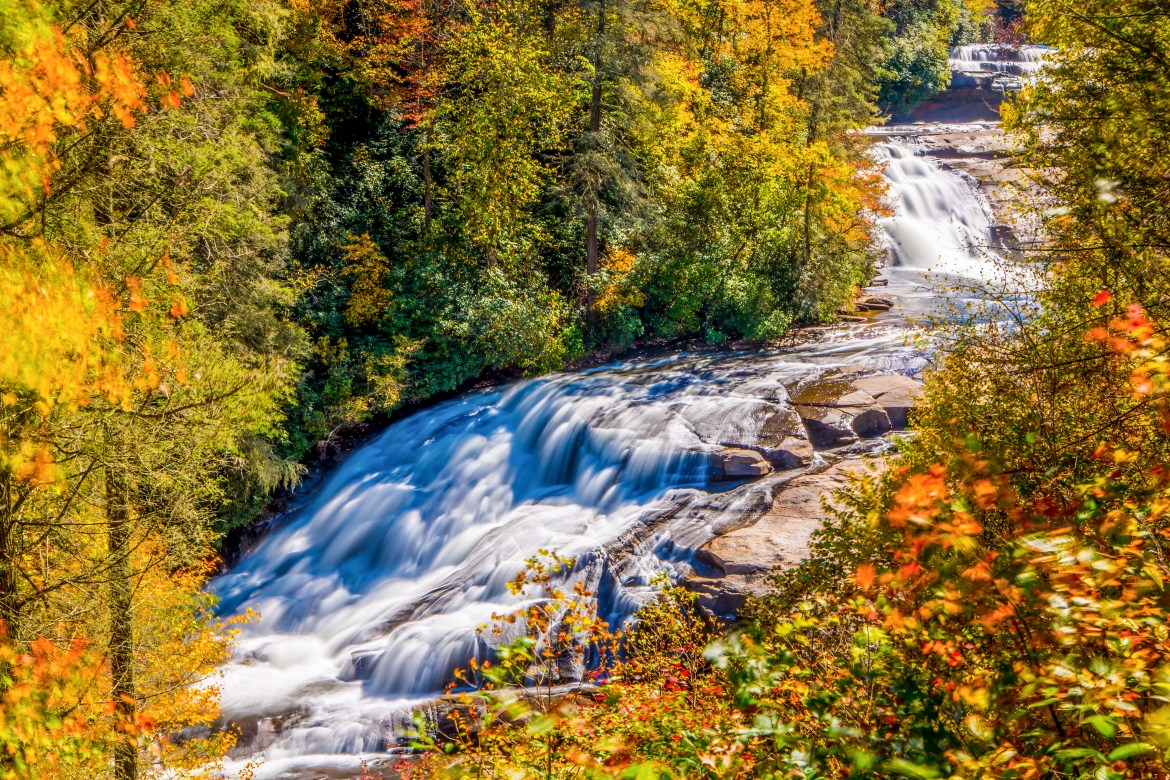
From stream level, rippled ledges pull the eye upstream to Linville Falls, glowing between golden trees. Low, wide framing makes the gorge feel immersive and wild.
The Linn Cove Viaduct slices a steady line through a mountainside exploding with scarlet, amber, and gold. From this distance the road looks almost delicate—just enough geometry to anchor the riot of leaves. Peak Blue Ridge at its showiest.
📸 The Visual Story: “Why This Niche Captures Hearts”
The Blue Ridge Parkway in fall isn’t just a drive—it’s an evolving light show that changes with every mile marker and minute of daylight. From Asheville northward toward Blowing Rock, the ridges melt into waves of tangerine, scarlet, and amber that look painted by sunlight itself. The combination of rolling Appalachian folds, fog-hugged valleys, and mile-high overlooks makes this one of America’s most cinematic landscapes for both photographers and dreamers. Each curve reveals another frame-worthy composition—streams curling around leaf mosaics, wooden fences slicing through meadows, and waterfalls turned to liquid silk by a patient shutter finger.
What makes the Parkway irresistible is its rhythm—the slow roll of its elevation shifts, the hush of its forests, and the serendipity of color at every turn. Here, your windshield becomes your viewfinder, your car your tripod on wheels. From Linn Cove Viaduct’s iconic engineering sweep to the DuPont Forest’s cascading drama, fall turns this mountain spine into a living gallery. And while everyone’s snapping the Viaduct, the true joy lies in the quiet in-betweens: that mist drifting through Tanawha Trail, or a solitary maple backlit like stained glass.
To feel the Parkway fully, you don’t just see it—you absorb it. Let a crisp morning drive roll into a late-afternoon hike, punctuated by picnic stops and roadside cider. Whether you’re chasing long exposures, drone panoramas, or the pure therapy of mountain air, this stretch of Carolina high country delivers a soul-steadying blend of wilderness and artistry.
Get closer to the heart of the mountains with two experiences that turn the drive into an adventure:
Hop aboard the Blue Ridge Parkway Guided Jeep Tour — perfect for catching rugged overlooks, hidden backroads, and spontaneous photo ops without worrying about directions.
Lace up for the Blue Ridge Parkway Waterfalls Hiking Tour from Asheville — a guided immersion into the forest’s soundtrack of rushing cascades and crunching leaves, with local insight that helps you find the best natural frames.
A few links and ads here are affiliate portals. If you click through and snag something, you’ll be fueling my next photo-quest at no extra cost to you. Thanks for keeping the adventure rolling!
🎯 Top 10 Can’t-Miss Subjects in Blue Ridge Parkway
Few places in America deliver this kind of symphony between light, landscape, and color. The North Carolina stretch of the Blue Ridge Parkway transforms into a natural studio every fall—each mile marker a mood shift, each overlook a perfect canvas. Here, your goal isn’t just to drive; it’s to linger. Morning fog and golden-hour flare make familiar views look new every hour. Below are ten unmissable subjects where you’ll find the Parkway’s essence—waterfalls with painterly grace, mountain ridges set ablaze with oak and maple, and man-made marvels that curve right through nature’s frame.
1. Rough Ridge Overlook — The Parkway’s Classic Fall Vantage Few scenes scream “Blue Ridge autumn” like the outcrop at Rough Ridge. The wooden boardwalk hugs the granite spine while sweeping views of the Linn Cove Viaduct and Grandfather Mountain burn with color. Come at sunrise for rolling fog curling through valleys like smoke from an unseen fire. Photographers love its leading lines; couples love that moment when the wind snatches a leaf mid-kiss. 🕒 Best Time to Shoot: Sunrise or early morning before haze sets in 💵 Access Cost: Free (parking at milepost 302.8) 💡 Insider Tip: Pack a wide-angle lens and a microfiber cloth—dew can settle fast on glass here.
2. Linn Cove Viaduct — The Icon in the Clouds Suspended gracefully around Grandfather Mountain, the Viaduct is one of the Parkway’s most photographed curves for good reason. Its sinuous line frames the mountains like a silver ribbon, especially when fall color blazes below. A pull-off at the visitor center leads to the Tanawha Trail, where you can shoot the viaduct from beneath—a composition that feels straight out of a car commercial. 🕒 Best Time to Shoot: Mid-morning light (for contrast between bridge and ridges) 💵 Access Cost: Free 💡 Insider Tip: Use a polarizer to cut glare off the bridge’s concrete and deepen the surrounding hues.
3. Tanawha Trail — The Golden Artery Beneath the Viaduct Threading roughly 13 miles along Grandfather Mountain, the Tanawha Trail offers forested boardwalks, rocky outcrops, and light shafts cutting through maple canopies. Autumn wraps every bend in warm tones, while the sound of wind and water reminds you why this path’s name means “fabulous hawk” in Cherokee. 🕒 Best Time to Shoot: Late afternoon when backlight filters through foliage 💵 Access Cost: Free 💡 Insider Tip: Bring a tripod for motion blur on leaves and streams; ND filter optional but glorious.
4. Linville Falls — The Drama Shot Every Portfolio Needs Where the Linville River hurls itself through rock gorges, Linville Falls offers layered perspectives—Upper, Chimney View, and Erwin’s View all within a few miles. Each platform reveals new geometry, and in October the maple canopy ignites like wildfire. Expect mist, rainbows, and the hum of camera shutters. 🕒 Best Time to Shoot: Midday for full rainbow mist visibility 💵 Access Cost: Free (at Linville Falls Visitor Center) 💡 Insider Tip: Don’t stop at the first overlook—continue to Erwin’s View for a sweeping 270° panorama.
5. DuPont State Recreational Forest — High, Triple & Hooker Falls This forest is a photographer’s playground. High Falls roars dramatically against red maples; Triple Falls stacks itself like a cinematic waterfall trilogy; and Hooker Falls invites silky exposures and leaf-swirl reflections. Each trail is short, manageable, and drenched in fall color, making it ideal for full-day shooting without long drives. 🕒 Best Time to Shoot: Mid-morning to early afternoon (ample light through canopy) 💵 Access Cost: Free (parking at Hooker Falls or High Falls access) 💡 Insider Tip: A neutral density filter (3–6 stops) turns waterfalls to silk and colors to velvet.
6. Craggy Gardens — The Parkway in Bloom Even After Summer Even as autumn claims the ridges, Craggy Gardens holds onto its high-altitude magic with rhododendron tunnels and skeletal trees catching fog. The overlook is among the Parkway’s most moody—a perfect balance of drama and calm for wide compositions. 🕒 Best Time to Shoot: Early morning or after rain for low-lying clouds 💵 Access Cost: Free 💡 Insider Tip: Carry a lens cloth; mist here settles like glitter on your front element.
7. Looking Glass Rock — Nature’s Mirror Framed in Gold Named for how it gleams after rain, Looking Glass Rock is best photographed from the Overlook near Milepost 417. When fall color climbs its flanks, the effect is otherworldly—an illuminated dome floating in a sea of orange. 🕒 Best Time to Shoot: Golden hour before sunset 💵 Access Cost: Free 💡 Insider Tip: Zoom to 100–200mm to compress distant ridges and catch subtle color bands.
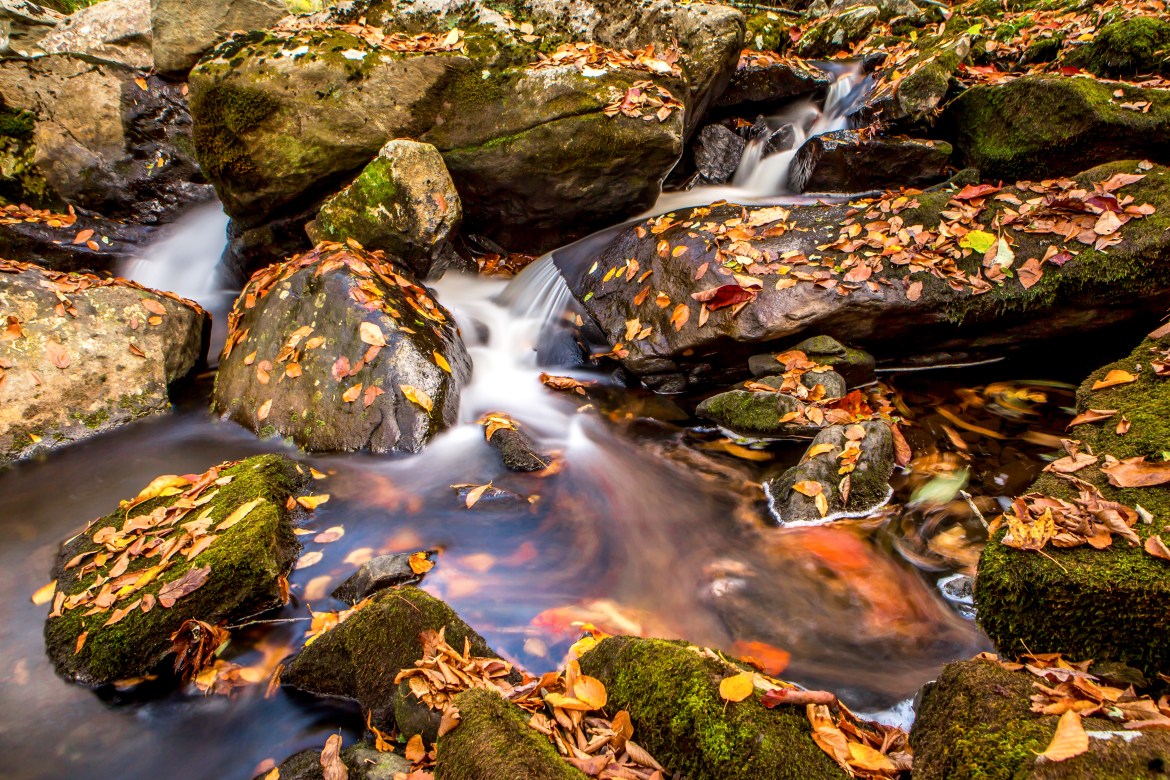
8. Parkway Streams & Reflections — The Hidden Macro Moments Between big vistas lie tiny wonders: mirror-smooth creeks carpeted in leaves, swirling eddies reflecting copper and gold. Pull off near Price Lake, Julian Price Park, or any roadside culvert—there’s art in the small stuff here. 🕒 Best Time to Shoot: Late afternoon when water reflects warm tones 💵 Access Cost: Free 💡 Insider Tip: Use manual focus and a low ISO—still water reveals every pixel of sharpness.
9. Moses H. Cone Memorial Park — Classic Americana in Autumn Wraps White fences, a historic manor, and a lake bordered by flaming dogwoods make Moses Cone Park feel like a painting from another century. It’s an ideal mid-drive break for strolling trails and catching pastoral reflections without the crowds. 🕒 Best Time to Shoot: Early morning before families arrive 💵 Access Cost: Free 💡 Insider Tip: Try a vertical composition using fence lines as leading guides toward the lake.
10. Parkway Overlooks at Sunset — Blue Ridge’s Farewell Performance From Beacon Heights to Cowee Mountain Overlook, the Parkway’s finale happens daily—ridges fading into smoky blues while golden light torches the horizon. The air cools, cicadas hum, and every car seems to pause mid-drive just to stare. 🕒 Best Time to Shoot: Sunset through twilight blue hour 💵 Access Cost: Free 💡 Insider Tip: Keep a lightweight tripod handy; long exposures here reveal painterly gradients in post-sunlight haze.
Linville Falls drops through a rock cleft into a calm basin, framed by canyon walls and peak October hues. Power meets poise—classic Linville Gorge drama from the Blue Ridge.
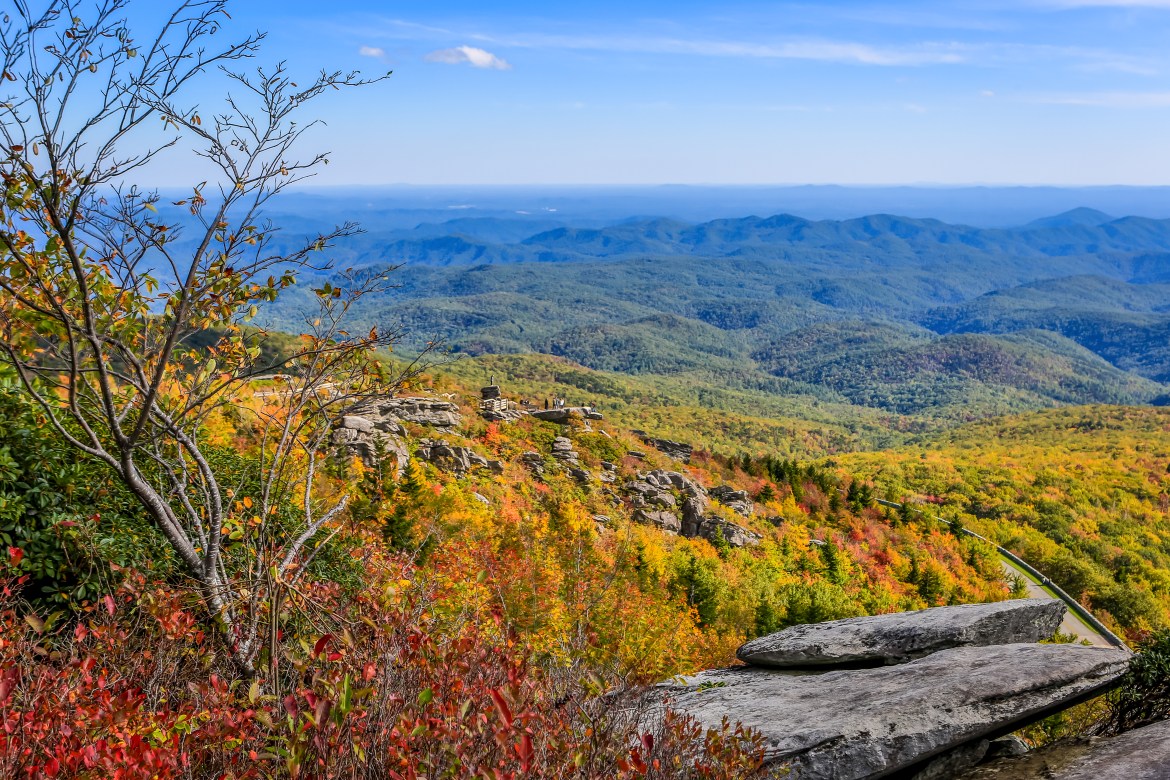
A granite fin at Rough Ridge spears into the frame, guiding the eye to wave after wave of the Grandfather Mountain high country.
Morning light throws prismatic flare across Hooker Falls in DuPont State Recreational Forest. The pool glints like hammered copper while the woods glow with October warmth.
🔍 Hidden Gems & Photographer Favorites
When the overlooks are shoulder-to-shoulder, slip into the Parkway’s quieter corners—places where leaf-confetti creeks hum, granite domes warm in the sun, and gorge rims serve up drama without the chorus. These spots won’t be empty in peak October, but they trade bus-lot bustle for trailhead nods and tripod camaraderie. Expect intimate frames: backlit beech leaves over cascades, sunstars through twisted rhododendron, and fog waves rolling like slow surf. Time them for early light or late-day glow and you’ll pocket portfolio keepers—no elbowing required.
Wiseman’s View (Linville Gorge) — Rim-Top Drama Without the Crowd A short walk leads to stone viewing terraces perched over the “Grand Canyon of the East,” with Table Rock and Hawksbill set against an ocean of color. On clear evenings the gorge swallows the sun in layers of cobalt and ember—pure Blue Ridge theater. Insider Tip: The gravel access road can be rutted; arrive for golden hour with a headlamp for the hike back, and bring a 70–200mm to compress ridgelines.
Boone Fork Cascades (Julian Price Park) — Leaf Swirls & Low-Angle Magic Follow the Boone Fork Trail to boulder gardens and playful slides where autumn leaves spin in eddies like tiny galaxies. It’s a macro playground—moss, foam, and copper foliage begging for slow-shutter studies. Insider Tip: Pack an ND (3–6 stops) and kneepads or a sit-pad for low, stable compositions on slick rock; sunrise light is softest through the canopy.
Flat Rock Trail (near Linville) — A Granite Porch Over the High Country A quick loop rewards with a broad, bare outcrop that feels like a private balcony above layered hills. The scene turns painterly at day’s end when ridges stack in indigo while foreground oaks blaze orange. Insider Tip: Aim for late-afternoon into blue hour and shoot a series for an easy panorama; a lightweight tripod keeps horizons tidy in the breeze.
Stack Rock Creek Falls Spur — Secret Splash Under Rhodo Tunnels Tucked off a Parkway pull-off, this short, scrambly spur slips to a petite cascade framed by rhododendron and granite ledges. It’s the antidote to big-scene fatigue: intimate, textural, and wonderfully quiet. Insider Tip: After rain, mist lingers—use a polarizer to kill glare on wet rock and deepen leaf color; bring trekking poles for the uneven descent.
Graveyard Fields (Upper/Second Falls) — Moody Meadows, Fiery Edges High-elevation meadows ringed by blueberry and birch burst into scarlet and gold, with easy paths to photogenic falls. Fog often drifts through at dawn, turning the boardwalks and pools into a dream set. Insider Tip: Go at sunrise on a weekday and work handheld at faster shutter speeds—wind can rattle foliage; save the tripod for the falls.
📸 In the Frame: Our Journey in Blue Ridge Parkway
Perched on the famous Rough Ridge ledge along the Tanawha Trail, gazing over the Grandfather Mountain skyline and a sky brushed with cloud streaks.
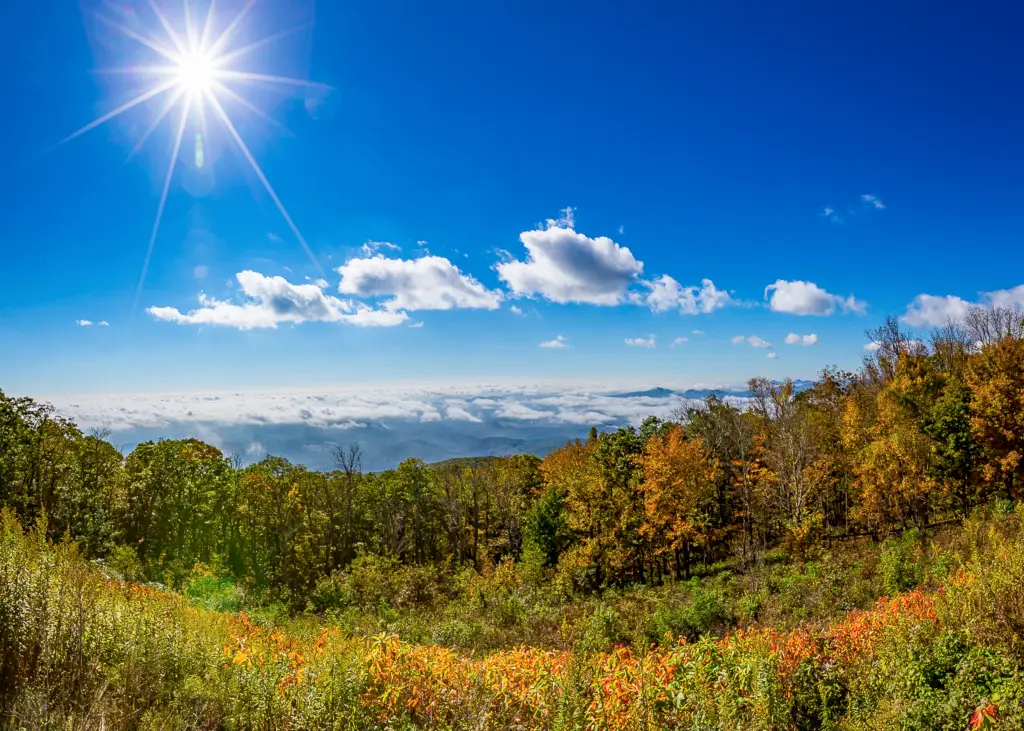
Standing at a Blue Ridge Parkway overlook above a rolling sea of clouds, basking under a crisp sun-star sky. Autumn color rims the ridge while the valleys vanish in white.
Perched on a balanced rock near Split Rock, soaking in a sky scrubbed clean and trees flashing their October best. Granite, wind, and wide views—everything good about a Blue Ridge day in one frame.
Sitting atop a granite ledge on Grandfather Mountain above the Linn Cove slopes, with the forest below exploding in peak color.
💵 Sleep • Eat • Move: Cost Snapshot
Traveling the Blue Ridge Parkway during fall foliage is as flexible as it is photogenic—whether you’re camping under the stars, booking cozy cabins in Blowing Rock, or checking into boutique stays in Asheville. Meals range from mountain diners slinging biscuits and gravy to elevated farm-to-table spots pairing craft brews with Appalachian flair. Gas prices fluctuate along the route, but most travelers will find the drive itself refreshingly budget-friendly. Your wallet’s main test? How many times you’ll “just pop into” local art shops or cider mills along the way.
🏷️ Category
💵 Cost Range (USD)
📌 What You Get
🏨 Lodging
$80 – $150
Cabins, roadside inns, and budget motels near Boone or Asheville.
Mid-Range
$160 – $250
Boutique lodges, B&Bs, and scenic Airbnb stays with kitchenettes.
Luxury
$300 – $600+
High-end resorts or spa retreats with Blue Ridge views and firepits.
🍽 Meals
$30 – $50
Local diners, BBQ joints, and hearty Appalachian comfort fare.
Mid-Range
$60 – $100
Farm-to-table restaurants and mountain breweries with live music.
Luxury
$120 – $200+
Fine dining with seasonal menus, local wines, and fall-view patios.
🚌 Transportation
$20 – $40
Daily fuel costs for scenic cruising and short detours.
Mid-Range
$50 – $80
Rental car or SUV for multi-day drives with gear storage.
Luxury
$100 – $150+
Private driver or guided tour options for carefree sightseeing.
🏛 Activities
$0 – $50
Parkway overlooks, hikes, and free waterfall trails.
Mid-Range
$60 – $120
Guided Jeep or waterfall tours, zipline parks, and entrance fees.
Luxury
$150 – $300+
Private photography sessions, spa add-ons, or bespoke scenic charters.
Average Cost Per Day in Blue Ridge Parkway
Budget travelers can roam the Parkway comfortably for the cost of a tank of gas and a plate of trout. Mid-range adventurers usually splurge on a mountain lodge, local brews, and at least one guided tour. Luxury wanderers treat it like an Appalachian spa retreat—chauffeured drives, gourmet dining, and sunset wine tastings. Whatever your tier, the Parkway’s beauty per dollar ratio is nearly unbeatable.
🧳 Traveler Type
💵 Daily Estimate (USD)
📌 What’s Included
🎒 Budget – Wander Smart
$100 – $150
Camping or basic lodging, local eats, personal car, self-guided hikes.
🏖️ Mid-Range – Wander Well
$200 – $300
Comfortable B&B or cabin, sit-down dinners, waterfall or Jeep tour.
🏰 Luxury – Wander Luxe
$400 – $600+
Resort lodging, fine dining, private guide, wine tastings, spa time.
From inches above the river’s lip, the cascade becomes a curtain of cream rushing over obsidian rock. Spray hangs in the air while yellow leaves cling to the edges. You can feel the mountain breathing.
Dark water velvets over a shallow ledge, curling beside a bank piled with orange leaves. Subtle textures glow where light skims the surface. Minimalist, seasonal, and soothing.
Glassy river reflections catch a slice of sky while silky currents blur between leaf-lined rocks. Cool blues meet warm ambers for a moody October palette. The forest hush wraps around the water.
📸 Essential Photo Tips for Capturing in Blue Ridge Parkway
The Blue Ridge Parkway is a color theorist’s playground—amber, copper, and crimson hues layered over endless ridgelines that change by the minute. Fall photography here is all about chasing light pockets—those fleeting bursts through birch and beech that transform a shot from ordinary to otherworldly. Mornings bring dew and mist for dreamlike tones; afternoons drape slopes in warm backlight; and golden hour turns every overlook into a postcard factory. Patience, planning, and a weatherproof bag are your best allies.
Whether you’re fine-tuning silky cascades at DuPont State Forest, braving wind gusts at Rough Ridge, or catching sun flare across the Linn Cove Viaduct, the Parkway rewards both precision and spontaneity. Pack for moisture, unpredictable temps, and long waits at overlooks—the kind that end with unforgettable skies.
👉 The Nomad’s Kit: Gear That Earns Its Miles
Canon RF 15–35mm f/2.8L — Ultra-wide for the iconic curves of Linn Cove Viaduct, fall color tunnels, and waterfall basins where “step back” means “goodbye, dry feet.” Canon RF 24–105mm f/2.8L — Your Parkway-to-peaks workhorse: mid-tele leaf canopies, portraits at Craggy Gardens, and quick roadside farm vignettes. Canon RF 100–500mm f/4.5–7.1L IS USM — From Waterrock Knob, Cowee Mountains, or Rough Ridge, compress misty ridge layers into painterly stacks; pick off elk in Cataloochee Valley or old barns down in the coves. Lowepro ProTactic BP 350 AW III — Trail-tough, small enough for overlooks, roomy enough for filters and a rain shell; fits neatly beside the driver’s seat. Peak Design Travel Tripod — Perfect for blue-hour clouds crawling through the valleys or silky cascades at Linville Falls; keep legs short on overlooks—wind here means business. JOBY GorillaPod 3K Kit — Clamp to railings at Rough Ridge or boulders at Looking Glass Falls for long exposures—tiny footprint, big stability in gusty air.
Cut Glare. Shape Time. Make Every Frame Sing. The Parkway is pure reflection: wet leaves, glassy waterfalls, and atmospheric haze. A circular polarizer tames glare on foliage and rock, turning “pretty green” into “deep velvet forest.” A variable ND lets you slow the mountains’ rhythm—ribbons of car lights on Viaduct curves, waterfalls turned to silk, and cloud layers crawling over ridge spines while peaks stay tack-sharp.
🌄 Control Reflections & Punch Up Color Circular Polarizer Filter — Kill glare on slick leaves and river stones, reveal depth in forest pools, and intensify cobalt sky between ridges. Pro tip: rotate gently—over-polarizing can make the sky patchy at high altitude; keep that soft Appalachian haze intact.
⏱️ Drag the Shutter on the Parkway Neutral Density Variable Filter — Drop 3–8 stops to smooth cascades at Graveyard Fields, blur leaf motion in autumn winds, and create headlight ribbons under the Milky Way from Waterrock Knob. Pro tip: start around 1/4–1 s for moving foliage; go 2–10 s for silky water and fog trails.
Pack both for any trip: the polarizer reveals the scene; the ND sculpts time. Together, they turn every turnout into a masterpiece.
Photo Policy Reminders — No drones along most Parkway sections (National Park Service restrictions). Tripods are welcome outdoors but never block overlooks or cause trail erosion. Stay off fragile vegetation near cliff edges and waterfalls. Respect wildlife distance rules, check fog forecasts before dawn drives, and never brake suddenly for the “perfect view”—the next overlook is a minute away, and the light here rewards patience.
⏰ When to Shoot
📍 Where & What to Shoot
📷 How to Nail the Shot
🏛 Tourist Traffic
💡 Insider Tip
Sunrise
Rough Ridge Overlook – Misty ridgelines glowing under pink light.
Use a tripod, f/8–f/11, ISO 100; bracket exposures for HDR sunrise color depth.
Moderate (arrive 45 min early for parking)
Pack gloves—temps drop fast; early fog gives ethereal backlight layers.
Early Morning
DuPont State Forest – High, Triple & Hooker Falls in soft mist.
Use ND filter for 1–2 sec exposures; shoot vertical frames for full cascades.
Medium (popular with hikers)
Arrive by 8 a.m.; best leaf reflections before direct sun hits water.
Midday
Linville Falls – Waterfall roar against maple canyons.
Use polarizer to tame glare; f/16 for starbursts off spray in bright light.
High
Skip weekends; weekday midday light still works for rainbow mist shots.
Afternoon
Tanawha Trail – Boardwalks and golden forest tunnels.
Lower shutter to 1/30 sec to catch falling leaves; use manual focus on trails.
Low to Moderate
Great time for portrait bokeh; the backlit canopy glows in warm amber tones.
Golden Hour
Linn Cove Viaduct – Bridge curve glowing against fall ridges.
Position on Tanawha Trail beneath; f/11 for crisp foreground-to-background focus.
High (sunset crowds)
Use long lens (100–200 mm) for compression; shoot RAW to recover highlights.
Blue Hour / Night
Beacon Heights Overlook – Ridges fading to indigo silhouettes.
Tripod, 10–20 sec exposures, ISO 400; capture city glow on distant horizon.
Low
Stay for first stars—Milky Way often visible in October’s crisp air.
🌎 Cultural & Historical Context
Long before the first overlook was paved, these ridges were the ancestral homeland of the Cherokee—a place of trade paths, story-rich forests, and rivers that doubled as roads. The Blue Ridge Parkway itself is a New Deal creation, stitched together in the 1930s by Civilian Conservation Corps crews whose stonework, tunnels, and scenic pull-offs were designed to feel of the mountains, not imposed on them. Its final puzzle piece—the sweeping Linn Cove Viaduct around Grandfather Mountain—opened in the 1980s, a marvel of engineering that preserved fragile slopes while giving travelers that “flying along the ridge” sensation. Today, the Parkway is equal parts road and open-air museum: farmsteads and craft centers preserve Appalachian lifeways, roadside stands pour generational recipes into paper cups, and fiddle tunes still float from small-town porches when the evenings turn cool.
Fall color season ties past to present. Harvest-time festivals echo the region’s agrarian roots, while modern hikers trace old Cherokee hunting routes to waterfalls like Linville Falls and the cascades of DuPont State Recreational Forest. Quilts become hillside mosaics, banjos share space with espresso machines, and you can wander from a historic parkway cabin to a farm-to-table dinner without leaving the rhythm of the hills. In short, the Parkway isn’t merely a drive; it’s a living corridor where culture, craft, and conservation meet—best appreciated slowly, with time to listen as well as look.
The Linn Cove Viaduct swoops around Grandfather Mountain like a ribbon laid gently on the forest. A few reds and golds are beginning to spark through the green, with layered Blue Ridge silhouettes fading into the haze. It’s the kind of curve that makes road-trippers slow down just to stare.
A slick stripe of Parkway asphalt leads the eye toward distant ridges while cottony clouds cruise a deep blue sky. Brushstrokes of red sumac and gold birch signal the season’s turn. It’s the call to roll the windows down and chase horizons.
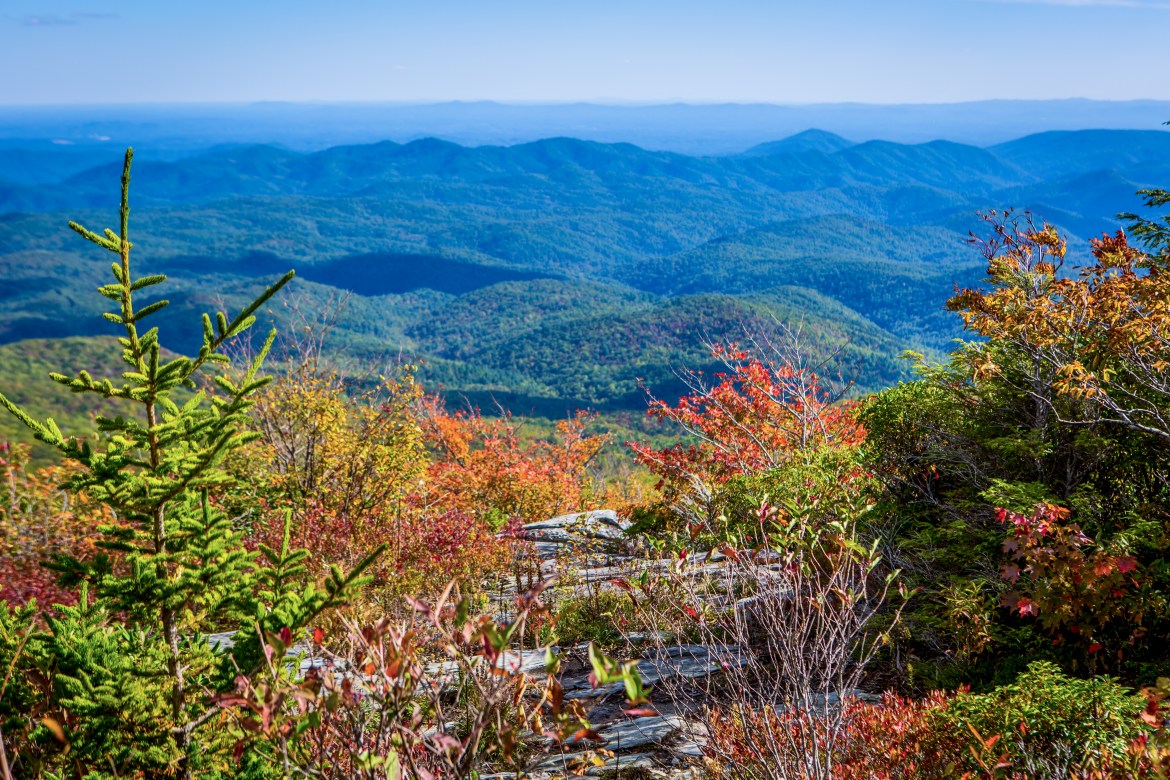
A foreground tangle of color—gold bay, red blueberry, glossy laurel—gives way to undulating green valleys and blue peaks. The light is crisp and the air feels brand new. High country perfection.
🗣️ Language & Local Lingo You’ll Hear
On the Blue Ridge Parkway, hikers and photographers share their own dialect—one built on switchbacks, summit views, and gear talk shouted across trailheads. It’s part camaraderie, part shorthand. Ask a local hiker about the “balds,” and you won’t get a haircut story—you’ll get directions to the next open summit carpeted in gold grass. Knowing the lingo helps you blend right in with trail regulars and know what to expect before your boots hit the dirt.
💡 Reason to learn a few words: Understanding hiking lingo turns trail talk into trail wisdom. You’ll know when someone says “it’s a burner” (steep climb ahead), or “the blaze turns white” (you’ve joined the Appalachian Trail). It’s practical vocabulary that saves confusion—and maybe your knees.
🇺🇸 English
🥾 Trail / Hiking Term
📖 Meaning
Open summit
Bald
A grassy, treeless mountain top—like those along the Parkway near Roan Highlands.
Trail marker
Blaze
Paint mark on trees or rocks showing trail direction; white blazes mark the Appalachian Trail.
Short connector path
Spur Trail
A side trail leading to a waterfall, overlook, or parking lot—like those to Linville Falls viewpoints.
Uphill grind
Burner
A steep or strenuous section of trail that gets the heart rate going.
Trail intersection
Junction
Where two or more trails meet—common along Tanawha Trail loops.
Quick rest stop
Breather
A pause to catch your breath—often at switchbacks or scenic benches.
Waterproof jacket
Shell
Light outer layer that blocks wind and rain during sudden mountain showers.
Stream crossing
Ford
A shallow area where you wade or hop rocks to cross a creek safely.
Trail section with ropes or ladders
Scramble
Hands-on climbing section—found near rugged overlooks like Rough Ridge.
Point where trail turns back
Out-and-Back
A hike that follows the same path in and out—like Hooker Falls or Beacon Heights.
Series of tight switchbacks
Stairmaster
Nickname for steep, zigzag ascents that feel like endless steps up the mountain.
Trail photo or summit selfie
Summit Snap
A celebratory shot taken at a viewpoint, ridge, or peak—your proof of the climb.
Stunning panoramic view
Money Shot
The ultimate frame you came for—usually at golden hour or fog lift.
Unexpected fog rolling in
Blue Smoke
The misty haze that gives the Blue Ridge its name; both obstacle and magic for photographers.
From peak to peak, the Grandfather Mountain skyline rolls beneath sculpted clouds and a patchwork forest. Early fall color freckles the valleys while the ridges fade to classic Carolina blue. Big scene, bigger grin.
🍽 Where to Refuel Nearby
North Carolina’s fall flavors, one plate at a time
Leaf-peeping works up an appetite, and the Blue Ridge Parkway rewards hungry travelers with plates that taste like the season—apple-cider glazes, mountain trout, and buttermilk biscuits big enough to use as reflectors. In Asheville, chefs riff on the region with global flair; around Blowing Rock and Boone, menus lean Appalachian-heritage with smoke, jam, and skillet sizzle. After waterfall mornings in DuPont and golden-hour at Rough Ridge, you’ll want cozy rooms with warm lighting, wood tables, and something slow-braised. Pair it all with small-batch coffee or a local pour, then step back into the chill evening air ready for blue-hour silhouettes.
⭐ Top Local Restaurants & Their Must-Try Specialties
Cúrate (Asheville) – $$$$ — A James Beard–lauded tapas bar where Spanish technique meets mountain mood; perfect for a celebratory post-shoot dinner. Order jamón Ibérico, pan con tomate, and bravas between sips from the all-Spanish wine list.
Biscuit Head (Asheville) – $ — Breakfast fuel before trails: sky-high biscuits, a jam & gravy bar, and playful spins like espresso red-eye gravy or fried-chicken gravy. Grab a biscuit sandwich to go for the overlook.
Rocky’s Hot Chicken Shack (Asheville) – $–$$ — Nashville-style heat calibrated from mild to “mercy,” with sides that taste like Sundays at grandma’s. Go for the hot chicken sandwich and a cold sweet tea; spice warms chilly ridge nights.
The Speckled Trout (Blowing Rock) – $$–$$$ — A bottle shop + kitchen celebrating Appalachian foodways; sit down to NC mountain trout, pickled veg, and heritage grains after a Moses Cone stroll.
The Gamekeeper (between Boone & Blowing Rock) – $$$$ — Fine-dining comfort with wild game (think elk, ostrich, venison) and local terroir on the plate; an atmospheric date night after sunset at Rough Ridge.
If you’re sprinting between overlooks, a Local Lion doughnut + fresh-roast coffee in Boone is a sweet pit stop that won’t steal your light—perfect for dawn call times.
🥩🥗☕🍰 Savor the Shot in Blue Ridge Parkway
A ribeye wearing perfect grill-mark crosshatches rests on creamy mashed potatoes with garlicky broccoli tucked alongside. Rich, fire-kissed edges cue up that first, savory slice.
Char-kissed octopus coins glisten under a drizzle of olive oil, dusted with paprika for warmth. A swoop of silky purée (potato/parsnip style) balances the smoke with buttery comfort.
A glossy brioche bun shelters smoky bacon, a juicy patty, and fresh-cut toppings that spill color from every angle. Golden, skin-on fries ride shotgun for the classic diner finish.
Three bronzed scallops crown ribbons of pappardelle tangled in a velvety spinach-mushroom sauce. The contrast of crusted tops and silky noodles is pure comfort food theater.
🗺️ Quick Itinerary for Capturing the Niche
Golden leaves, soft light, and zero wasted miles—your one perfect Blue Ridge fall day, dialed.
Kick off before dawn and ride the color wave all day: misty ridges at sunrise, waterfall silk by mid-morning, quiet boardwalks in the afternoon, and a grand-curve finale at the Viaduct before a blue-hour bow. This route balances easy wins for vacationers (short walks, picnic pockets, coffee stops) with photographer candy (leading lines, long exposures, ridge compression). Distances stay tight so you spend more time shooting and less time shuttling. Pack layers, a thermos, and your patience—the Parkway rewards the unhurried.
🕒 6:30 AM — Rough Ridge Sunrise & Ridge Walk Arrive in the blue-grey pre-dawn to claim a boardwalk perch with wide views toward Grandfather Mountain. As the sun breaks, fog drapes the valleys and the first maple leaves ignite—perfect for wide-angle panoramas and a few intimate frames of frost on rhododendron. Non-shooters will love the short, scenic walk and the thrill of watching the ridges wake up. Work a series (wide, medium, detail) so you leave with a story, not just a single hero shot.
🕒 Open: 24/7 trail access (daylight recommended) 💵 Cost: Free 💡 Insider Tip: Bring light gloves and a headlamp; shoot bracketed exposures to hold sky color and shadowy foreground.
🕒 9:00 AM — DuPont State Forest: Triple Falls → High Falls → Hooker Falls Loop Shift to waterfall mode while the light’s still soft. The short trails string together three distinct personalities: stacked tiers at Triple, thundering sheets at High, and a calm curtain at Hooker for silky slow-shutter studies. Families can peel off for snack breaks near the river while photographers experiment with ND filters and leaf-swirl reflections. Watch your footing—slick rock and wet leaves are a fall combo.
🕒 Open: Daily, typically dawn–dusk 💵 Cost: Free (main lots). Arrive early for parking 💡 Insider Tip: Aim for 1–2 sec exposures with a polarizer to kill glare on wet stone and deepen color.
🕒 12:15 PM — Picnic & Reflections at Julian Price Lake Trade waterfalls for a quiet lake framed by fire-colored trees and wooden fences. Set up a simple picnic while the wind drops—glass-calm water means mirror-image symmetry shots that even phone cameras nail. It’s a restful reset for non-shooters, and a chance for photographers to play with reflections, leading docks, and gentle telephoto compression across ripples.
🕒 Open: Day-use areas typically sunrise–sunset 💵 Cost: Free 💡 Insider Tip: If there’s a breeze, hug the leeward shore for the smoothest water; keep a microfiber cloth handy for stray spray and pollen.
🕒 2:00 PM — Tanawha Trail Forest Tunnels & Boardwalk Textures Slip under the maple canopy where shafts of light sketch patterns across planks and roots. This is your “details” block—bokeh leaves, boots on boardwalks, sunstars through branches, and that quintessential fall-trail vibe for reels. Hikers in your group get a mellow ramble; photographers get manageable contrast and gorgeous backlight.
🕒 3:30 PM — Linville Falls Viewpoint Trio Stack your angles: start at Upper Falls, swing to Chimney View, and finish at Erwin’s View for the iconic panorama. Mid-afternoon light produces rich canyon color without the harsh midday sheen, and casual visitors appreciate the well-marked, short paths between overlooks. Soundtrack: distant thunder of the river and the rustle of oak leaves under boots.
🕒 Open: Visitor area typically daylight hours (seasonal) 💵 Cost: Free 💡 Insider Tip: Pack a light telephoto (100–200mm) to isolate the falls against blazing foliage bands.
🕒 5:15 PM — Linn Cove Viaduct Golden Hour Set up below the curve via the Tanawha access for that “bridge slicing through flame-colored forest” composition. Golden hour wraps the concrete in warm tones while cars streak for subtle light trails if you stretch your shutter. Travelers who don’t want to hike can enjoy the classic roadside overlook view; shooters should work both wide and compressed frames.
🕒 Open: Parkway daylight driving; trail access daylight hours 💵 Cost: Free 💡 Insider Tip: A polarizer deepens ridge color; shoot a quick 5–7-frame pano for billboard-worthy resolution.
🕒 6:45 PM — Beacon Heights Sunset → Blue Hour Farewell Close the day on a granite perch where the ridges fade through gold, violet, then inky blue. Non-photographers can simply soak the view while you lock down a tripod for layered silhouettes and the first star pops. The walk is short, the payoff grand, and the vibe pure Blue Ridge—quiet conversations and camera shutters whispering into night.
🕒 Open: Daylight hours; depart after blue hour for safety 💵 Cost: Free 💡 Insider Tip: Stay 15 minutes past sunset—blue hour gradients are the Parkway’s secret encore.
A mountain stream tumbles over granite shelves into a clear pool, wrapped in pines and early fall color. The slow shutter turns the water to silk without losing edge detail in the rocks. It’s a quiet pocket of the Parkway built for long breaths.
The Linn Cove Viaduct slices a steady line through a mountainside exploding with scarlet, amber, and gold. From this distance the road looks almost delicate—just enough geometry to anchor the riot of leaves. Peak Blue Ridge at its showiest.
Wave after wave of Blue Ridge Mountains slip into the horizon like watercolor washes. Billowing cumulus and a crisp sky make the greens pop, hinting at the first turn toward autumn. It’s the quintessential Parkway overlook—quiet, vast, and humbling.
🎥 Reels on the Road
Short-form gold lives on this ribbon of mountain highway—mist that breathes, waterfalls that turn to silk, and a viaduct that seems to levitate at golden hour. Think sequences, not single clips: establish the road, cut to a hand-on-rail detail, then reveal the vista with a slow tilt. Keep transitions simple (whip pans, match cuts on color), and let the natural sound lead—rushing water, leaf crunch, a distant motorcycle on the grade. When crowds gather, shift to tight frames: boots on boardwalks, fingers brushing tall grass, maple leaves spinning in eddies. And always roll a few extra seconds after your “hero” moment—Blue Ridge light likes to throw bonus flare at the end.
🎥 Rough Ridge Overlook — Sunrise horizon pan from boardwalk planks to blazing ridgelines; end on a slow push-in through the railing. Best at sunrise with valley fog.
🎥 DuPont’s Triple → High → Hooker Falls — Handheld walk-through cuts of each cascade, then a tripod long-exposure reveal for the finale. Best mid-morning when the canopy glows.
🎥 Linville Falls (Erwin’s View) — Start with a tight roar-and-mist shot, whip-pan to the full amphitheater, then a telephoto pull on the main drop. Best early afternoon for color depth.
🎥 Tanawha Trail Boardwalks — POV footsteps with leaf crunch, tilt up to backlit boughs, finish on a sunstar through rhododendron. Best mid-afternoon in filtered light.
🎥 Linn Cove Viaduct — Low angle from the boulders; hold for a passing car to create motion streaks, then a slow rack focus to the ridge. Best at golden hour into blue hour.
🎥 Beacon Heights — Timelapse of sunset gradients shifting to indigo, then a static tripod shot catching first stars. Best sunset → 20 minutes past sundown.
🌲 Wrap-Up: Why This Niche Matters
The Blue Ridge Parkway is more than a scenic drive—it’s a moving meditation on color, craft, and connection. Every curve tells a story: of Cherokee homelands, Depression-era stonework, and a wild landscape that refuses to hurry. For travelers, it’s a reminder that slow miles make the richest memories; for photographers, it’s a masterclass in patience and changing light. You can chase autumn anywhere, but nowhere else does it unfold so poetically—ridge after ridge like brushstrokes across a living canvas.
Capturing this niche means honoring the rhythm of the mountains: waiting for fog to lift, greeting locals at overlook pull-offs, tasting cider between shots. It’s travel that teaches timing, restraint, and respect—skills that spill into every other journey you’ll take. Whether you’re behind the wheel, behind the lens, or just watching the sun fall through gold leaves, the Blue Ridge Parkway reminds you what happens when you give beauty enough time to reveal itself.
🎞️ Frames From the Road: Scenes Worth Stopping For in Blue Ridge Parkway
I’m Steve—a retired Army vet who traded ruck sacks for camera bags and now chases light across every latitude I can reach. From 110 point & shoot film camera beginnings to a Canon R5 Mark II and Mavic Pro II drone, I’ve logged shots in 36 countries and all 50 states, squeezing solo photo runs between corporate flights and longer adventures with my wife. Shutter Nomadica is where I share the hits, misses, and field notes so fellow roamers can skip the guesswork and grab the shot!