Porto, Portugal | Palaces, Gothic Halls & Views Across the Douro

Porto Without Much of a Plan

We started Porto with a seated breakfast on Celebrity Equinox instead of our usual trip through the buffet. After eating, Laura, Todd, Dawn and I got everything together, grabbed some bottled water on the way out and headed ashore. There wasn’t much around Leixões that caught our attention from the ship, so we didn’t spend any time trying to explore the port area. We ordered a rideshare and asked to be taken straight to Palácio da Bolsa.

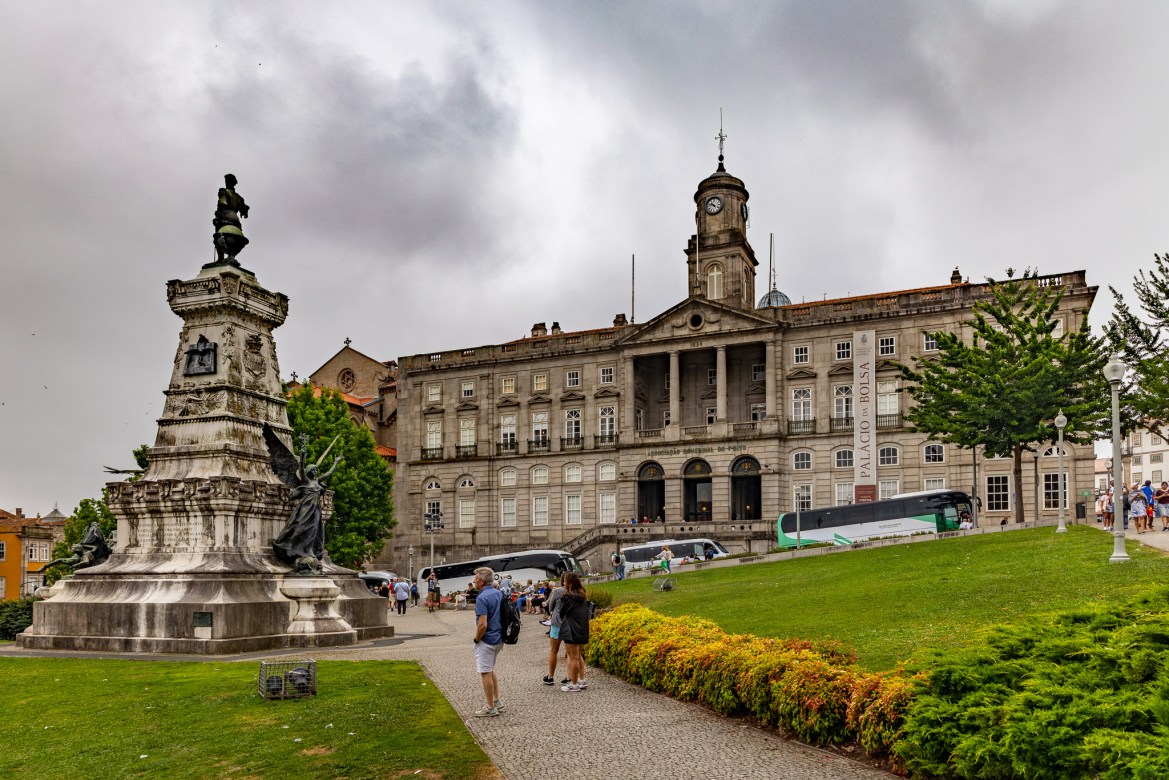
The drive into Porto took around 20 or 30 minutes. Once we reached the historic center, our driver circled the block before finding a place to stop near the Monument to Infante Dom Henrique. Palácio da Bolsa was right there, Mercado Ferreira Borges stood nearby, and old buildings filled the streets around the square. It was cloudy and warm, with signs that it had drizzled earlier.

We didn’t have an excursion or much of an itinerary beyond a few places I wanted to see. Palácio da Bolsa was our starting point, São Bento Railway Station was somewhere I wanted to work into the day, and we knew we would eventually make our way toward the Luiz I Bridge. Everything in between was going to depend on what we found once we started walking.

That turned out to be a pretty good way to see Porto.

A yellow Metro do Porto train crosses the upper deck of the Dom Luís I Bridge above the Douro River.
A wide view across the richly decorated Arabian Room inside Porto’s Palácio da Bolsa.
A panoramic view across Porto Cathedral’s Gothic cloister shows the arcaded courtyard, upper terrace and fortress-like cathedral rising behind it.
Carved stone columns and decorative architectural details frame the entrance to the church at Mosteiro da Serra do Pilar.
Gothic stone arches line the cloister of Porto Cathedral beside large blue-and-white azulejo panels.
Intricate gilded carving surrounds the monumental main altarpiece inside Porto Cathedral.
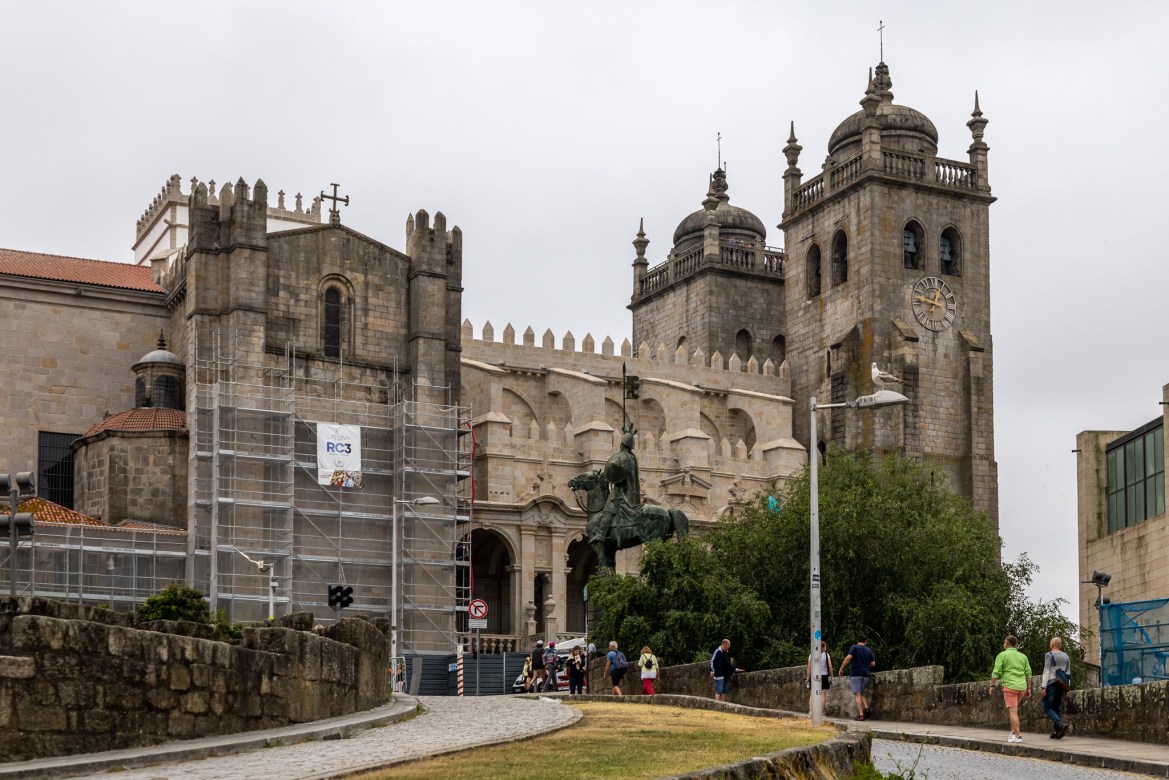
The twin towers and medieval rose window dominate the fortress-like main façade of Sé do Porto.

Journey Timeline

Morning → Celebrity Equinox & Leixões – Seated breakfast aboard the ship, bottled water on the way out, then all four of us headed ashore together.

Late Morning → Praça do Infante & Palácio da Bolsa – A rideshare took us directly into Porto. We bought tickets for a scheduled palace tour, explored the square while we waited, then spent much of the morning inside Palácio da Bolsa.

Midday → Walking Porto – We wandered without a fixed route, climbed toward Miradouro da Vitória only to find it closed, encountered the street performer with his live chickens, and eventually reached São Bento Railway Station.

Early Afternoon → Porto Cathedral – We continued uphill to Sé do Porto. Laura and I went inside while Todd and Dawn continued toward the bridge, agreeing that we would meet again later on the ship.

Afternoon → Luiz I Bridge & Vila Nova de Gaia – After finishing the cathedral, Laura and I eventually found our way to the upper level of the bridge, crossed the Douro and climbed toward Serra do Pilar rather than heading down to the Gaia waterfront.

Late Afternoon → Bia Lounge & Return to Leixões – We crossed back toward Porto, stopped at Bia Lounge for tapas and wine, then caught a ride back toward the cruise port. A final walk near Matosinhos Beach brought us past the Tragédia do Mar memorial before we returned to the ship.

Evening → Back Aboard – We met back up with Todd and Dawn for drinks, dinner and the evening entertainment aboard Celebrity Equinox.

The Experience, Told Through the Journey

Starting at Palácio da Bolsa

Our rideshare dropped us near Praça do Infante D. Henrique, which gave us plenty to look at before we’d even figured out what we were doing. Palácio da Bolsa was the obvious landmark, but Mercado Ferreira Borges and the surrounding older buildings made the whole area worth walking around.

We went over to the palace and learned that the interior could only be visited as part of a scheduled guided tour. We bought tickets for the next available time, then used the wait to walk around the monument, take some pictures and pull up Google Maps to see what else was nearby. I really didn’t know anything about Palácio da Bolsa before we arrived, so I wasn’t walking in with a checklist of rooms I wanted to see.

Laura is much better at staying with the guide and listening to everything being explained. I listen enough to know what I’m looking at, but I’m also watching the room, figuring out where I want to shoot from and usually falling behind everybody else while I wait for people to move.

There was plenty inside the palace to keep me busy. The Noble Staircase was one of my favorite areas, with the stone stairs, chandeliers and upper gallery all working together in one view. The problem was getting that view without somebody standing in the middle of it, so I stayed behind after most of the group moved on and waited for openings.

I did the same thing in the Arabian Room. The patterns and gold detail covered the ceiling, walls, doors and arches, so I photographed it several different ways rather than trying to force everything into one shot. Laura stayed closer to the tour while I hung back with the camera and caught up afterward, which is pretty much how we operate whenever a guide and photography are competing for my attention.

Wandering Through Porto

Once we finished the palace tour, the itinerary became considerably less sophisticated. We knew the bridge was somewhere in our future and I wanted to see São Bento, but otherwise we started walking and used Google Maps whenever we needed some direction.

I also have a bad habit of navigating by whatever sticks above the buildings. If I see a steeple, tower or turret in the distance, I’m probably going to wonder what’s underneath it and start drifting that way. Porto supplied plenty of opportunities for that.

The city wasn’t looking its best that morning because we were there immediately after the São João celebration. There were sections covered with trash, broken bottles, banners and whatever else had been left behind the night before. Cleanup crews were already working, but it was clearly going to take a while.

We climbed toward Miradouro da Vitória hoping to get one of the elevated views over the city and found the area closed when we got there. That was especially appreciated after we’d already done the uphill portion of the visit.

We turned around and kept walking.

Somewhere along the route we came across a street performer sitting beside a homemade collection of pipes, bells, percussion pieces and other assorted parts. That alone probably would have gotten my attention, but he also had live chickens incorporated into the performance.

I’m still not sure how somebody gets from “I should learn an instrument” to that particular setup, but he made it work. It was funny, strange and surprisingly good, and we stood there watching him for a while before continuing.

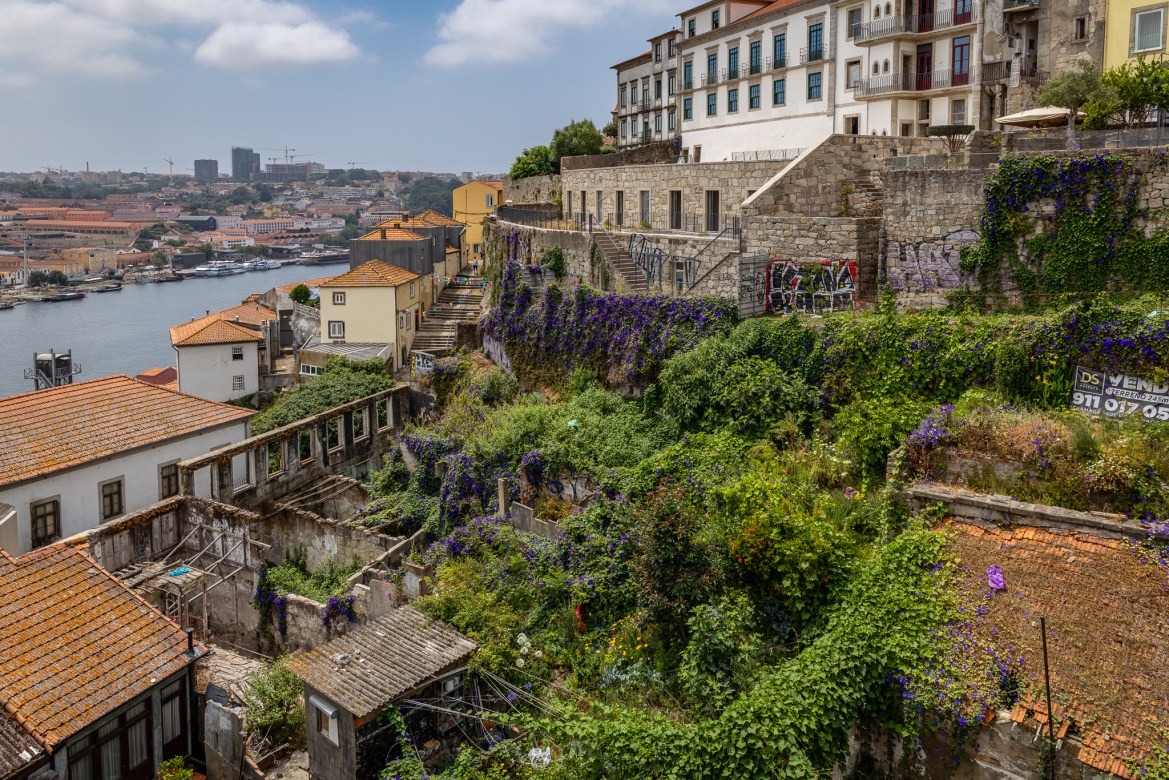
Colorful buildings crowd the steep Porto riverbank as seen from high above the Douro on the Luiz I Bridge.
The Monument to Infante Dom Henrique rises above the landscaped square in Porto’s historic center.
Painted walls, religious artwork and dark carved cabinetry fill the ornate Baroque sacristy of Porto Cathedral.
Gilded reliquary urns and blue-and-white azulejos surround the altar inside the Chapel of Nossa Senhora da Piedade at Porto Cathedral.
A vertical view from Serra do Pilar emphasizes the height and enormous steel arch of the Luiz I Bridge above the Douro River.
A street performer plays music beside a colorful roadside setup while several live chickens gather around him in Porto’s historic center.
The ornate stone Pelourinho da Sé stands at the center of Terreiro da Sé overlooking Porto’s historic district.

The Experience, Told Through the Journey

São Bento Railway Station

São Bento was one of the few places I had specifically wanted to see before we started walking. I’d seen photographs of the blue-and-white tile panels inside and wanted to photograph them myself.

What surprised me was the size of the station. For whatever reason, I had built it up in my head as something closer to Grand Central Station in New York, and São Bento is nowhere near that large.

The entrance hall is really what you’re there to see. The tile panels cover the walls around the doors and tall windows while passengers walk through carrying bags and heading for trains. We spent some time photographing the interior, walked through toward the platforms and looked around before continuing uphill.

It wasn’t what I’d pictured, but I was glad we’d made the stop.

Splitting Up at Porto Cathedral

We eventually reached Porto Cathedral, where the area was noticeably busier than most of the streets we’d been walking earlier.

Laura and I wanted to go inside. Todd and Dawn preferred to keep moving toward the bridge, so there wasn’t much reason for all four of us to compromise. We agreed we’d meet again back on Celebrity Equinox and split up there.

The cathedral turned into a much longer stop for Laura and me than I had planned.

Its layout felt different from many of the other large churches we’d visited. There were long Gothic corridors surrounding a central courtyard, with chapels, rooms and stairways opening off them as we worked our way through the complex. The main church still had plenty of the elaborate gold decoration, altars, religious artwork and objects we’d seen in other European cathedrals, but the cloisters and surrounding rooms gave this one a different feel.

Laura took her time looking through everything while I took my time photographing it, so neither of us was exactly rushing the other.

We went through the main church, chapels, cloisters, sacristy and upper levels before reaching exterior sections of the complex. Some areas were undergoing renovation, but what really caught our attention were the historic objects sitting outside. Ancient bells were displayed along the route, and parts of the old bishops’ cemetery were open to the elements. Standing there looking at things that had already survived for centuries, both of us thought it seemed strange that they were basically just outside dealing with the weather.

By the time we finally made our way out, Todd and Dawn had a pretty substantial head start toward the bridge.

Finding the Luiz I Bridge

We headed in the same general direction and, unless my memory is being generous, managed to take a longer route to the bridge than necessary.

Eventually we found the upper level and started across.

Metro trains came through regularly beside the pedestrian walkway, and most looked packed. Between trains, the bridge gave us open views along the Douro, down toward Ribeira and across to Vila Nova de Gaia. From that height, Porto’s terrain became much more obvious, with buildings and red roofs stacked up the hills from the waterfront.

We crossed the river and reached the Gaia side, where we had another decision to make. We could head downhill toward the waterfront or keep climbing toward Serra do Pilar.

After already walking around Porto most of the day, we chose the hill. Of course we did.

Above the Douro

The extra climb worked out well for me because the view changed completely once we were above the bridge. From the upper deck, the riverfront had been the subject. From Serra do Pilar, the Luiz I Bridge became part of the photograph.

That was the view I wanted. From higher on the Gaia side, I could include the full steel arch, the Douro and Porto climbing the opposite hillside in the same frame. I spent some time photographing the bridge and city from different positions before Laura and I finally agreed we’d put enough miles and elevation into Porto for one day. There was no need to discover whether the next hill had an even better view.

Tapas, Wine and a Ride Back

We crossed back toward Porto and started looking for somewhere to sit while we waited for a ride back toward Leixões.

We ended up at Bia Lounge Tapas Bar & Cocktails, which checked the boxes we cared about at that point: somewhere to sit, something to eat and wine.

We ordered a couple of tapas, including an octopus dish, and everything we had was good. After most of the day on foot, sitting there with Laura while we waited for our ride was a pretty easy way to finish the city portion of the day.

Our ride took us back toward Leixões but couldn’t drop us directly beside the ship, so we still had a decent walk ahead of us. Fortunately, this part was flat.

We were near the beach and followed the pathways for a while before turning back toward the cruise terminal. What I remember most was how wide the sandy area looked. There seemed to be a ridiculous amount of beach between the walkway and the actual water.

I took a few final photographs around Matosinhos, including the Tragédia do Mar memorial, before we headed back aboard Celebrity Equinox.

Todd and Dawn had returned separately, so the four of us met up again on the ship and settled back into the normal cruise routine of drinks, dinner and whatever show was scheduled that evening.

For a day that basically started with “drop us at Palácio da Bolsa and we’ll figure out the rest,” we managed to see quite a bit of Porto without ever needing an excursion.

A Metro do Porto train passes pedestrians on the upper deck of the Luiz I Bridge high above the Douro.
Bronze figures of grieving women and children form the powerful Tragédia do Mar memorial near Matosinhos Beach.
The riverfront of Vila Nova de Gaia stretches west along the Douro with traditional boats moored beside the quay.
Gilded arches, patterned walls and the decorated ceiling surround the ceremonial interior of Palácio da Bolsa’s Arabian Room.
Blue-and-white azulejo murals cover the walls around an arched doorway inside São Bento Railway Station.
The bronze equestrian statue of Vímara Peres stands prominently beside the ancient walls of Porto Cathedral.
Torre dos Clérigos rises above a dense field of terracotta rooftops in Porto’s historic center.

Food, Drinks & Quick Stops

Bia Lounge Tapas Bar & Cocktails

By the time Laura and I crossed back from Gaia, we’d reached the point where sitting down sounded considerably better than finding another landmark.

We stopped at Bia Lounge Tapas Bar & Cocktails while waiting for our ride back toward Leixões and ordered a couple of tapas with wine. One of the dishes was octopus served with a crisp fried accompaniment, and both the food and wine were good.

It wasn’t someplace we’d researched beforehand. We found it when we needed it, sat down for a while and enjoyed it. That’s really all it needed to be.

In the Frame

The Faces Behind This Journey

Laura and I above the Douro with Vila Nova de Gaia stretching across the river behind us.
The four of us on the Noble Staircase inside Palácio da Bolsa before we split up later in the day.
Laura beside one of the enormous historic bells we found while exploring the upper levels of Porto Cathedral.
Laura at Bia Lounge while we finally sat down for tapas and wine after a long day of walking Porto.

Just Beyond: Lisbon

Follow our route through Lisbon’s hills, tiled streets and historic neighborhoods, from grand plazas and viewpoints to the landmarks that made this one of the most memorable stops on the cruise.

Explore Lisbon
The Roman Aqueduct of Segovia crosses Plaza del Azoguejo on two tiers of granite arches.

Intricate figures and biblical scenes cover the monumental silver altarpiece inside Porto Cathedral.
The grand stone façade and clock tower of São Bento Railway Station overlook Praça de Almeida Garrett in central Porto.
Tall arched windows, decorative ceilings and blue-and-white tile murals surround the busy vestibule of São Bento Railway Station.
A weathered bronze cathedral bell rests beside the upper cloister during our tour of the Sé do Porto complex.
The stone bell tower rises beside the whitewashed church of Mosteiro da Serra do Pilar.
A carved stone crucifix rises from a stepped base at the center of Porto Cathedral’s Gothic cloister courtyard.
Repeating pointed arches and ribbed stone vaults stretch along the quiet Gothic cloister of Porto Cathedral.

Photography Notes

Palácio da Bolsa required more patience than anything technical. The rooms were busy because everyone was moving through as part of a guided tour, so getting the photographs I wanted usually meant hanging back and waiting after the guide and most of the group had moved on. That worked especially well on the Noble Staircase and in the Arabian Room, where removing a handful of people from the frame made a huge difference.

The interiors also had a wide range between darker rooms and bright windows, so I bracketed several scenes and used HDR where it helped hold detail at both ends. The Arabian Room was less about finding one perfect composition and more about breaking the room into pieces—the ceiling, doors, arches and wider views all showed something different.

Porto Cathedral presented a similar lighting problem but with rougher stone, stained glass and smaller rooms mixed in with the gilded chapels. I moved between wider architectural photographs and tighter details as we worked through the cloisters and upper levels rather than trying to photograph every room the same way.

The best exterior photography came later in the day. The bridge gave me good views of the riverfront, but Serra do Pilar gave me the composition I preferred because the Luiz I Bridge itself became part of the scene. The cloudy weather kept the sky fairly plain, but it also prevented harsh midday light from beating up the buildings along the Douro.

Mosteiro da Serra do Pilar rises dramatically above the Douro as we look back toward Vila Nova de Gaia from the Luiz I Bridge.
Stone arches, tomb fragments and weathered masonry remain within Porto Cathedral’s old cloister and former Bishop’s Cemetery.
The long stone nave of Porto Cathedral leads toward the richly gilded main chapel at the eastern end of the church.
Dark wooden cabinetry and a pink-and-white marble basin stand beneath the painted walls of Porto Cathedral’s ornate sacristy.
Marble columns and a richly gilded altarpiece frame the main chapel of Porto Cathedral.
The elaborate Baroque façade of Igreja da Misericórdia rises between colorful buildings along Rua das Flores.
Ornate bookcases, reading tables and a painted ceiling fill the historic library inside Palácio da Bolsa in Porto.

Practical Notes & Lessons Learned

  • Buy the Palácio da Bolsa ticket first. The tours run on set times, so we bought ours and used the wait to explore Praça do Infante.
  • June 24 comes with a São João hangover. Trash, broken bottles and cleanup crews were everywhere, and Miradouro da Vitória was closed.
  • Porto is a workout. Between the hills, cathedral, bridge and climb into Gaia, we covered a lot of elevation.
  • São Bento is compact. The azulejo hall is what makes the stop interesting, not the size of the station.
  • Give Porto Cathedral real time. There’s a lot more inside than the main church, especially the cloisters, upper levels and side rooms.
  • For photos, keep climbing into Gaia. The bridge views are good, but Serra do Pilar puts the bridge, river and Porto together in one frame.
Painted panels, arched windows and carved courtroom furnishings surround the former Commercial Court Room inside Palácio da Bolsa.
Curving staircases and carved stone railings frame the grand Escadaria Nobre inside Palácio da Bolsa.
Red curtains, dark wood furnishings and an elaborate gilded ceiling fill the Golden Room of Palácio da Bolsa.
Intricate geometric patterns and slender columns surround an ornate doorway in the Arabian Room of Palácio da Bolsa.
A closer view highlights the clock tower, arched windows and ornate stonework of São Bento Railway Station.
The glass-covered Pátio das Nações forms the soaring central courtyard inside Porto’s Palácio da Bolsa.
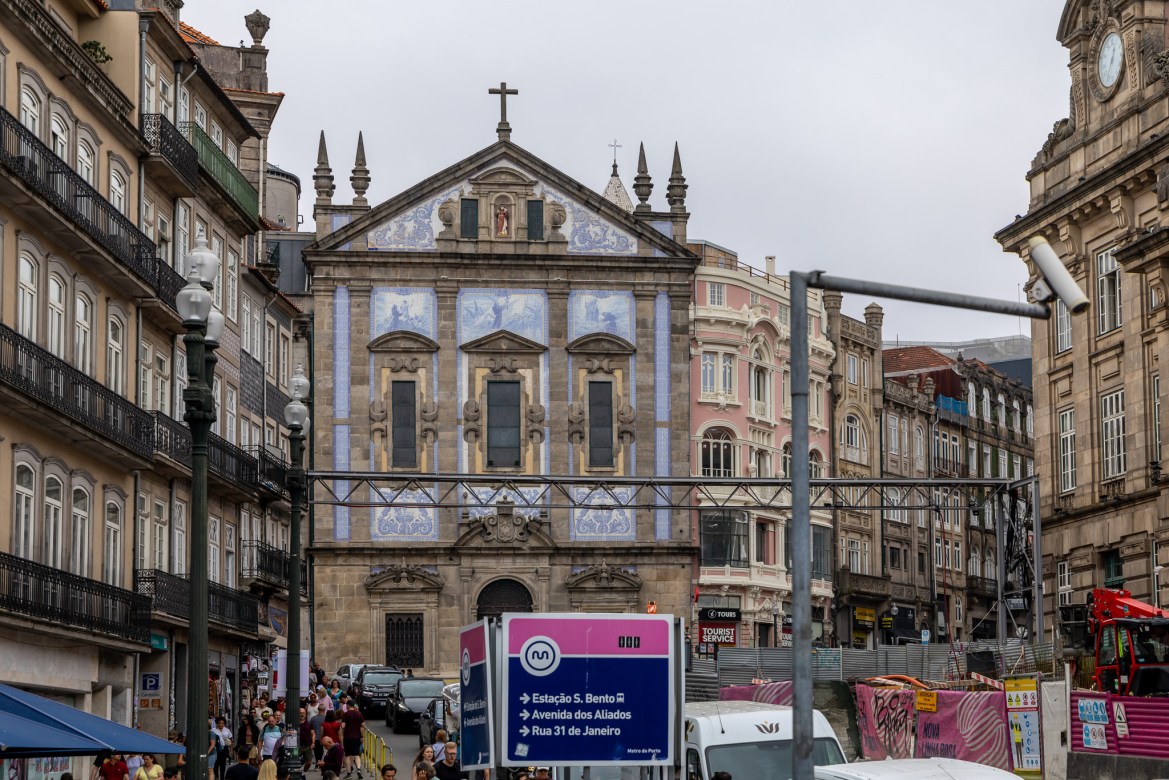
Blue-and-white azulejo tiles frame the stone façade of Igreja de São Nicolau near Porto’s riverfront historic district.

The Journey in Motion

Most of our Porto day happened on foot, so the videos follow the same progression as the photographs: moving through the city, catching some of the things we found along the way and eventually spending much more time inside Porto Cathedral than we had planned. Together they show the parts of the day that still photographs don’t really capture—the trains moving across the bridge, the sounds of the street and what it was like walking through the cathedral complex.

Porto in Motion

Walking Porto eventually brought us to the upper deck of the Luiz I Bridge, where Metro trains passed only a few feet away. We crossed into Gaia and kept climbing until the bridge, Douro and Porto were all part of the view.

Porto’s Street Symphony

Some of the more memorable parts of Porto weren’t landmarks at all. We came across musicians while wandering the streets, including one guy with a homemade musical setup that somehow incorporated live chickens into the performance. Strange, funny and actually pretty talented.

Inside Porto Cathedral

Laura and I split from Todd and Dawn at Porto Cathedral and went inside while they continued toward the bridge. What started as another church stop turned into a much longer walk through the nave, chapels, Gothic cloisters, upper levels and courtyard.


Behind the Lens

I’m Steve—a retired Army vet who traded rucksacks for camera bags and never stopped exploring. What started with a simple 110 film camera grew into photographing all 50 states and 30+ countries, from quick business-trip detours to adventures with my wife Laura. Shutter Nomadica is where I share those travels through the photographs, stories, and moments that made each place memorable.


Just Beyond: Cádiz

Continue along the cruise with another self-guided port day, where we skipped the excursion and explored Cádiz on foot through its plazas, waterfront, market and cathedral.

Explore Cádiz
The Roman Aqueduct of Segovia crosses Plaza del Azoguejo on two tiers of granite arches.

Leave a Comment