Where Time Still Whispers: A Journey Through Colonial Williamsburg

Lanterns, Lattices & Living History: Rediscovering Colonial Williamsburg

Stepping into Colonial Williamsburg feels like entering a carefully rewound film reel where the 18th century still breathes. Cobblestone lanes echo with the clop of horse-drawn carriages, while wood smoke drifts from tavern chimneys and candlelight pools against weathered brick. Lanterns sway over shopfronts filled with pewter mugs and parchment maps; every creak of a tavern door carries a whisper from America’s infancy. Time slows here — not as a theme park fantasy, but as a living conversation between past and present.

The scent of woodsmoke drifts from the Governor’s Palace kitchens, and interpreters in tri-corner hats strolled past as if they’d simply paused time for a conversation. By twilight, lanterns flickered alive, transforming the streets into a painter’s dream — a soft chiaroscuro of amber light, whispered history, and the quiet pride of a living town that remembers exactly who it is.

Mounted redcoat with yellow facings on a white horse in Williamsburg
Another British cavalryman holds a stern line atop a pale horse, yellow facings bright against a field of red. The pairing of disciplined rider and calm mount turns the street into a living parade ground. Stoic, striking, and very 18th century.
Interior court of the Williamsburg Capitol with clock tower and arches
Step inside the Capitol courtyard and the clock tower rises like a metronome for civic life. Arches, coats of arms, and steep roofs stack into a tidy lesson in colonial order. It’s all rhythm, brick, and purpose.
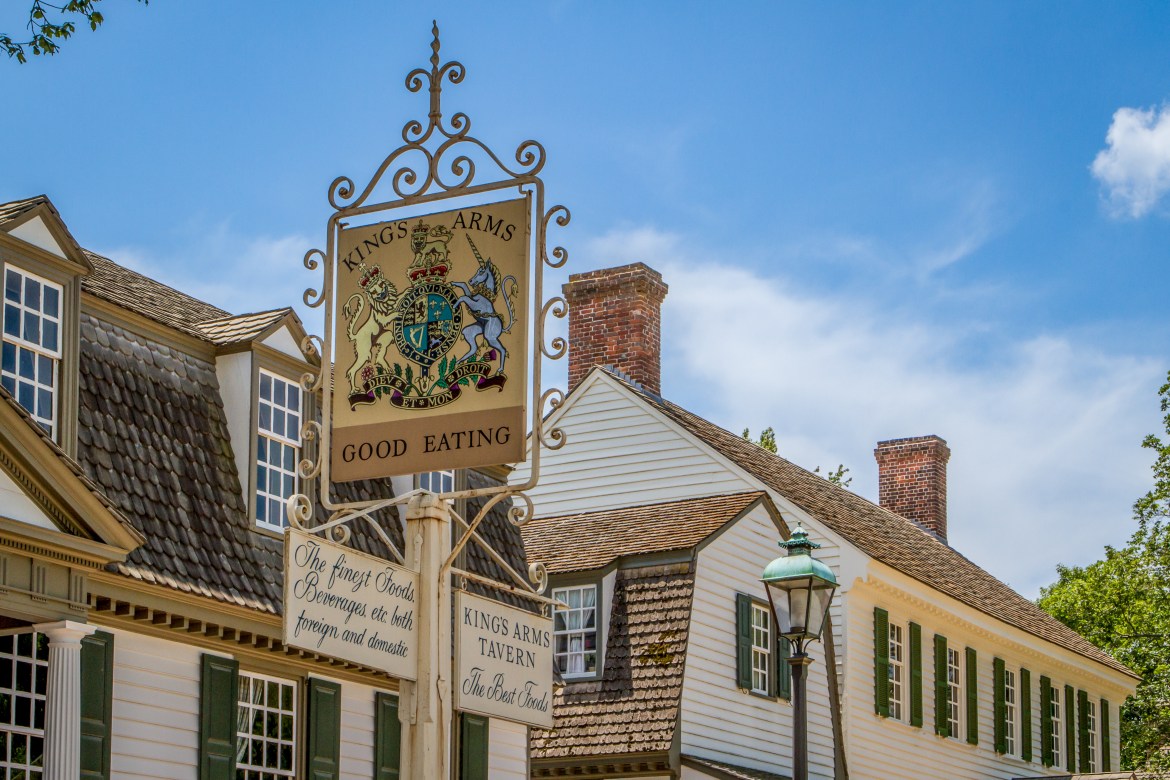
King’s Arms Tavern sign with royal coat of arms and wrought bracket in Williamsburg
The iconic King’s Arms Tavern sign swings from its wrought bracket, crowned by the royal coat of arms and a promise of “Good Eating.” It’s Williamsburg’s most photogenic invitation to sit, savor, and time-travel by candlelight.
Smiling colonial interpreter in round hat, spectacles, and striped waistcoat, Williamsburg
A cheerful interpreter pauses in a round broad-brim hat and small spectacles, the very picture of colonial cool. His relaxed grin and hands-in-pockets stance say the conversation’s about to get good.

🏛️ Story & Significance: The Soul of Colonial Williamsburg

Few places in America let travelers walk so fully through the bones of their nation’s birth as Colonial Williamsburg. Once the beating heart of Virginia’s colonial government, this town became a stage where the language of revolution was first spoken aloud. From the rhythmic clang of the blacksmith’s forge to the oratory echoing through taverns and assembly halls, Williamsburg’s story hums with the energy of people who didn’t just dream of freedom — they built it, step by handmade step. Visitors wandering its 18th-century streets sense not only the texture of history but the stubborn vitality that still animates the community today.

The idea to resurrect that past came centuries later from an unlikely partnership — a small-town clergyman and one of America’s wealthiest families. Reverend W. A. R. Goodwin, rector of Bruton Parish Church, feared the city’s colonial landmarks would crumble into dust. His vision caught the attention of philanthropist John D. Rockefeller Jr., who saw in Williamsburg a chance to restore not only buildings, but a national memory. Their collaboration, launched in the 1920s, became a cultural crusade: decades of archaeological sleuthing, archival research, and craftsmanship that turned ruins into living classrooms.

Today, more than 300 acres of restored streets, gardens, and workshops form the largest living-history museum in the world. Yet its significance lies not in nostalgia, but in participation. Interpreters weave the rhythms of the 18th century into the 21st, artisans shape pewter and iron as their forebears did, and travelers find themselves unexpectedly moved by the echo of ideals — liberty, civility, and craft — that remain deeply relevant.

Notable People & Patrons

The rebirth of Colonial Williamsburg owes its existence to Reverend W. A. R. Goodwin, often called the “Father of the Restoration.” His passion for preservation met its match in John D. Rockefeller Jr. and Abby Aldrich Rockefeller, whose resources and devotion transformed Goodwin’s vision into one of the most ambitious historical reconstructions in American history. Alongside them stood architects like William Graves Perry, whose early blueprints blended scholarship and artistry. Together, they didn’t just save buildings — they restored context, resurrecting an entire ecosystem of colonial life.

Architecture in a Nutshell

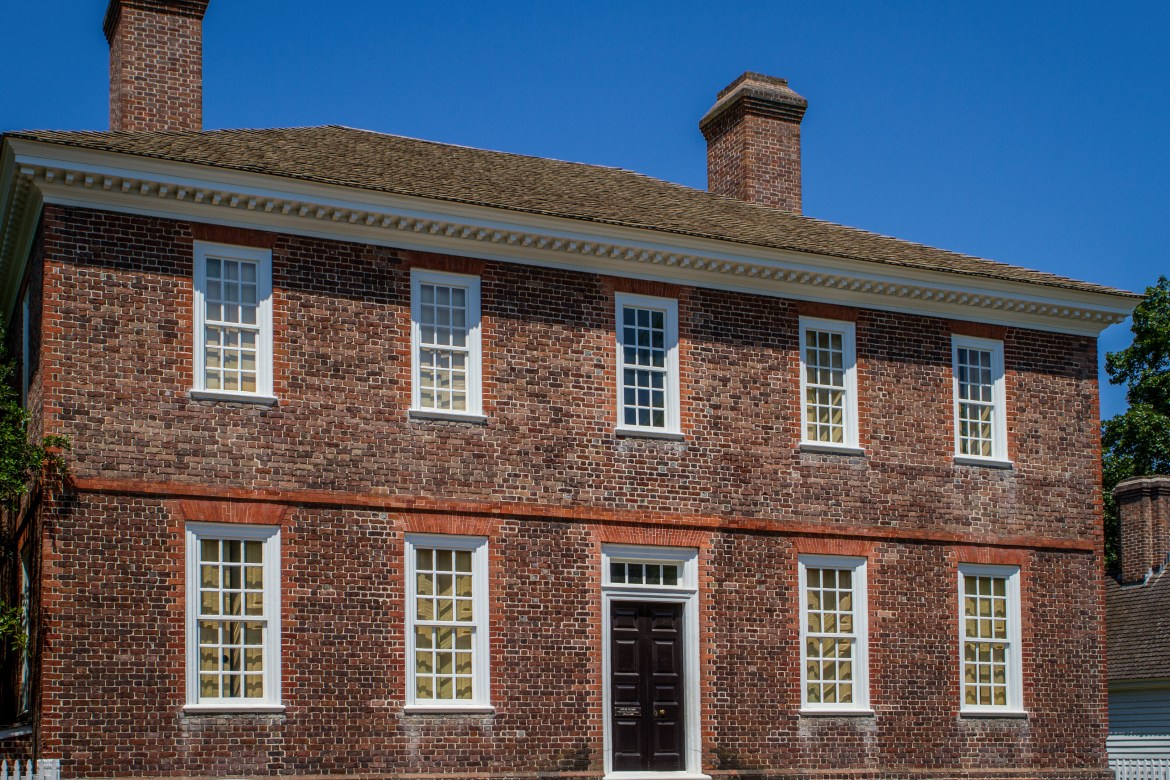
Williamsburg’s skyline reads like a study in Georgian precision and Enlightenment balance. Symmetrical façades, hipped roofs, sash windows, and Flemish bond brickwork reflect both English influence and colonial adaptation. Landmarks such as the Governor’s Palace, Capitol, and Bruton Parish Church demonstrate refined craftsmanship — from hand-wrought hinges to glazed headers that shimmer under Virginia sunlight. Even reconstructed homes follow authentic proportions dictated by surviving foundations and 18th-century pattern books, making the city itself an open-air architecture portfolio of America’s colonial ambition.

Living Traditions Today

What keeps Colonial Williamsburg vibrant is its unbroken dialogue between past and present. Artisans still forge iron with charcoal fires, spin wool into thread, and bind books by hand. The taverns hum with fife tunes and stories that merge education with entertainment, while annual events like the Grand Illumination transform the historic district into a blaze of candlelit celebration. Visitors can join interactive workshops, sit in mock trials, or even dine by lantern light — not as spectators, but as participants in an ongoing conversation about what it means to live history rather than merely observe it.

Formal garden pavilion with royal crest at Colonial Williamsburg’s palace grounds
A stately garden pavilion crowned with royal arms presides over clipped hedges and a pristine gravel walk. The petite cupola and weather vane give it a jaunty silhouette against the blue Virginia sky. It’s compact grandeur, built to impress.
Blacksmith and apprentice working at anvil inside Colonial Williamsburg forge
A blacksmith and apprentice lean into the work—one steady on the tool, the other ready at the hammer. Soot, sweat, and focus turn raw iron into everyday miracles.
Yellow stage wagon carriage pulled by two horses on Duke of Gloucester Street
A sunny yellow stage wagon clatters past white picket fences, passengers grinning from the open sides. It’s the most charming way to survey Duke of Gloucester Street—and yes, the hoofbeats echo history.

🧠 Fascinating Facts & Hidden Meanings

Every corner of Colonial Williamsburg hides a whisper from the past — symbols carved into brick lintels, coded language in weathervanes, and numerology embedded in architectural symmetry. Travelers who pause to look closer discover a world of intention: from the way streets align with cardinal directions to the quiet political theater staged inside taverns. This isn’t just a museum; it’s a cipher of colonial ideals made tangible, inviting curiosity at every turn.

Five Quick “Did-You-Knows”

  1. The Duke of Gloucester Street runs precisely east to west, a design reflecting both symbolic order and the Enlightenment’s obsession with balance.

  2. The Governor’s Palace façade contains 13 window bays — a deliberate echo of the original 13 colonies.

  3. Beneath the Bruton Parish Church lies a time capsule of 17th-century gravestones reused as foundation stones to honor earlier settlers.

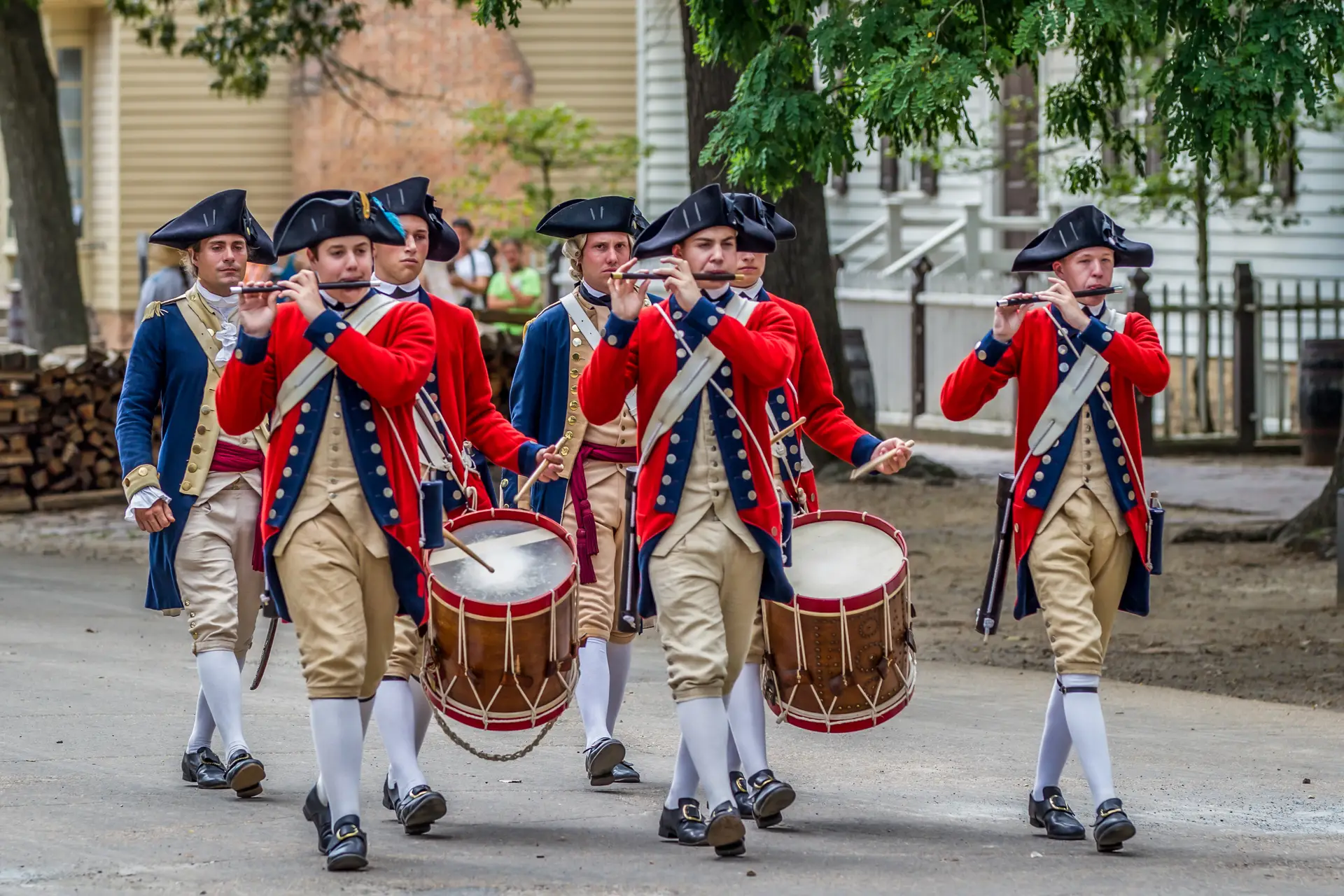
  4. The town’s fifes and drums play authentic 18th-century military tunes once used to signal troops — each melody held a distinct command rhythm.

  5. The Raleigh Tavern’s Apollo Room was where the colony’s Burgesses secretly met after the royal governor dissolved their assembly — a rebellion brewed over beer and philosophy.

A few links and ads here are affiliate portals. If you click through and snag something, you’ll be fueling my next photo-quest at no extra cost to you. Thanks for keeping the adventure rolling!

To experience the full sweep of Williamsburg’s story, consider joining a Private Tour – Colonial Life & Revolutionary Role of Williamsburg. It’s a superb way to see the city through the eyes of interpreters who weave together architecture, politics, and human resilience across centuries.

Or, for those ready to step beyond the town’s borders, the Jamestown Settlement & American Revolution Museum 7-Day Ticket offers deeper context — linking Williamsburg’s revolutionary heart to the first English outpost and the ideals that reshaped a continent.

Two colonial interpreters in coats and tricorn hats walking with folded garments, Williamsburg
Two colonial interpreters stride down Duke of Gloucester with folded uniform pieces cradled in their arms. Gold buttons and tricorns flash in the sun as everyday chores meet military polish. The street becomes a moving stage.
Octagonal brick Powder Magazine with surrounding wall in Colonial Williamsburg
The octagonal Powder Magazine rises like a brick strongbox in the middle of the green—small, sturdy, and full of stories. It once guarded the town’s most volatile treasure: gunpowder for defense and revolution.
Colonial Williamsburg Courthouse with cupola and brickwork on a clear summer day.
The courthouse sits square and stately, its cupola pointing history straight into the clouds. A lone figure on the steps lends scale while the shade tree balances the sun-washed brick.

📌 Plan Your Visit: Hours, Tickets & What to Expect

Visiting Colonial Williamsburg is less about sightseeing and more about immersion. The 301-acre historic district unfolds as an open-air stage where artisans, interpreters, and musicians bring the 18th century to life from sunrise to candlelight. The rhythm of the day follows the heartbeat of colonial routine — morning for market bustle, midday for craft demonstrations, and twilight for tavern music drifting down Duke of Gloucester Street. Every sense is engaged: the clatter of horse hooves, the scent of hearth-baked bread, the rustle of petticoats in the breeze. The experience feels both cinematic and intimate, as though travelers have slipped into a world where ideals were handmade and freedom still felt new.

Give yourself at least two full days to wander at a relaxed pace. Start at the Visitor Center, then follow carriage routes past the Governor’s Palace, Capitol, and Blacksmith’s Forge before detouring through gardens and the campus of William & Mary. Evening is best spent inside one of the historic taverns — perhaps King’s Arms or Christiana Campbell’s — where live music and storytelling stretch the magic into the night. Spring and fall bring the mildest weather and softer light, ideal for both exploration and photography.

🎫 Ticketing Tips

The single-day ticket grants access to all public buildings and demonstrations, while the multi-day pass allows repeat entry to trades, museums, and evening programs. Bundle passes often include shuttle service and admission to the Art Museums of Colonial Williamsburg — well worth it for the decorative arts collection and seasonal exhibits.

🎉 Festival / Peak-Day Watch

Major celebrations like the Grand Illumination in early December and Independence Day in July draw large crowds and early sellouts for tavern dining and carriage rides. To capture photos without the bustle, visit on weekday mornings or shoulder-season weekends in late spring or early fall.

🎟️ Category 📌 Details
Location Williamsburg, Virginia, USA – midway between Richmond and Norfolk
Founded 1632 (restored beginning in 1926)
Hours Most sites open daily 9:00 AM – 5:00 PM; taverns and evening programs vary
Admission From $49 USD (adult 1-day) to $74 USD (multi-day); children 6-12 half price
Best Months to Visit April–May and September–October for mild weather and soft golden light
Accessibility Wheelchair-friendly main routes; shuttle service connects key areas
Nearest Airport Newport News/Williamsburg International (PHF) – 30 min drive
Photography Notes Tripods permitted outdoors; no flash inside restored buildings

🚶 Getting There, Entry & Accessibility

Arriving at Colonial Williamsburg is wonderfully straightforward: most visitors start at the Visitor Center, where shuttles roll directly into the Historic Area and eliminate the guesswork of parking near the brick-lined streets. If you prefer to walk, expect an easy, scenic approach along well-marked paths that lead toward Duke of Gloucester Street and the first clusters of trades shops. Entry is fluid rather than gated—docents check tickets at building doors and museum entrances—so you’ll drift naturally from carriage routes to workshops without feeling bottlenecked. Pace yourself with the terrain in mind: surfaces shift from smooth sidewalks to packed dirt, brick, and occasional gravel, and the distance between headline sights can be longer than it looks on a map. A relaxed cadence—morning core sights, a midday museum break, and golden-hour streets—keeps both mobility and attention fresh.

Parking & Drop-offs — The primary Visitor Center lots are the best bet for all-day access; they’re well signed, typically open from early morning to evening, and sized for buses and RVs. Follow wayfinding boards to shuttle stops a short walk from the lots; rideshare drop-off zones are clearly marked near the Visitor Center approach. Closer to town, limited-duration street parking exists but fills quickly on weekends and during events—treat it as a bonus rather than a plan. If you’re traveling with kids, strollers, or photo gear, the Visitor Center drop-off loop keeps unloading simple before you park.

Accessibility Notes — Main corridors are wheelchair-friendly, with a mix of paved, brick, and hard-packed paths; some 18th-century thresholds and narrow doorways remain, but staff can advise on accessible alternatives. Expect a few low steps and uneven bricks at historic building entries; ramps are present at many sites and at the Art Museums of Colonial Williamsburg. You’ll find accessible restrooms at the museums and select hubs, plus shaded benches and tavern porches that double as quiet seating. Footwear matters here: choose supportive, closed-toe shoes that handle brick joints and gravel comfortably.

Wayfinding Inside — Think of the district as a spine-and-ribs layout: Duke of Gloucester Street is the spine, with gardens, greens, and craft yards branching like ribs to either side. There are no strict one-way routes outdoors; you’ll weave between houses, trades, and greenspaces, then anchor your bearings at icons like the Governor’s Palace, Capitol, and Bruton Parish Church. For groups, pick meet-back spots with shade and visibility—Palace Green, the Capitol lawn, or the museum atrium—so people can explore at their own pace. Pocket maps from the Visitor Center and the simple “follow the fife & drum” rule make navigation intuitive even on a first visit.

Blue horse-drawn carriage with ornate panels waiting in shade in Williamsburg
A handsome blue carriage, all scrollwork panels and polished wheels, waits in the shade like a VIP ride from another century. In Colonial Williamsburg, transport doubles as theater—and this coach steals the scene.
Basket maker weaving splints beside hearth in Colonial Williamsburg trades shop
A costumed basket maker finesses long splints into shape while shavings gather at her feet. It’s patient, rhythmic work—the kind of handcraft that kept markets moving in 18th-century Williamsburg.
Close-up of British redcoat officer speaking, tricorn and gold trim visible
A redcoat officer calls out with urgency, voice clearly meant for a crowd or a company. Gold braid and crisp ruffles frame the moment like punctuation marks. You can almost hear the command cut through the street noise.

🧭 How to Explore: Smart Routes for Any Timeline

Think of Colonial Williamsburg as a slow-unfolding sequence: begin at the Visitor Center courtyard where maps, shuttle cues, and orientation briefings set the tone; slip into the highlight halls of power at the Capitol and the Governor’s Palace to feel the pulse of colonial politics; drift outward into terraces and gardens where brick paths and boxwood alleys calm the tempo; and finish at a finale vantage—the long green of Palace Lawn at golden hour or Duke of Gloucester Street under lanterns—where the 18th century seems to exhale. The narrative reads left to right across the day: crafts by morning light, museum cool-downs at midday, and music or candlelit tavern glow by evening. Keep an ear out for the fife-and-drum corps; they function like a living breadcrumb trail. Aim to punctuate the flow with one tactile craft stop, one reflective chapel moment, and one outdoor green where the sky does half the storytelling.

60-Minute “Essentials” — Start at the Visitor Center shuttle and ride straight to the Capitol; take a brisk 10–12 minute walkthrough to grasp the stakes of representation and revolt. Stroll west along Duke of Gloucester Street, pausing for a blacksmith or printer demo (5–7 minutes each) to turn ideas into materials. Continue to Bruton Parish Church for a quick reflective pause under honeyed wood and clear panes, then step onto Palace Green for your hero wide shot with carriages crossing the frame. If you’re pairing the day with Water Country USA or Busch Gardens, close the loop by hopping the shuttle back from the Governor’s Palace stop—clean, compact, and surprisingly complete.

90–120 Minutes “Deeper Look” — Run the same arc, but add the Art Museums of Colonial Williamsburg (DeWitt Wallace/Abby Aldrich Rockefeller) for 25–35 minutes of decorative arts, folk art, and summer-friendly air-con. Slip out to the Governor’s Palace gardens for trimmed hedges, sunken parterres, and a layered perspective that photographs beautifully from eye level and low angles. Fold in one quieter court—like the cooper’s yard or a back-lane kitchen garden—where ambient sound is birds, not bustle. End with five extra minutes inside a tavern doorway to soak up timber textures and the smell of hearth smoke before catching the shuttle.

Leisure Pace (3+ Hours) — 9:00 AM: Capitol orientation and light-angle exteriors (15–20 minutes). 9:30 AM: Crafts corridor (choose blacksmith then printer; 30–40 minutes total) and a meander through side gardens (10 minutes). 10:30 AM: Art Museums mini-gallery loop (30 minutes) for context and a cool sit-down; grab a quick ginger cake or hand pie on the way out (10 minutes). 11:30 AM: Governor’s Palace interiors and the rear terraces (30–40 minutes) for your first hero view; then shift to Palace Green for your second hero view—long lens on carriages or a wide establishing frame (10 minutes). Noonish: a reflective moment at Bruton Parish Church (5–10 minutes) with one detail shot (organ pipes, hymn board, or pew finial). Wrap with a late snack at a nearby tavern porch—lemonade or a bite—and let the fife-and-drum cadence be your curtain call before you amble back to the shuttle.

🖼️ Spaces & Highlights You’ll Love

Colonial Williamsburg rewards travelers who slow to the rhythm of hand tools and hoofbeats. Treat each space like a short story: pause for the opening scene, notice the supporting characters (textures, sounds, light), then let the finale be a quiet moment where the place speaks back. The best experiences unfold in layers—politics in one hall, craft in the next yard, reflection beneath a church window—each chapter deepening your sense of why this town mattered. Don’t rush the transitions; the walk itself is the narrative thread. And whenever possible, revisit a favorite spot at a different hour—morning clarity reveals details that evening lantern-light turns to poetry.

Governor’s Palace — Power dressed in brick and boxwood.
This stately residence channels the theater of authority: formal rooms, polished banisters, and drill-straight garden lines that announce who’s in charge. Look for symmetries—the measured spacing of windows, the ceremonial stair, the axial view that pulls your eye through hedged parterres. Outside, the terraced gardens are your canvas: step back for grand geometry, then drop to knee height to frame hedges against sky. The best way to enjoy it is unhurried—let your eyes travel from gilt details indoors to blade-sharp shadows outdoors, then return at golden hour when the façade glows like a stage set awaiting its cue.

The Capitol — Where words struck flint and made fire.
Inside these chambers, debate was a contact sport—ideas thrown like gauntlets, compromises hammered out in oak-paneled air. Focus on the spatial choreography: opposing benches, high-backed chairs, and thresholds that turn footfalls into punctuation. Watch how voices carry; even in a quiet moment, the room feels tuned for persuasion. Walk the exterior colonnade and frame columns against the street—your photo will read like a political cartoon in perfect perspective. Linger long enough to imagine the echo of votes, then step outside to feel how public greens turn rhetoric into community.

Trades Yards (Blacksmith & Printer) — The sound of a nation being made.
Here, the soundtrack is iron on anvil and the rasp of type being set—material proof that liberty needed tools, nails, and news. At the forge, note the glow of the fire and the choreography of tongs, hammers, and quench—great for tight, tactile compositions. In the print shop, lines of movable type and drying broadsides make graphic studies; frame hands at work to turn process into portrait. Give yourself time to watch a piece go from raw to refined; the satisfaction of a finished hinge or crisp ink impression is the payoff. Leave when your clothes smell faintly of charcoal and ink—that’s your souvenir of honest craft.

British redcoat cavalry interpreter on horseback at Colonial Williamsburg
A mounted British redcoat rides through town in full dress—braided epaulettes, tricorn, and crimson coat blazing against the green. The pose is all command, the leather tack and fur saddle blanket adding battlefield grit to the pageantry. History trots right up to the lens.
Blacksmith tending bright forge fire beside brick chimney in Williamsburg shop
The blacksmith coaxes the forge, eyes locked on the orange heart of the coals. Sparks, tools, and a brick chimney frame a craft that shaped the bones of colonial life.
Close-up of fifers from Colonial Williamsburg Fife and Drum Corps in red coats
Two young fifers from the Colonial Williamsburg Fife and Drum Corps focus on the melody, lips set and fingers flying. The tight framing lets the textures do the talking—wool, wood, brass, and a hint of drum leather. You can almost hear the high, bright trill.
Colonial seamstress arranging printed chintz fabric in a dressmaker’s shop, Williamsburg
A costumed mantua-maker smooths lengths of printed chintz, coaxing tomorrow’s gown from today’s cloth. Bonnet ribbon, pastel shawls, and hanging dresses turn the shop into a color wheel of 18th-century fashion. Quiet industry never looked this elegant.
Hedge maze and flower beds at the Governor’s Palace gardens in Williamsburg
Curving boxwood walls carve a playful maze around bright flower beds, a formal garden with a wink. The paths promise both order and surprise—classic Williamsburg. A gardener’s compass and a photographer’s playground.
Colonial kitchen interpreter demonstrating hearth cooking at Colonial Williamsburg
A costumed interpreter grates ingredients beside a glowing brick hearth, turning simple produce into 18th-century fare. Copper pots, wooden boards, and a spread of vegetables make the table look like a painting you can smell. History never tasted so real.
Colonial Williamsburg interpreter reading from a book in straw hat by garden fence.
A costumed interpreter pauses mid-reading, brimmed hat tipped just so against the summer light. The garden greens and picket fence frame a quiet moment that makes the 18th century feel close enough to overhear.

🍽️ Nearby Pairings & Pleasant Pauses

Keep the day low-stress by pairing the Historic Area with easy add-ons: Merchants Square for cafés and people-watching, the William & Mary Sunken Garden for a green breather, and—if you have wheels—quick hops to Busch Gardens Williamsburg (late-afternoon rides, then blue-hour lights), Water Country USA (midday cool-down before a golden-hour stroll back in town), or Jamestown Settlement (quiet morning galleries and riverside palisade shots before Williamsburg’s peak crowds). Blue hour belongs on Duke of Gloucester Street, where lanterns and carriage silhouettes do the heavy lifting; save Busch Gardens’ night lighting for a post-dinner thrill sequence. If splitting the day, do Jamestown Settlement early for context (fort, museum, and re-created ships), then return for tavern ambience and soft evening glow in Colonial Williamsburg. Aim for warm late-afternoon frames on Palace Green; let rides and water slides be your energetic bookends rather than the main act.

Family-Friendly Stops — Treat the crew to a sweet reset at Wythe Candy & Gourmet Shop or Kilwins (benches and stroller-friendly space). The Palace Green and Sunken Garden offer safe run-around zones before loading up for Busch Gardens or Water Country USA. Shuttles from the Visitor Center make hop-on returns painless; pack towels and a change of clothes if you’re slotting Water Country midday between Historic Area segments.

Rain/Heat Refuge — Cool off inside the Art Museums of Colonial Williamsburg—wide corridors, reliable seating, and engaging exhibits for mixed-age groups. During a shower, Merchants Square’s covered arcades connect cafés and shops without a soaking; on hot days, it’s your breezy shade route. If you’re en route to Jamestown Settlement, note the museum’s climate-controlled galleries as a relaxing pre- or post-outdoor buffer before you head back for Williamsburg’s golden hour.

🎥 Reels on the Road

Colonial Williamsburg practically storyboards itself for short-form reels — every frame seems composed for motion. The clip-worthy rhythm here isn’t about quick cuts, but slow transitions: a blacksmith’s hammer striking in rhythm, sunlight flickering through lattice shutters, a carriage turning under oak boughs. Capture textures over time — brick, brass, and candlelight — and let ambient sound do some of the storytelling. Late afternoon and blue hour deliver the dreamiest contrast, when the fife-and-drum corps parades down Duke of Gloucester Street and lanterns start to glow like time capsules. Layer snippets of dialogue from interpreters or the echo of hoofbeats to blend atmosphere with authenticity; your audience will feel transported straight into the 1700s.

  🎥 Governor’s Palace Gardens — Smooth pan from the wrought-iron gates to boxwood symmetry at sunrise; end with a tilt up toward the glowing façade. Best at golden hour for warm tones on the brick.
  🎥 Duke of Gloucester Street — Handheld walkthrough following carriages and candlelight reflections; transition from daylight chatter to twilight stillness. Ideal around blue hour.
  🎥 The Capitol Steps — Stationary shot as reenactors pass, then pull focus to the flag fluttering above; slow motion works beautifully here. Mid-morning light gives crisp contrast.
  🎥 Trades Yards (Blacksmith Forge) — Tight macro of hammer sparks in rhythm with clanging sound; dissolve into molten color against dark interiors. Shoot in late afternoon for glowing coals.
  🎥 Bruton Parish Church & Palace Green — Start with bell toll or organ note, then drone or wide pan across the lawn as the sun drops behind the rooftops. Perfect closing reel sequence at sunset.
  🎥 Jamestown Settlement Extension — Quick-cut montage tying Williamsburg’s street life to Jamestown’s riverfront palisade; fade between past and present. Works well as a “Then & Now” storytelling reel.

🧳 What to Pack for Picture-Perfect Memories

Colonial Williamsburg is a walking campus of brick, gravel, and shaded greens, so start with the comfort kit: a refillable water bottle, wide-brim sun hat, breathable layers that respect historic venues, and cushioned socks for long days on mixed surfaces. Keep a small microfiber cloth handy—woodsmoke, dust, and fingerprints love glass—and tuck electrolyte tabs in your pocket for summer humidity. For photos, think low-key stability that doesn’t slow you down: a compact tripod or clamp where allowed, and steady hand-held technique inside. Light changes quickly between sun and porch shade, so pack an ND filter for softening midday scenes and a circular polarizer to cut glare on shop windows and bring out sky and brick texture. Finally, a slim daypack leaves hands free for doors, maps, and ginger cakes—trust me, those will detour your route in the best way.

👉 The Nomad’s Kit: Gear That Earns Its Miles

Canon RF 15–35mm f/2.8L — Own the sweep of Duke of Gloucester Street, tight tavern interiors, and the Governor’s Palace façade without backing into a boxwood hedge.
Canon RF 24–105mm f/2.8L — Your tavern-to-trade-shop workhorse: character portraits of costumed interpreters (with permission), mid-tele details of joinery, pewter, and quills, plus quick cider-house vignettes.
Canon RF 100–500mm f/4.5–7.1L IS USM — From Capitol Landing or the Palace gardens, compress palisades, cupolas, and horse teams; isolate the Magazine weathervane or a fifer on the march from a respectful distance.
Lowepro ProTactic BP 350 AW III — Slim and site-friendly; slides past ticket checks, rides comfortably on a shoulder all day, keeps filters and program maps tidy.
Peak Design Travel Tripod — Best for blue-hour symmetry at Palace Green or Crim Dell—keep legs short and yield to foot traffic; most interiors don’t allow full sticks.
JOBY GorillaPod 3K Kit — Clamp to split-rail fences or porch rails for long-exposure lantern scenes and silky fountain water—tiny footprint, period-appropriate discretion.

Cut Glare. Shape Time. Make Every Frame Sing.
Williamsburg’s palette is brick, brass, and hand-blown glass—high noon can turn everything shiny. A circular polarizer tames glare on windowpanes and polished wood while deepening colonial reds and leafy greens. A variable ND lets you slow the scene so strolling crowds become a soft blur, the Governor’s Palace canal smooths to glass, and evening carriages trace gentle motion without losing the crisp geometry of Georgian façades.

🌊 Control Reflections & Punch Up Color
Circular Polarizer Filter — Knock hotspots off lacquered banisters and shop windows, enrich the patina of brick and slate, and keep sky detail behind the Capitol cupola. Pro tip: rotate lightly indoors—too much polarization can mute candle-glow on brass and darken those lovely wavy windowpanes.

⏱️ Paint History in Long Exposure
Neutral Density Variable Filter — Drop 3–6 stops to blur visitors along Duke of Gloucester, turn the Bassett Hall springhouse run into satin, and capture twilight carriage wheels as elegant arcs. Pro tip: start around 1/4–1 s for people-motion; go 2–8 s for dreamy water and lantern trails.
Pack both for any colonial ramble: the polarizer reveals hand-wrought detail; the ND sculpts atmosphere. Together, they make 1776 feel timeless.

Photo Policy RemindersNo flash in historic interiors (Governor’s Palace, Capitol, trade shops); many buildings restrict tripods/stands and rope off artifacts—shoot handheld and keep to visitor paths. Always ask interpreters before close-up portraits, and avoid photographing private events or children without permission. Drones are not permitted in the Historic Area. Be courteous around carriages and costumed demonstrations (musket firings are loud—mind your ears and timing), and watch slick bricks after rain—those cobbles have seen centuries of footsteps.

💰 On-Site Costs Snapshot

Most travelers spend for admission, a bit extra for guided context (tour or carriage ride), and a modest treat or souvenir before day’s end. If you plan to linger beyond a single afternoon, the multi-day pass is the best value—especially if you want to dip into the Art Museums and return for evening programs at an unhurried pace. Consider upgrading for a specialty tour if you’re a history buff or photographer; it concentrates insight (and access) so you waste less time connecting the dots. Save room in the budget for a tavern drink and snack—it’s part of the experience and pairs perfectly with golden-hour street wandering.

Category Typical Spend (USD) What It Covers
Entry $49–$74 Single-day to multi-day access to Historic Area sites, trades, and Art Museums (check inclusions on your pass).
Guided Access $15–$40 Add-on specialty tours or short carriage rides; great for concise storytelling and priority photo angles.
Extras $8–$25 Tavern drink & snack (ginger cake, lemonade) or a small souvenir (map print, pewter token) to round out the experience.

🤝 Etiquette & Respectful Visiting

Colonial Williamsburg thrives on civility — the same virtue it was built to teach. Dress comfortably but respectfully; lightweight, modest attire works best in summer heat, and hats should come off in Bruton Parish Church or any space where prayers or quiet reflection are taking place. Step aside for carriages, reenactments, and guided groups—they operate on tight choreography and deserve a clear stage. Keep phones on silent and voices low inside buildings; interpreters stay in character for immersion, so address them courteously and enjoy the gentle time travel that comes with it. Don’t handle artifacts or cross ropes, and if you’re photographing, move mindfully to keep others’ views clear. Above all, remember that patience and kindness are the true ticket here—manners never go out of style, especially in a place that celebrates where they began.

Ornate white wrought-iron garden gate at the Governor’s Palace, Colonial Williamsburg
An elegant wrought-iron gate ushers visitors down a chalk-white path toward the manicured Palace Gardens. Brick pillars and urns add a flourish that whispers, “mind your manners.” It’s symmetry with a colonial accent.
Two Continental Army officers in blue and buff uniforms with tricorn hats, Williamsburg
Two Continental-style officers confer in crisp blue-and-buff coats, brass gleaming and tricorns perfectly cocked. Their serious expressions read like a dispatch from the front—strategy meets street theater.
Front facade of the Governor’s Palace in Colonial Williamsburg under clear sky
The Governor’s Palace stands perfectly symmetrical and unapologetically grand, a brick manifesto of royal authority in colonial Virginia. From the ornate iron gate to the lanterned cupola, every line says power and pageantry.

🕰️ Historical Timeline at a Glance

These milestones tune your eye to materials, motifs, and room uses you’ll encounter on-site. Knowing when power shifted, styles evolved, and restorations began helps you read brick bonds, paneling, and garden geometry like chapters in a living book.

Year Milestone What You’ll Notice Today
1632 Settlement established Early colonial footprint; simple timber and brick beginnings that set the street grid.
1693 College of William & Mary chartered Academic influence; refined Georgian proportions and scholarly civic spaces nearby.
1699 Becomes capital of colonial Virginia Rise of formal power rooms—Capitol, Governor’s Palace, axial gardens, ceremonial halls.
1776 Revolutionary period Spaces used for debate and muster; hear fife & drum rhythms and see printed broadsides lore.
1780 Capital moves to Richmond Government rooms lose daily function—notice their preserved symbolism more than active governance.
1862 Civil War: Battle of Williamsburg Later-era scars and stories; guides may reference shifting uses of buildings and grounds.
1926 Restoration begins (Goodwin & Rockefeller) Authentic reconstruction methods; archaeology-informed layouts and period-correct details.
1934 Governor’s Palace reconstructed Signature baroque axis and boxwood gardens—look for symmetry and ceremonial staging.
2007–2020 Art Museums expansions Climate-controlled galleries showcasing decorative arts and folk collections—ideal midday reset.
Today Largest living-history museum in the U.S. Active trades, interpretive programs, and lantern-lit evenings that animate restored streets.
Woman sitting beside cascading fountain at the Courtyard of Philanthropy in Colonial Williamsburg.

📓 Through My Lens: Field Notes from the Road

Mid-summer turned into a family time capsule: a long weekend stitched together with Busch Gardens adrenaline, Water Country USA splash-happy laughter, a grounding morning at Jamestown Settlement, and unhurried afternoons inside Colonial Williamsburg where time walks beside you. Heat shimmered over brick and boxwood while carriage wheels clicked like a metronome; costumed interpreters held character with uncanny grace, answering questions as if the eighteenth century were simply the present tense. Streets smelled of woodsmoke and fresh bread, and the tavern wasn’t just a meal—it became a salon of ideas, the kind of conversation that reminds you revolutions begin at tables before they ever reach assemblies. For a photographer, it felt like a playground of textures and light—polished banisters, leaded panes, forge sparks, and lantern glow—yet the real frame was our family moving through history together, laughing one moment and listening closely the next. Leaving at blue hour, with fifes in the distance and warm brick catching the last trace of sun, the day closed like a well-bound book you know you’ll open again.

☀️ When to Go & Weather Sweet-Spots

Colonial Williamsburg by the Seasons: Light, Lanterns, and Easy-Breeze Days

Colonial Williamsburg wears the year like a four-act play: spring arrives with soft light and camellias, summer brings festival energy and thunderhead drama, fall paints the boxwoods in gold hour after hour, and winter trades heat for candlelit calm. Expect a humid subtropical rhythm—shade under porches and breeze corridors along Duke of Gloucester Street matter in July, while museums make perfect midday cool-downs. Crowds peak during school breaks, summer vacation, and Grand Illumination weekends, so shoulder seasons reward patient travelers with kinder temperatures and clearer frames. Rain tends to pop up as quick afternoon showers in warm months; pack a compact umbrella and treat it as a fifteen-minute intermission before the light turns glorious.

🌞 Season 🧘‍♂️ Vibe Check 🌦 Rain Factor 🏛 Tourist Traffic
🌴 Winter (Dec–Feb) Crisp air, lantern-lit evenings, and quieter streets; festive sparkle early December. Low to moderate; occasional cold rain—pack a warm layer and gloves. Low after holidays; weekends rise around events.
🌸 Spring (Mar–May) Blooming gardens, soft light, and comfortable strolling temps. Spotty showers; easy to dodge under arcades and museum roofs. Moderate; spikes on spring breaks and May weekends.
☀️ Summer (Jun–Aug) High energy, long days, golden-hour magic after hot afternoons. Frequent brief afternoon thunderstorms; great post-rain skies. High—school vacation and July 4th bring crowds.
🍂 Fall (Sep–Nov) Warm days, cool nights, and leafy glow over Palace Green. Generally light; occasional fronts with quick showers. Moderate; popular on October weekends.
🌧️ Rainiest Months: July–August (brief afternoon downpours; beautiful post-storm skies).
🎯 Peak Tourist Season Months: June–August, plus early December (Grand Illumination weekends) and July 4th.
🏖️ Off-Season Sweet Spot Months: Late January–February (quiet interiors) and late September–October (gentle warmth, golden light).
💡 Insider Pro Tip: Plan a midday museum break for air-conditioning and context, then return outdoors for late-day glow; after a summer shower, head straight to Duke of Gloucester Street for reflective puddles and saturated brick.

🛡️ Practical & Safety Notes

Colonial Williamsburg is one of the gentlest walking destinations in Virginia, but a little awareness keeps it seamless. Keep bags zipped and valuables close in crowded tavern entries or during festival weekends, when foot traffic tightens around shuttles and shop doors. After rain, brick paths and cobblestone thresholds can turn slick—step carefully under shaded porches and garden slopes. At closing time, streets release crowds in waves toward the Visitor Center shuttles, so set an easy meet-back point like Palace Green or Merchants Square if your group scatters. The district is well-lit and patrolled, yet classic travel sense applies: stay alert, hydrate often in summer humidity, and treat carriages, reenactments, and candlelight evenings as shared-stage moments—grace and patience always frame the best experience.

🗣️ Cheat Sheet for Friendly Encounters while in CITY

Even though English was spoken in 18th-century Williamsburg, much of its language carried different meanings—a mix of formal civility, trade jargon, and expressions that marked class and craft. Knowing a few of these early-settlement terms adds depth to your visit: you’ll catch subtle jokes from interpreters, understand shop signs, and read broadsides with new appreciation. Listen for turns of phrase like “pray, step within” (an invitation to enter) or “good morrow” (a morning greeting); they’re part of the living theater that keeps Williamsburg authentic.

🇺🇸 Modern English 🏴 Colonial Term or Phrase 📖 Meaning / Context
Hello / Good Morning Good Morrow Standard polite greeting used until midday.
Please come in Pray, step within Common shopkeeper invitation to enter the premises.
Goodbye Godspeed / Fare Thee Well A blessing for safe travels or good fortune.
Friend / Neighbor Goodman / Goodwife Courtesy titles for respected townsfolk below the gentry class.
Gentleman / Lady Sirrah / Mistress Address forms denoting social rank; “sirrah” could be familiar or mildly scolding.
Inn / Restaurant Tavern Public house for meals, drink, and spirited political debate.
Money / Change Pence / Shilling Currency units prior to U.S. coinage; 12 pence = 1 shilling.
Workshop Smithy / Shoppe Space for skilled craft or trade; the suffix “-pe” signaled refinement.
Apprentice ’Prentice A youth bound by contract to learn a trade from a master craftsman.
Public Official Burgess Representative in Virginia’s colonial assembly (House of Burgesses).
Newspaper Broadside Single-sheet news or announcement posted in public spaces.
Police / Guard Watchman Town security responsible for curfew and night patrols.
Meeting / Gathering Assembly / Court-Day Public forum for civic discussion or legal matters—often social as well as formal.
Clothes / Outfit Habit Term for one’s full attire; to be “well-habited” was to be well-dressed.
Store / Market Mercantile Shop offering imported goods and colonial staples for trade or coin.
Lens & Latitude – Chasing Peaks at Mount Rainier

Behind the Lens

I’m Steve—a retired Army vet who traded ruck sacks for camera bags and now chases light across every latitude I can reach. From 110 point & shoot film camera beginnings to a Canon R5 Mark II and Mavic Pro II drone, I’ve logged shots in 36 countries and all 50 states, squeezing solo photo runs between corporate flights and longer adventures with my wife. Shutter Nomadica is where I share the hits, misses, and field notes so fellow roamers can skip the guesswork and grab the shot!


Leave a Reply

Discover more from Shutter Nomadica

Subscribe now to keep reading and get access to the full archive.

Continue reading