Amber Fort, Jaipur: A Traveler-First Deep Dive into Mirrors, Marble, and Rajput Majesty

From Maota Lake to Sheesh Mahal: How to Experience Amber (Amer) Fort Like a Pro

At first light, Amber (Amer) Fort glows like a palace cut from sunrise—honeyed sandstone and creamy marble stepping down the Aravalli hills into the stillness of Maota Lake. Elephants once climbed this slope; today you’ll wander the same switchbacks into a world of mirrored ceilings, latticed shadows, and frescoes that look hand-warmed by centuries. Inside, the acoustics turn a whispered “wow” into a soft chorus, and every courtyard gifts you another geometry lesson: filigree windows, scalloped arches, colonnades that frame Jaipur’s pink horizon like a living postcard. Photographers will chase reflections in the water palace garden, then pivot to the Sheesh Mahal where gemstones and glass flake sunlight into starfields.

Travelers will love how the Fort unfolds as a story of Rajput pride, Mughal finesse, and royal everyday life—audience halls, queens’ apartments, secret passages. By day’s end you’ll understand why Amber is more than a checklist stop: it’s a study in light, craftsmanship, and the thrill of standing where power once wore silk. In this Deep Dive, you’ll learn the cultural backstory, smart routes, hidden angles, and timing tricks to make every frame—and every moment—count.

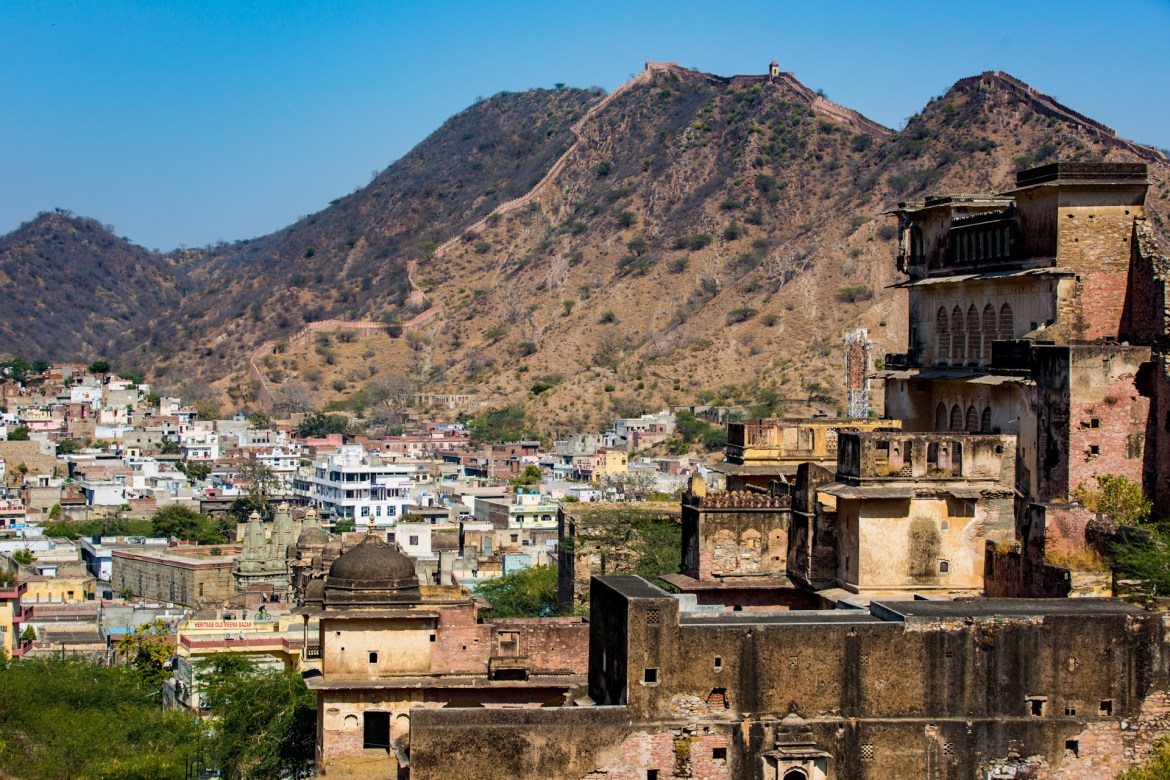
Stone temple tower in Jaipur near Amer Fort with intricate carvings
A detailed temple spire rises among Jaipur’s old town near Amer Fort.
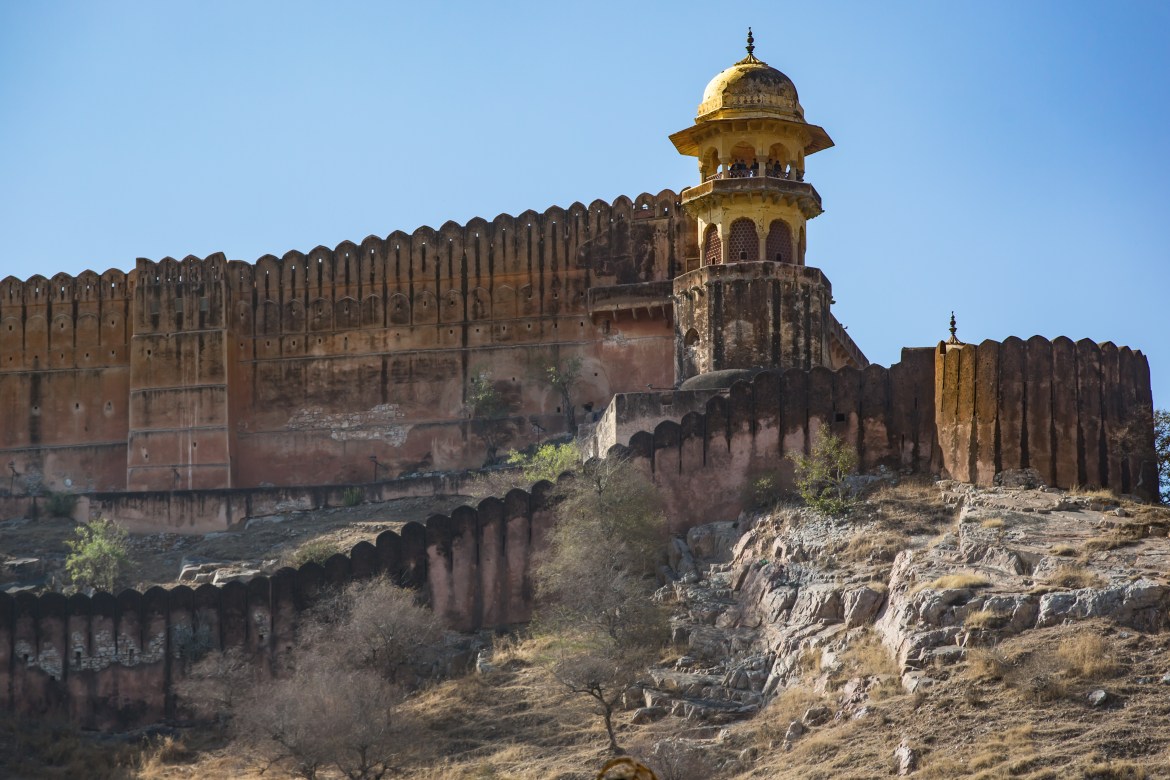
Amer Fort twin towers Jaipur with weathered stone walls under clear blue sky
The iconic twin towers of Amer Fort rise proudly over weathered walls, a timeless reminder of Jaipur’s royal legacy.
Amer Fort Jaipur – intricate floral stone inlay window design
A stunning jali window displays delicately carved blossoms framed by gilded motifs inside Amer Fort.
Jaigarh Fort defensive wall stairway in Jaipur Rajasthan
A dramatic stretch of Jaigarh Fort’s ancient stone wall snakes over the hillside in Jaipur.

🏛️ Story & Significance: The Soul of Amer Fort Jaipur

Where Rajput Valor Met Mughal Grace

Amber Fort isn’t just a palace—it’s a statement carved in stone and mirror. Rising above the old capital of the Kachhwaha Rajputs, it was both fortress and fairytale, built to dazzle guests while protecting a dynasty. Raja Man Singh I began construction in 1592, and successive rulers—most notably Mirza Raja Jai Singh I and Sawai Jai Singh II—expanded it into a full-scale royal residence. From its terraces, you can still imagine camel caravans winding through the valley below while court musicians played for the queen’s chambers. Today, visitors trace that same path: through massive gates, marble courtyards, and the breathtaking Sheesh Mahal, where thousands of tiny mirrors once multiplied a single candle into a universe of light. The fort’s layered purpose—defense, devotion, and decadence—makes it a living timeline of Jaipur’s rise, balancing the might of Rajput warfare with the refinement of Mughal artistry.

Notable People & Patrons

Raja Man Singh I, a trusted general of Mughal Emperor Akbar, first envisioned Amber Fort as a residence fit for diplomacy and spectacle. Later rulers added their mark: Mirza Raja Jai Singh I infused Persian aesthetics and expanded the courtyards, while his descendant Sawai Jai Singh II—the founder of Jaipur—refined the design before shifting the royal capital to his newly built Pink City in 1727. The result is a fort that feels like a family chronicle, each addition a new chapter in Rajasthan’s evolving style of power.

Architecture in a Nutshell

Amber Fort’s architecture is a conversation between Hindu and Mughal ideals. Crafted primarily from red sandstone and white marble, it’s divided into four main courtyards, each serving a unique purpose—from public audience halls to private zenanas (women’s quarters). Delicate jali (lattice) screens filter sunlight into geometric mosaics, while mirrored ceilings and frescoed arches showcase Rajput artisanship at its peak. The Sheesh Mahal and Sukh Niwas capture the fort’s ingenious side: one dazzles with reflection, the other channels cool air over flowing water to beat desert heat. Every balcony, gateway, and corridor seems designed for photographers long before cameras existed.

Living Traditions Today

Though royals left Amber centuries ago, the fort remains alive with ritual and rhythm. Each morning, priests still perform brief offerings at the Shila Devi Temple, dedicated to the warrior goddess Durga, echoing prayers once said before battle. Local musicians and dancers perform at dusk during light-and-sound shows that recount the fort’s legends in golden floodlight. Artisans sell hand-carved miniatures nearby, keeping alive the same crafts that once adorned the palace walls. Modern travelers may visit by jeep or foot instead of elephant, but the atmosphere of reverence and romance hasn’t changed—Amber still feels like Rajasthan in its purest form, suspended between myth and marble.

🧠 Fascinating Facts & Hidden Meanings

Where Geometry, Myth, and Mirrors Collide

Every inch of Amber Fort hides a whisper of symbolism or clever design, rewarding anyone curious enough to linger. The fort wasn’t simply a show of power—it was a coded masterpiece where architecture mirrored cosmic balance and ritual order. From secret passages connecting royal quarters to numerological patterns in courtyards, Amber is filled with details that bridge the earthly and divine. Look closer, and you’ll start to see that every mirror, staircase, and carving was more than ornament—it was storytelling in stone and light.

Five Quick “Did-You-Knows”

  • The Sheesh Mahal’s mirror mosaics are arranged so that a single candle could illuminate the entire hall—an early feat of light engineering symbolizing the triumph of knowledge over darkness.

  • The Ganesh Pol Gate bears sacred symmetry in its arches: seven lotus motifs to honor the chakras and invite spiritual harmony into the king’s court.

  • Beneath Amber runs a tunnel linking Jaigarh Fort, built as a hidden escape route and supply line—proof that beauty and battle readiness coexisted here.

  • The Maota Lake reflection was intentionally aligned with sunrise to double the fort’s grandeur during royal ceremonies—essentially creating a “mirror fort” on the water.

  • Local lore says the Shila Devi idol was carved from a single stone of the same material used in Bengal’s goddess temples, a divine import meant to fuse northern valor with eastern blessing.

A few links and ads here are affiliate portals. If you click through and snag something, you’ll be fueling my next photo-quest at no extra cost to you. Thanks for keeping the adventure rolling!

If you want to experience Amber Fort (and the rest of Jaipur’s royal circuit) without missing a single story or secret passage, a guided tour is worth every rupee. I’d recommend starting with the 2-Day Jaipur Tour for First-Time Visitors — it balances palaces, bazaars, and fort photography, with enough time to linger over those honey-lit terraces at Amber. You’ll get a crash course in Rajput history and access to some hidden angles photographers love (plus a comfortable pace between the city’s steep climbs).

For travelers short on time, the Full-Day Jaipur Private Sightseeing Tour by Car with Guide  delivers the greatest hits—Amber Fort, City Palace, Jantar Mantar, and the Hawa Mahal—with your own driver-guide who knows every photo vantage point. It’s the easiest way to move between Jaipur’s pink alleys and the hilltop fortress without losing hours to navigation or parking chaos.

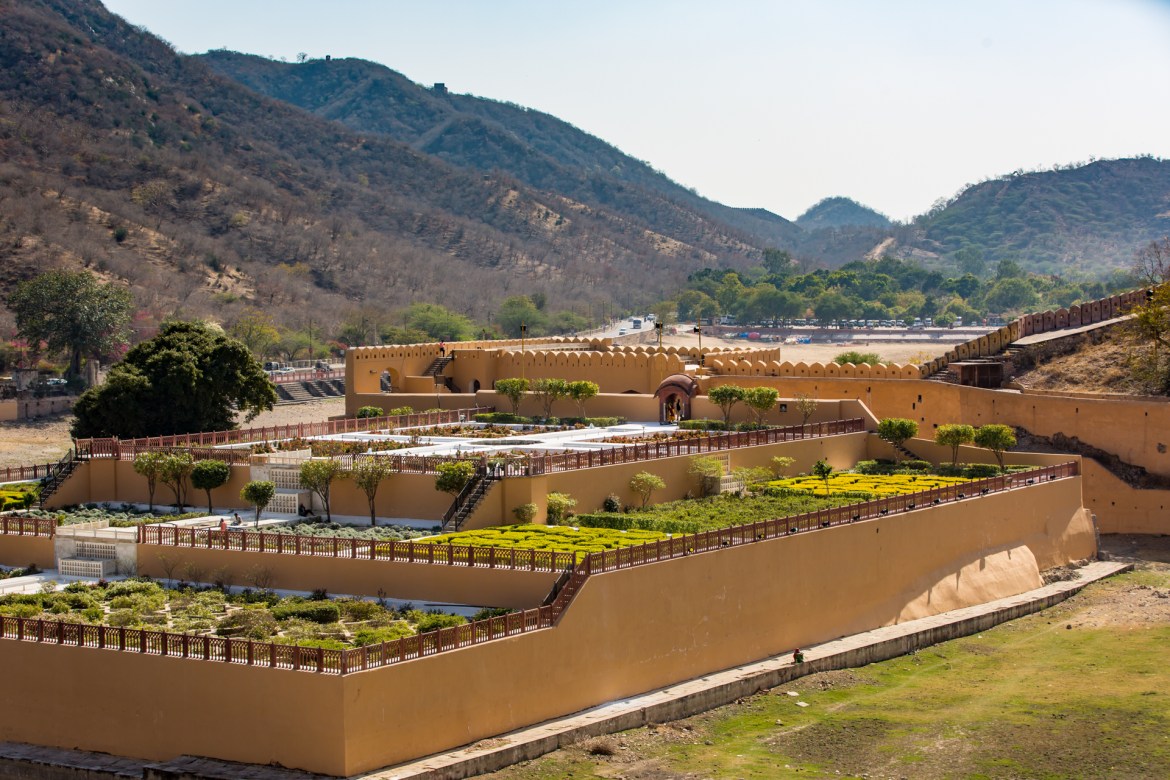
Amer Fort Jaipur overlooking lush gardens with visitors strolling below
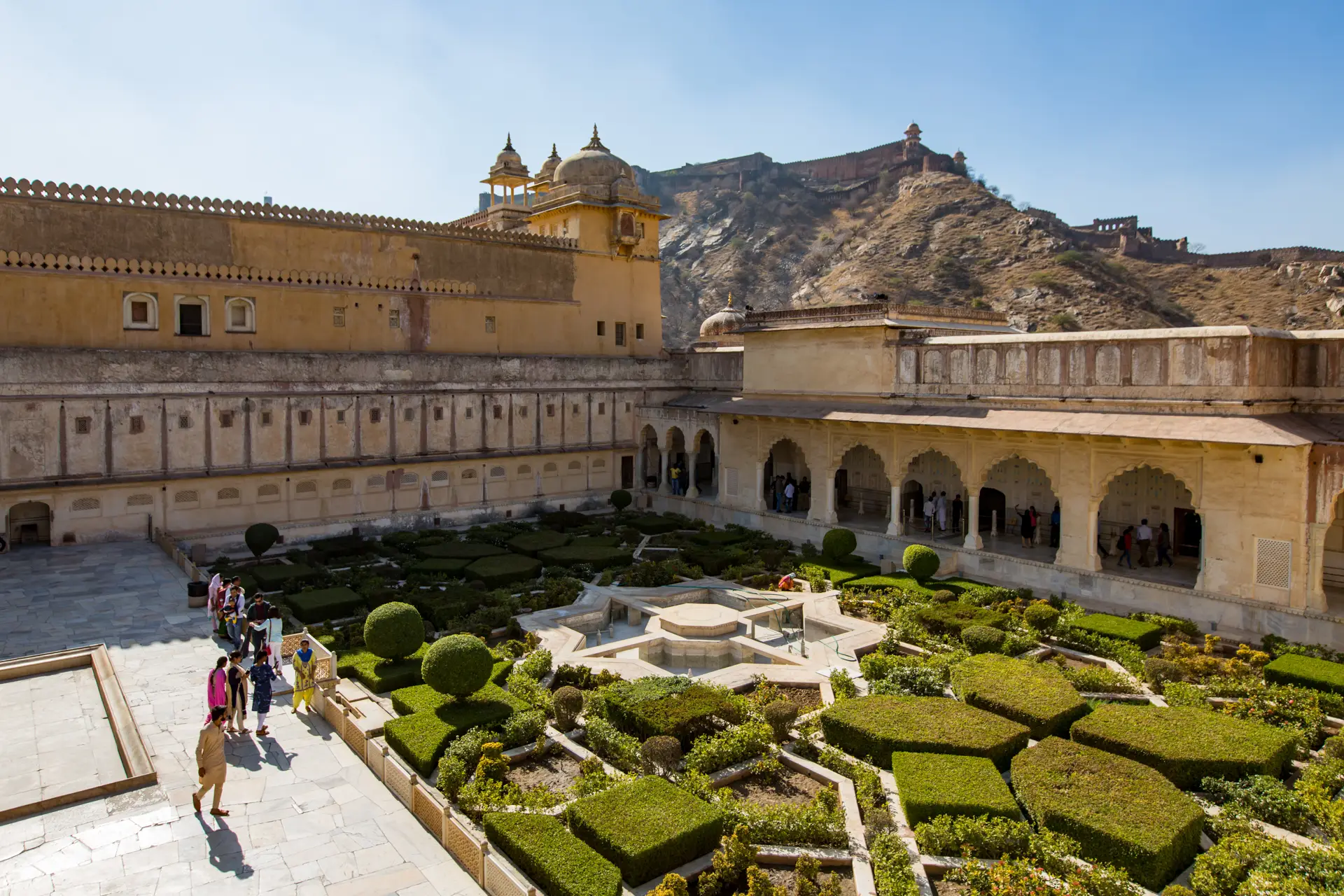
From the ramparts of Amer Fort, the manicured gardens unfold below, blending Mughal precision with Rajasthani charm.
Amer Fort Ganesh Pol gate painted domes Jaipur Rajasthan
The painted domes of Amer Fort’s Ganesh Pol glow under Rajasthan’s brilliant blue sky.
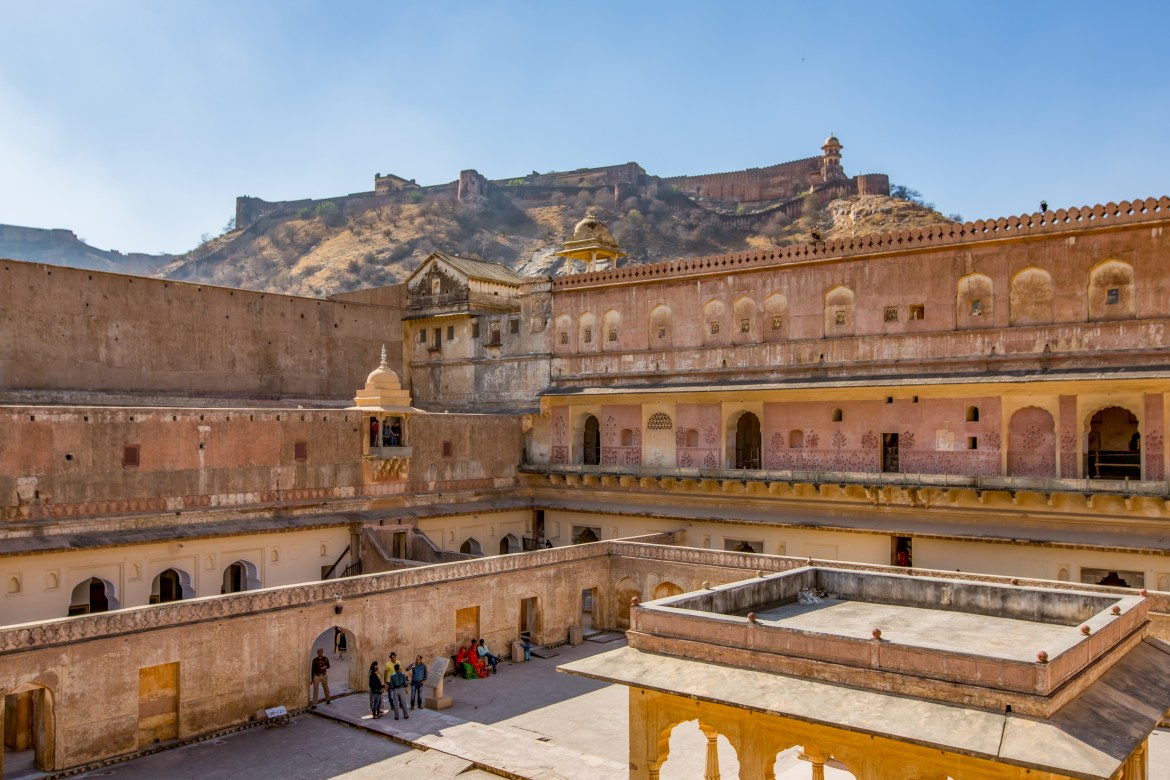
Amer Fort Jaipur – Diwan-i-Aam Hall of Public Audience with tourists
Visitors explore the grand colonnade of the Diwan-i-Aam beneath a flawless Jaipur sky.

📌 Plan Your Visit: Hours, Tickets & What to Expect

Budget 2–3 hours for Amber Fort itself (more if you pair it with Jaigarh Fort via the hillside tunnel or road). Crowds crest from 10:00–13:00; the sweet spots are right at opening and again late afternoon when golden light kisses the courtyards. Tickets are checked at the main entry before Jaleb Chowk and again as you pass toward Ganesh Pol into the private palaces; small side doors may have separate attendants—keep your stub handy. A few restored chambers (including parts of the Sheesh Mahal) and select passages are guided-access only or tied to add-on experiences; if you want those, plan them first and build the rest of your wander around confirmed time slots.

🎫 Ticketing Tips — Buy online the day before to skip the base-area queues, and screenshot your QR in case cell data drops on the hill. Combo options sometimes bundle Amber with Jantar Mantar/City Palace style sights—compare totals before you commit. Note the light & sound show requires a separate ticket. Refunds and date changes can be strict on peak days; assume no-refund unless clearly stated.

🎉 Festival/Peak-Day Watch — Expect heavier crowds and traffic slowdowns during Diwali, Holi, Teej, and major wedding weekends; gates can bottleneck and inner rooms may operate one-way flows. Arrive before 9:00 or go after 15:30 on these days, and pad transfers between Amber and central Jaipur by 20–30 minutes. If a VIP visit or filming is underway, some courtyards close temporarily—have a flexible order (Jaleb Chowk → Diwan-i-Aam → Ganesh Pol → Zenana → Ramparts) so you can pivot without losing the light.

Location Amer (Amber), 11 km north of central Jaipur; overlooks Maota Lake
Core Visiting Hours Typically ~8:00 AM – 5:30 PM for day visit; separate night entry window often runs ~6:30 PM – 9:00 PM. Check the day’s schedule before you go.
Sound & Light Show Evenings on the fort lawns (Kesar Kyari / Maota Lake area). Common timings show English ~7:30 PM, Hindi ~8:00 PM (seasonal shifts possible). Separate ticket required.
Time Needed 2–3 hours for Amber Fort alone; add 60–90 minutes if pairing with the Jaigarh Fort connection.
Best Crowd Windows Opening hour and late afternoon (golden light). Peak flow 10:00–13:00.
Tickets & Checks Main check at the hilltop entry before Jaleb Chowk, with secondary checks near Ganesh Pol into the private palaces. Keep your stub/QR handy.
Typical Entry Fees Day visit commonly posted as (local pricing varies by category); Sound & Light Show often ~₹250–₹300. Verify on the day for the exact slate.
Guided-Only Areas Select restored chambers (parts of Sheesh Mahal, passages) may require a guide or special add-on slot; confirm availability at the gate.
Tripods & Drones Handheld photo/video is broadly allowed; tripods typically not permitted inside main palace areas without prior permission. Drones are restricted.
Getting There App cabs/taxis from Pink City (~25–40 min with traffic). Final ascent by jeep or on foot via the ramp. (Elephant rides operate mornings only and are subject to policy/fee changes.)
Pair It With Jaigarh Fort (hill-crest armory views) via tunnel/road; optionally Panna Meena ka Kund stepwell and Jagat Shiromani Temple in Amer town.
Amenities Basic restrooms, small cafés/vendors near the entrance; bottled water strongly recommended. Shade is limited in mid-day courtyards.
Accessibility Historic ramps, cobbles, and stairs throughout; inner courtyards are spacious but uneven. Jeep drop-off shortens the climb; allow extra time for mobility needs.

🚶 Getting There, Entry & Accessibility

Getting There, Entry & Accessibility — Smooth Arrival to First Courtyard

Most visitors approach Amber (Amer) Fort from the Maota Lake side, where jeeps shuttle you up the hill or you can walk the broad ramp (about 10–20 minutes depending on pace). If you’re arriving by car or rideshare, expect to be dropped at the base area and then transfer to the jeep stand; buses usually park farther back with a short walk in. Security and bag checks happen at the hilltop gate before you enter Jaleb Chowk, and tickets/QRs are scanned again as you move toward Ganesh Pol into the private palaces. Courtyards are spacious but surfaces are uneven—cobbles, stone thresholds, and occasional steps—so budget a little extra time for footing and photo stops. If mobility is a concern, take the jeep both ways, explore one courtyard at a time, and use shaded edges to rest between climbs.

Parking & Drop-offs
Private vehicles and tours use the base-area lots near Maota Lake; attendants will direct you to the nearest available space during busy hours. Expect standard city rates and time windows aligned with fort visiting hours; lots can fill by late morning on weekends and festivals. Rideshares typically drop at the jeep/ticket zone—set your return pickup there rather than at the hilltop to avoid congestion. If you’re pairing Jaigarh Fort, drivers can wait or reposition above the ridge; confirm the rendezvous before you go inside.

Accessibility Notes
Pathways are primarily stone ramps and cobbles with intermittent stairs; there are no elevators in the palace sequence. Handrails are limited, but benches and shaded ledges appear around courtyard perimeters—use them as catch-your-breath spots. Accessible restrooms are closest to the main entry cluster; inside, facilities are simpler. Wear supportive shoes with good grip; you’ll remove footwear only if you step into the Shila Devi Temple (carry a light pair of socks if the stone is hot).

Wayfinding Inside
Think of Amber as four main courtyards in a gentle climb: Jaleb Chowk → Diwan-i-Aam (Public Hall) → Ganesh Pol into the private palaces (Sheesh Mahal/Sukh Niwas) → Zenana quarters and terraces. On crowded days, some passages run one-way; follow guards’ cues to avoid backtracking. Good “meet-back” anchors are the center of Jaleb Chowk (easy sightlines) and the arcade of the Diwan-i-Aam. If you’re combining with Jaigarh, ask staff for that connection before you start, so you can time your route to the tunnel/transfer without retracing steps.

Red sandstone pavilion at Amer Fort Jaipur with pigeons perched
A sandstone pavilion in Amer Fort becomes a perch for Jaipur’s resident pigeons.
Intricate jali stone latticework at Amer Fort in Jaipur casting patterned shadows
Sunlight streams through Amer Fort’s jali windows, casting mesmerizing geometric shadows on the floor.
Amer Fort garden courtyard Jaipur Rajasthan
Visitors stroll through the manicured Mughal gardens inside Amer Fort’s grand courtyard in Jaipur.

🧭 How to Explore: Smart Routes for Any Timeline

Amber (Amer) Fort reads best as a rising sequence: you enter into the bustle of Jaleb Chowk, then climb into ceremony at the Diwan-i-Aam, slip through Ganesh Pol into glittering intimacy at Sheesh Mahal and the breezy Sukh Niwas, and finally exhale on the zenana terraces with Maota Lake and Kesar Kyari garden below. The rhythm is courtly: public → privileged → private → panoramic. Light evolves with you—cool shade and latticed patterns at first, then mirrored sparkle, and a golden finale across the ramparts. Photographers should keep one eye on the arches for framing and the other on reflective stone floors that double your compositions. End by looking back from the upper terraces: the fort you just walked becomes a layered backdrop to your last portrait or wide-angle sweep.

⏱️ 60-Minute “Essentials”
Start at Jaleb Chowk and glide straight to the Diwan-i-Aam for your first symmetrical frame under arcades. Pass through Ganesh Pol (pause for close-ups of floral inlay) into the Sheesh Mahal corridor—capture one tight mirror mosaic and one environmental shot. Exit via Sukh Niwas for a cooling moment by the water channel and finish on the zenana terrace with a wide shot over Maota Lake. You’ll leave with one hero façade, one intimate detail, and one balcony panorama.

⏱️ 90–120 Minutes “Deeper Look”
Do the Essentials loop, then linger: circle back to the ramparts for layered walls and leading lines, and add the small Museum/arms exhibit (when open) for context and quieter corners. Detour into a side courtyard near the queens’ apartments where jali screens throw patterned shadows—perfect for portraits. Time your final climb so you reach the upper terrace as sun slides warm along the sandstone and the Kesar Kyari garden glows below.

⏱️ Leisure Visit (2–3 Hours)
00:00–00:15 — Jaleb Chowk → Diwan-i-Aam: establish the scale; shoot a centered, low-angle symmetry as crowds are still thin.
00:15–00:45 — Ganesh Pol → Sheesh Mahal: your first hero view is the painted arch framing the courtyard; your detail is mirror tile meeting carved marble.
00:45–01:20 — Sukh Niwas → Zenana: grab a reflective moment beside the water channel, then a quiet portrait in lattice shade.
01:20–01:35 — Quick Local Snack: step back to the entrance cluster for bottled water + a savory kachori or samosa; hydrate and reset.
01:35–02:15 — Ramparts/Upper Terrace: second hero view—compressed layers of walls and the chessboard of Kesar Kyari; shoot one wide and one telephoto.
02:15–02:45 — Optional Jaigarh Connection (if open/time allows): peek toward the ridge for context, then return for a last glance over Maota Lake before you descend.

Just Beyond: Jaipur Travel Guide

Step outside the palace walls and dive into the vibrant rhythm of Jaipur—the Pink City that paints history in rose tones and markets in technicolor. From the iconic Hawa Mahal to the hilltop Amber Fort and night bazaars pulsing with sound and spice, our full Jaipur guide captures it all with photo-forward itineraries, festival insights, and practical tips. Find out where to chase the best light, the best lassi, and the most breathtaking rooftops overlooking this royal city of Rajasthan.

View Our Jaipur Guide

🖼️ Spaces & Highlights You’ll Love

Amber (Amer) Fort is a choose-your-own-adventure carved in sandstone and marble, and each courtyard reads like a new chapter. Start with the public drama—arches, drumbeats, and the hum of Jaleb Chowk—then slip into intimate rooms where mirrors multiply a single glance into starlight. As you climb, the air cools over water channels and the city view widens, turning your photo frames into layered landscapes. Don’t rush: pause in doorways, let your eyes adjust to low light, and trace patterns with your feet as well as your lens. By the time you reach the terraces, you’ll feel the story finishing exactly where it should—on a breeze-kissed balcony over Maota Lake and the jeweled geometry of Kesar Kyari.

Sheesh Mahal (Mirror Palace)
This is Amber’s showstopper: a chamber where thousands of inlaid mirrors catch the faintest light and fling it across carved marble like a private constellation. Step close to see floral vines and starbursts in glass; then step back for a wider frame that captures the room’s glow without crowds. Low ISO, steady hands, and a half-step off the main flow buy you cleaner reflections. Linger a minute—when your eyes settle, subtle colors bloom in the mirrorwork, and that’s your moment.

Ganesh Pol (Painted Gate to the Private Palaces)
Ganesh Pol is the ceremonial threshold between public power and private grace, painted with peacocks, lotus curls, and jewel-toned arches. It’s a masterclass in framing: line up your shot so the arch embraces the courtyard beyond, or go tight on a single motif to let the pigments speak. Morning light rakes across the reliefs, revealing textures that mid-day glare flattens. Take a quiet beat beneath the vault and you’ll hear the palace exhale—this is where the fort changes tempo.

Sukh Niwas & the Water Channel (Cool Hall of Comfort)
Here the desert meets ingenuity: breeze drawn over a narrow water run chills the air and softens the room’s mood. The teak doors, blue-washed niches, and gentle arcades feel instantly human—royal, yes, but designed for lingering conversation and summer afternoons. Compose with the channel as a leading line toward a doorway, or tilt up to catch repeating curves floating above the cool. It’s the calm between bright courtyards and the final climb to the terraces—let it slow your pulse before the panorama.

Amer Fort Jaipur golden walls reflecting in Maota Lake
The golden sandstone of Amer Fort reflects perfectly in Maota Lake under Jaipur’s bright sky.
Amer Fort Jaipur – interior room with painted ceiling motifs and arched niches
Intricate floral ceiling designs crown an empty chamber washed in warm desert light.
Amer Fort Jaipur – antique brass lantern with perched pigeon
A lone pigeon perches atop an antique brass lantern hanging beneath the palace’s aged ceiling vaults.
Amer Fort Jaipur – antique black cannon on wheels outside palace wall
An iron cannon rests on heavy wooden wheels beside the sunlit sandstone walls of Amer Fort.

🍽️ Nearby Pairings & Pleasant Pauses

After Amber’s mirror-lit halls, keep the vibe mellow with easy add-ons close by. Stroll down to Panna Meena ka Kund for geometric serenity and a quick wide-angle study; late afternoon gives warm raking light on the stepwell’s zigzags. Duck into Jagat Shiromani Temple to admire quiet stone carving and gentle shade—perfect when the courtyards feel bright. For a breather (and a lens wipe), pop into the Anokhi Museum of Hand Printing in Amer town; its small galleries and café make a low-stress reset between sites. Cap the day on a Maota Lake rooftop with chai as blue hour switches on Jaipur’s glow—soft, forgiving light for portraits and skyline frames without the rush.

Family-Friendly Stops
Benches cluster along Jaleb Chowk’s edges and by the lakefront below; they’re reliable meet-up points with clear sightlines. Ice-cream and snack vendors work the base area most afternoons. The stepwell is photogenic but steep—strollers struggle on the stairs, so plan a short look rather than a full descent. For calmer pacing, the Anokhi Museum offers small rooms, seating nooks, and easy restroom access.

Rain/Heat Refuge
When the sun bites, the breezy arcades of Sukh Niwas and shaded lanes in Amer town give quick relief. The Anokhi Museum provides air-cooled galleries and a café for unhurried breaks. If showers roll in, temple interiors at Jagat Shiromani stay peaceful and dry, and covered shopfronts along the main lane let you wait out a squall without losing your spot in the afternoon light.

🎥 Reels on the Road

Amber Fort is a cinematographer’s playground, where every turn of a corridor gives you a new play of shadow, reflection, and royal rhythm. The fort’s long ramps are built for elegant pans, while its courtyards offer space to catch candid moments—footsteps echoing through arches, mirrors glinting like sequins under shifting light. Use transitions that mimic the fort’s climb: start low at Maota Lake, then ascend through gates, courtyards, and terraces so your reel feels like a journey upward through centuries. Golden hour wraps the stone in honeyed tones; blue hour, by contrast, makes the marble glow under floodlights for an otherworldly finale. Capture snippets of local musicians or the soft hum of evening crowds to layer in texture—sound and movement tell Amber’s story better than filters ever could.

🎥 Jaleb Chowk — Begin with a slow, rising pan from the fort walls to the bustling entry court as morning crowds arrive, using footsteps and chatter for ambient sound.
🎥 Ganesh Pol Gate — Frame a smooth push-in through the painted arch while the camera glides toward the light; perfect transition clip from outer court to private palaces.
🎥 Sheesh Mahal — Go handheld for sparkle: capture mirror reflections dancing across the walls as a candlelight glimmer or phone flashlight passes by.
🎥 Sukh Niwas Water Channel — Shoot a gentle dolly along the running water; use slow motion to highlight droplets catching sunlight.
🎥 Zenana Terrace & Maota Lake View — Finish with a 360° spin during golden hour showing the layered walls cascading down to the lake.
🎥 Evening Sound & Light Show — End your reel with 5 seconds of floodlit fort outlines fading into deep blue sky—timelapse or wide still-motion sequence works beautifully.

🧳 What to Pack for Picture-Perfect Memories

Jaipur’s sun and sandstone can be equally dazzling, so start smart: carry plenty of water, a broad-brimmed hat, and light, respectful clothing that covers shoulders and knees—it keeps you cooler and shows respect at the Shila Devi Temple. Slip a pair of socks in your daypack for shoe-off areas, and a small towel or lens cloth to handle both sweat and dust. Mid-day heat can be intense, so a compact umbrella or scarf doubles as shade. Photographers should travel light: a single camera body, two lenses, and a discreet stabilizer will cover every courtyard without wearing you down. Keep gear compact, stay hydrated, and you’ll have the freedom to linger wherever the light feels right.

👉 The Nomad’s Kit: Gear That Earns Its Miles

Canon RF 15–35mm f/2.8L — Ultra-wide for mirrored ceilings in Sheesh Mahal, grand courtyards, and winding ramp paths where stepping back means “hello, elephant.”
Canon RF 24–105mm f/2.8L — Your fort-to-lake workhorse: portraits framed in arches, mid-tele fresco and carving details, quick street vignettes in the Jaigarh market below.
Canon RF 100–500mm f/4.5–7.1L IS USM — From ramparts or Jaigarh Fort above, compress domes, watchtowers, and Maota Lake; isolate ornate windows or visitors in vibrant dress from afar.
Lowepro ProTactic BP 350 AW III — Security- and crowd-friendly; keeps filters, scarf, and water organized through narrow passageways and checkpoints.
Peak Design Travel Tripod — Full tripods are not permitted inside; use in the outer ramparts or gardens for sunrise or twilight panoramas.
JOBY GorillaPod 3K Kit — Clamp to balcony railings or marble ledges for silky fountain or light-trail shots—tiny footprint, perfect balance.

Cut Glare. Shape Time. Make Every Frame Sing.
Amber Fort dazzles in light and reflection—gold, marble, mirror, and water. A circular polarizer tames glare on polished plaster and mirrored glass, drawing out natural sandstone tones. A variable ND lets you slow the royal rhythm—turn moving crowds into soft motion, still fountain ripples, and make sunlight shimmer through lattice screens like painted light.

🌞 Control Reflections & Punch Up Color
Circular Polarizer Filter — Reduce glare on mirror mosaics and marble inlay, deepen the blue above Maota Lake, and reveal the subtle rose in sandstone under morning sun. Pro tip: rotate gently indoors—over-polarizing can darken reflective tiles and kill that warm, luminous glow Amber is famous for.

⏱️ Drag the Shutter in Courtyard Light
Neutral Density Variable Filter — Drop 3–6 stops to blur foot traffic in the Diwan-i-Aam, smooth water in Maota Lake, and turn drifting clouds behind the fort into streaks of drama. Pro tip: start around 1/4–1 s for people blur; go 2–10 s for silky water and sky trails.
Pack both for any fort day: the polarizer reveals Amber’s intricate detail; the ND sculpts its grandeur. Together, they bring the past to life.

Photo Policy RemindersNo flash in Sheesh Mahal or temple interiors; tripods/stands are not allowed inside the complex without special permission. Drones are prohibited around Jaipur’s heritage zone. Respect rope lines and guards—do not touch frescoes or climb battlements. Dress modestly, keep walkways clear for elephants and visitors, and visit early or late for the fort’s best light—Amber glows most when the sun and stone are in quiet conversation.

💰 On-Site Costs Snapshot

Plan for the basics: a day entry ticket, a licensed guide (highly worth it for context and access flow), and a drink/snack near the gate. If you love pageantry, upgrade to the evening Light & Sound Show; it’s inexpensive and photogenic at blue hour. Families or mobility-minded travelers sometimes add the jeep shuttle from Maota Lake; photographers chasing a once-in-a-trip perspective may consider the (limited, mornings-only) elephant ride—note the new, higher rate.

Item Typical Cost (INR / ~USD) Notes & When It’s Worth It
Day Entry — Foreign Visitor ₹500 (≈$6) Standard daytime admission; plan 2–3 hours to enjoy main courtyards and highlights.
Day Entry — Indian Visitor ₹50–₹100 (≈$0.60–$1.20) Local pricing varies by category; confirm posted rates at the gate.
Light & Sound Show (Evening) ~₹295 (≈$3.50) Separate ticket; beautiful blue-hour ambiance and narration.
Licensed Guide (Private) ₹1,500–₹2,000 (≈$18–$24) For ~2–3 hours; best upgrade for context, pacing, and photo angles.
Jeep Shuttle (Base ↔ Hilltop) Posted on site (per person) Saves the uphill ramp walk; buy at the Maota Lake stand.
Elephant Ride (Morning, Limited) ~₹2,500 per ride Operates mornings only; policies/availability can change—verify same day.
Bottled Water + Snack ₹40–₹150 (≈$0.50–$1.80) Vendors near the entrance; quick reset between courtyards.

Just Beyond: Agra & Taj Mahal Travel Guide

Follow the road east from Jaipur to the city that defined Mughal grandeur. Our full Agra & Taj Mahal Travel Guide unlocks the marble masterpiece at dawn, explores Agra Fort, Itimad-ud-Daulah, and riverside gardens, and shares the best spots for reflection shots across the Yamuna. Learn when to visit for crowd-free views, where to catch the pink-gold sunrise, and how to pair Agra’s timeless icons with street-side chai and local artisan workshops. It’s everything you need for a day steeped in history, light, and perfect symmetry.

View Our Agra & Taj Mahal Guide
Agra Travel Guide — Taj Mahal reflecting in the Yamuna River at sunrise

🤝 Etiquette & Respectful Visiting

How to Be a Gracious Guest at Amber Fort

Amber Fort still carries the dignity of its royal and spiritual past, so moving through it with quiet respect makes your visit richer. Dress with modesty—covered shoulders and knees are expected, especially near the Shila Devi Temple, where you’ll also remove shoes before entering. Keep voices low in echoing halls and during any local prayer moments; it’s fine to observe from a short distance, but avoid photographing worshippers directly. Step aside for elders, staff, and tour groups on narrow stairways, and resist the urge to touch mirror panels or frescoed walls—body oils damage centuries of craftsmanship. Finally, tip musicians or guides with small notes, carry your trash back to the bins near Jaleb Chowk, and smile often—politeness in Rajasthan travels farther than you think.

Jaipur street vendor preparing traditional Indian snacks
A local vendor prepares colorful chaat along Jaipur’s bustling streets.
Amer Fort fortress walls and gates in Jaipur Rajasthan
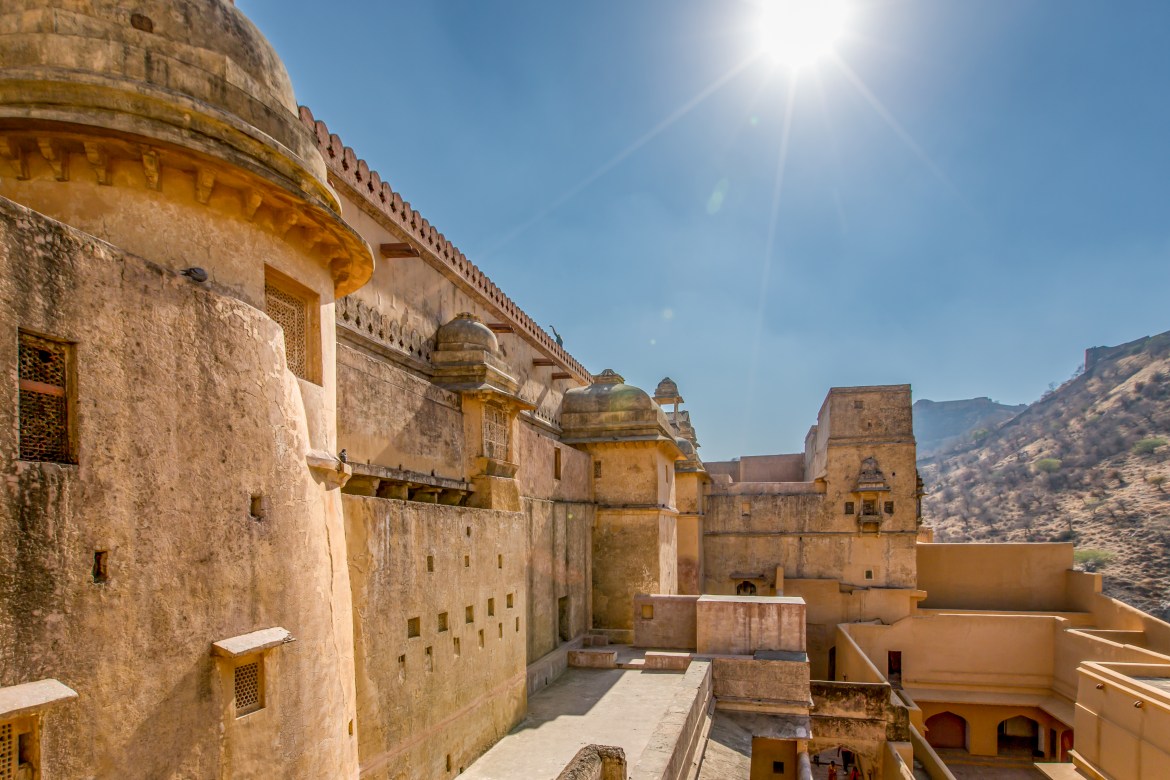
The golden-hued walls of Amer Fort dominate the hillside outside Jaipur under a clear blue sky.
Mirror Palace Sheesh Mahal interior Amer Fort Jaipur
The Sheesh Mahal glimmers with thousands of mirror tiles reflecting golden light.

🕰️ Historical Timeline at a Glance

Seeing Amber through time sharpens your eye: once you know who built what, you’ll spot the shift from rugged Rajput defenses to polished Mughal-influenced elegance—stone ramparts giving way to marble inlay, mirror mosaics, and cooling water channels. These milestones also explain room purpose: audience halls for power, private suites for pleasure, temples for protection—so every arch and courtyard suddenly makes narrative sense.

Year / Period Milestone What to Notice On-Site
c. 11th–13th c. Early Amer hill settlement takes shape Fortified ridgelines and strategic siting above Maota Lake—defense first, décor later.
1592 Raja Man Singh I begins Amber Palace complex Heavier red sandstone, barracks logic, broad courts like Jaleb Chowk for military display.
Early 1600s Public audience zones formalized Diwan-i-Aam symmetry for ceremony; arches sized for crowd flow and acoustics.
c. 1620s Ganesh Pol gateway embellished Painted peacocks, floral inlay, and a threshold separating public power from private grace.
Mid-17th c. Sheesh Mahal (Mirror Palace) perfected Micro-mirror mosaics and marble reliefs—watch how a tiny light blooms across the ceiling.
17th c. Sukh Niwas cooling systems refined Water channel as natural A/C; blue niches and teak doors made for summer comfort.
1690s–1720s Private suites & zenana terraces expanded Lattice (jali) screens for privacy and patterned light—portrait heaven at the queens’ courts.
1727 Capital shifts to planned city of Jaipur Amber’s role becomes ceremonial; note the blend of lived-in wear and showpiece rooms.
18th–19th c. Link with Jaigarh Fort maintained Hidden passage logistics—beauty below, armory above; the ridge explains Amber’s survival story.
20th c. Conservation & tourism era Restorations stabilize mirrorwork and frescoes—watch for areas signed with recent repairs.
21st c. Sound-and-light storytelling & access tweaks Evening floodlights reveal façade geometry; guided-only zones manage fragile interiors.

📓 Through My Lens: Field Notes from the Road

Day 3 of my India journey started before sunrise with a train ride from Agra, still buzzing from the memory of the Taj Mahal, to the rose-hued sprawl of Jaipur. By midmorning, I’d met my local guide Shahid—a proud, friendly Jaipur native who navigated the city like it was an extension of his own smile. He zipped me through streets alive with horns, spice scents, and bursts of color in his trusty tuk tuk, ticking off sights like postcards: Hawa Mahal, City Palace, Jaigarh Fort, Jal Mahal, and finally the majestic Amber Fort. Amber was everything I’d imagined Rajasthan to be—graceful, golden, and grounded in stories. I could’ve easily spent a full day wandering those marble corridors, tracing mirrorwork reflections, and watching shadows chase the afternoon light up the ramparts. Every courtyard felt like an open-air museum of craftsmanship, every view from the terraces a reminder of how much beauty one day can hold. Leaving as the sun dipped behind the Aravalli hills, I promised myself I’d return—not just to photograph the fort, but to feel its rhythm again without rushing.
☀️ When to Go & Weather Sweet-Spots

Jaipur’s Golden Hours at Amber — chase honeyed stone, dodge harsh sun, and let the monsoon do the mood lighting

Amber Fort rewards timing. From October to March, mornings are crisp and the courtyards glow—shade lines and breeze corridors make wandering easy, and blue hour feels downright cinematic. April to June brings searing heat; plan dawn entries, linger in breezy spots like Sukh Niwas, and save terraces for the softer late light. July to September is monsoon season: showers roll through in bursts that clear the air, deepen colors, and give you dramatic cloud backdrops (carry a light poncho and protect your gear). Crowd-wise, winter holidays and festival weeks pack the gates; shoulder weeks just before/after are the sweet spot for travelers and photographers alike.

🌞 Season 🧘‍♂️ Vibe Check 🌦 Rain Factor 🏛 Tourist Traffic
🌴 Winter (Dec–Feb) Cool mornings, crystal light, long golden hours; perfect for slow exploring. Minimal; clear skies most days. High—holiday season and peak tourism; arrive early.
🌸 Spring (Mar–Apr) Warm, lively, festival energy; soft morning/late-afternoon light. Low; occasional haze on hot days. Moderate rising to busy around holidays.
☀️ Summer (May–Jun) Intense heat—plan dawn entries, seek shade and breeze-cooled halls. Very low rain, high glare; heat shimmer mid-day. Lower than winter; fewer crowds but tougher conditions.
🍂 Fall/Monsoon (Jul–Sep) Moody skies, saturated colors; dramatic clouds over ramparts. Frequent bursts; carry rain cover for you + camera. Moderate; showers naturally thin mid-day crowds.
🌧️ Rainiest Months: July–August (with lingering showers into early September)
🎯 Peak Tourist Season Months: December–January, plus festival weeks (Diwali/late Oct–Nov))
🏖️ Off-Season Sweet Spot Months: Late September–October and late February–March)
💡 Insider Pro Tip: Hit the gate at opening for quiet mirrors and clean frames, then return at blue hour for floodlit façades—two different Ambers in one day.

🛡️ Practical & Safety Notes

Amber Fort is generally welcoming and safe, but a little awareness keeps the day smooth. Watch for pickpockets in tight gateways like Ganesh Pol and near ticket queues—keep small cash in front pockets or zipped pouches. After rain, the marble floors and ramp stones can turn slick; step carefully, especially on downhill slopes toward Maota Lake. At closing time, crowds release quickly and the lower ramps can bottleneck—wait a few extra minutes inside or at the upper terraces to let traffic clear. Set clear regroup points such as Jaleb Chowk’s center or the Diwan-i-Aam arcade if your group spreads out; they’re easy to spot and shaded.

🗣️ Cheat Sheet for Friendly Encounters while in Amer Fort Jaipur

Handy Hindi for Amber & Jaipur Explorers

In Jaipur, a few words of Hindi go a long way toward turning a transaction into a conversation. While many guides and shopkeepers speak English, locals light up when you greet them with a simple “Namaste” or thank them with “Dhanyavaad.” Learning even a handful of phrases shows respect and often earns you a warmer smile, a better photo angle, or even an unexpected story about the fort’s past. It also helps photographers and travelers navigate gracefully—whether you’re asking for permission to shoot, buying a snack near Maota Lake, or chatting with your tuk-tuk driver about his favorite viewpoint. A touch of local language is the fastest route to connection, and Jaipur’s easygoing rhythm makes it fun to try.

🇺🇸 English 🇮🇳 Hindi 📖 Phonetic Spelling
Hello / Greetings नमस्ते Namaste
Thank you धन्यवाद Dhanyavaad
Please कृपया Kripya
Yes / No हाँ / नहीं Haan / Nahin
How much does it cost? यह कितने का है? Yeh kitne ka hai?
Where is the restroom? शौचालय कहाँ है? Shauchalay kahaan hai?
Can you take my photo? क्या आप मेरी फोटो ले सकते हैं? Kya aap meri photo le sakte hain?
Beautiful! सुंदर! Sundar!
Excuse me / Sorry माफ़ कीजिए Maaf kijiye
Good morning सुप्रभात Suprabhat
Good night शुभ रात्रि Shubh raatri
Where is Amber Fort? आमेर किला कहाँ है? Amer kila kahaan hai?
Let's go! चलो! Chalo!
Too crowded! बहुत भीड़ है! Bahut bheed hai!
I love Jaipur! मुझे जयपुर पसंद है! Mujhe Jaipur pasand hai!

Lens & Latitude – Chasing Peaks at Mount Rainier

Behind the Lens

I’m Steve—a retired Army vet who traded ruck sacks for camera bags and now chases light across every latitude I can reach. From 110 point & shoot film camera beginnings to a Canon R5 Mark II and Mavic Pro II drone, I’ve logged shots in 36 countries and all 50 states, squeezing solo photo runs between corporate flights and longer adventures with my wife. Shutter Nomadica is where I share the hits, misses, and field notes so fellow roamers can skip the guesswork and grab the shot!


Leave a Reply

Discover more from Shutter Nomadica

Subscribe now to keep reading and get access to the full archive.

Continue reading