Ayutthaya Historical Park: A Deep Dive into Siam’s River-Island Capital

Ayutthaya Historical Park: Where Ruins Glow and Rivers Tell Stories

Rising from the plains north of Bangkok, Ayutthaya Historical Park feels less like a ruin and more like a dream the earth refused to forget. Once the glittering heart of Siam’s empire, this UNESCO World Heritage site is a hauntingly beautiful mosaic of crumbling stupas, serene Buddha faces, and banyan trees that seem to cradle history itself. Walk its ancient grounds and you’ll feel time loosen — incense curling in the heat, cicadas buzzing through still air, and the river glinting where kings once sailed.

For travelers and photographers, Ayutthaya is a masterpiece of texture and light. Capture sunrise as mist drifts through Wat Chaiwatthanaram, frame the meditative calm of the Buddha head entwined in tree roots at Wat Mahathat, and chase golden-hour reflections across Wat Phra Si Sanphet’s towering chedis. It’s a landscape that rewards patience — every crumbling brick and flicker of candlelight whispers another story from centuries past.

The best time to explore is November–February, when the air is cooler and the light stays soft long into the day. Fly into Bangkok’s Suvarnabhumi Airport (BKK), then take a 90-minute train or car ride north — a journey that feels like slipping backward through time. Spend one to two full days wandering temple ruins, cycling the quiet lanes, and capturing those moments when the sunlight and history align just so. Because in Ayutthaya, the past doesn’t fade — it waits, golden and eternal, for you to find it.

Wat Mahathat Buddha head entwined in tree roots Ayutthaya
One of Thailand’s most iconic sights peers out from a living frame—Buddha calm, tree resolute. The bark’s silver gray wraps the serene face like time’s own reliquary. It’s quiet, intimate, and unmistakably Ayutthaya.
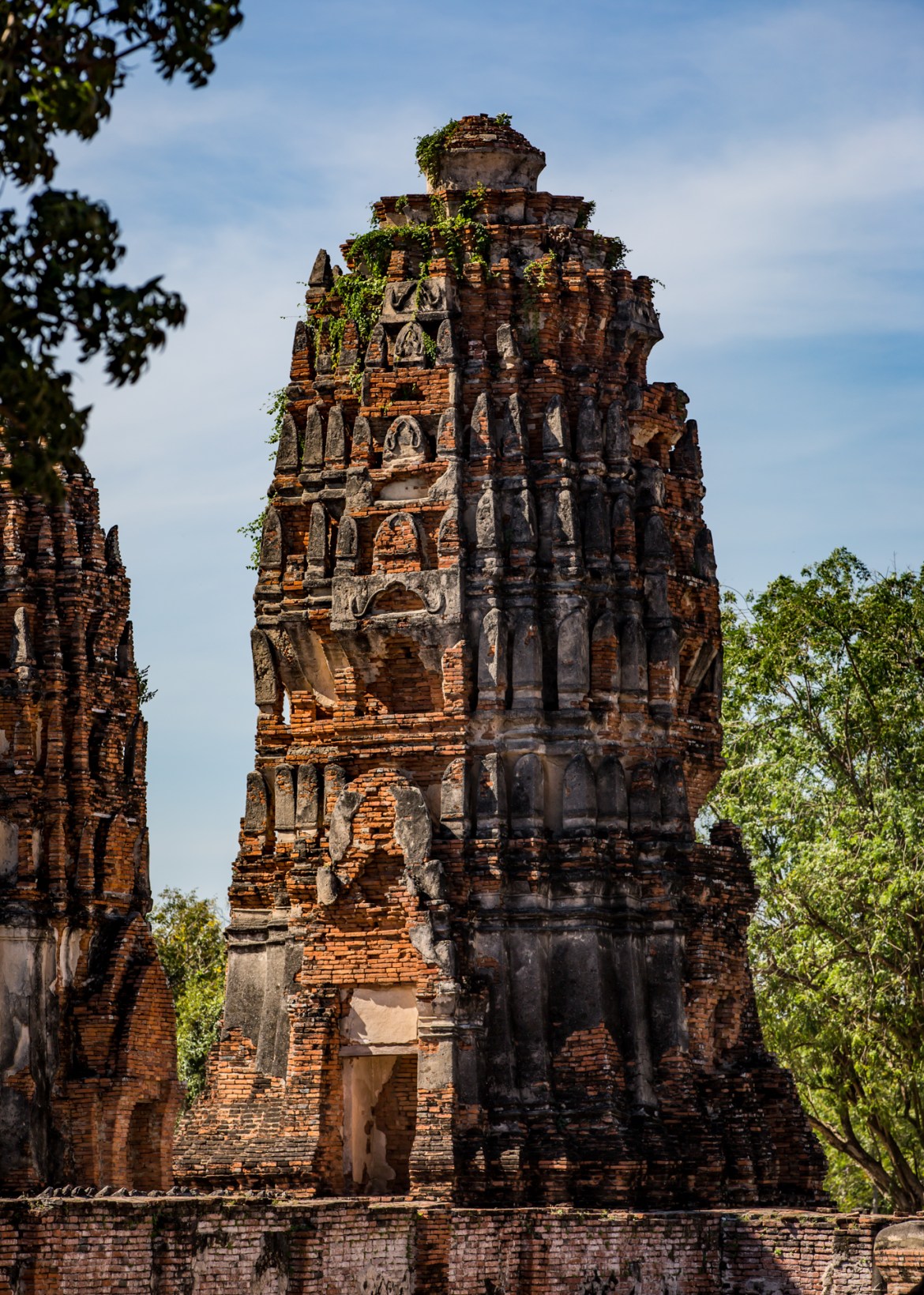
Ornate prang with arched niches and headless statues in foreground at Ayutthaya
An intricately banded prang climbs beyond a small field of headless figures. The afternoon sun paints warm highlights along the carved arches. Trees filter the background, letting the brick glow.
Thai national flag waving with bokeh trees and pond in background, Ayutthaya
The red, white, and blue stripes ripple softly beside the ruins, a modern heartbeat in an ancient place. Shallow depth of field turns the park into creamy greens and golds. A single wooden pole and a breeze do the rest, simple and proud.
Close view of seated Buddha statue with cracked patina in Ayutthaya
Up close, the statue’s cracked surface reads like a map of seasons passed. Gentle side light and a leafy bokeh keep the mood contemplative.

🏛️ Story & Significance: The Soul of Ayutthaya

Ayutthaya’s story begins in 1350, when King Ramathibodi I chose a river island encircled by the Chao Phraya, Pa Sak, and Lopburi as his capital—an inspired bit of geography that doubled as moat, market highway, and pilgrimage route. From the start, the city’s identity braided Theravada Buddhism, courtly ceremony, and hard-nosed river commerce. You’ll feel that marriage of sacred and practical the moment you step onto the island: monastery precincts stand just a tuk-tuk putter away from old customs quays, and the skyline is a forest of prang and chedi that once telegraphed power to anyone approaching by boat.

Across the next four centuries the city exploded into a cosmopolitan hub—Persian traders, Portuguese musketeers, Japanese mercenaries, Chinese junks, French Jesuits, all woven into a court that managed diplomacy with theater and towering architecture. Ayutthaya’s temples evolved in rhythm with its reach: early Khmer-style prang proclaiming cosmic mountains; later Sri Lankan-inspired chedi introduced a gentler bell silhouette; by the high period, Ayutthaya crafted its own confident blend—Ayutthayan style—with brick cores, stucco skins, rhythmic cloisters, and axial courtyards designed for processions and sightlines. As you walk today, those axes still guide your eyes—and your feet—toward sacred centers the way they guided royal parades.

The city’s fall in 1767—a Burmese sack that left palaces skeletal—didn’t end its voice; it changed the way it speaks. The capital shifted downstream to Bangkok, wood vanished, stucco sloughed off, and the brick bones now glow at sunrise like warm embers. Yet Ayutthaya remains a living sacred landscape: alms rounds continue at dawn, local markets pulse outside the park, and festivals sew the ruins back into everyday life. Stand in the hush of Wat Phra Si Sanphet or under the banyan at Wat Mahathat, and you’re not just sightseeing—you’re eavesdropping on a capital that still whispers in brick and bell.

Ayutthaya Historical Park panoramic view of stepped brick pyramid with chedis and prangs under blue sky
The ruins sweep across the frame like a red-brick skyline, all terraces and toothy towers. A ringed chedi on the right balances the giant stepped pyramid to the left. Clean blue sky turns the scene into a crisp architectural study.

🧠 Fascinating Facts & Hidden Meanings

    • Island by design. Ayutthaya’s river-wrapped plan wasn’t a happy accident; it created defense, customs control, and cooler breezes, while putting sacred precincts within ceremonial boat reach. Notice how many grand axes point toward water—the city staged devotion where traders would see it.

    • Embassy city. In the 17th century Ayutthaya hosted envoys from Persia, France, and beyond. Look for motifs—lotus, kalasa vases, cloud scrolls—that hint at global tastes grafted onto Buddhist symbolism.

    • Prang as cosmos. The tall prang at sites like Wat Chaiwatthanaram symbolizes Mount Meru (the universe’s axis). When you frame it with a low angle at sunset, you’re echoing that vertical cosmology with light.

    • Buddha-in-the-tree. At Wat Mahathat, a Bodhi tree cradles a Buddha head—an image of nature reclaiming impermanence. Photographers love the dappled shade, but the deeper read is about cycles: rise, fall, renewal.

    • Brick and stucco. Ayutthaya’s “look” comes from brick cores once covered by white stucco. After centuries of sun and monsoon, the brick breathes again—golden at dawn, ember-red at dusk, charcoal after rain.

    • Ritual motion. Many precincts were designed for circumambulation (clockwise walking). Following the galleries at Wat Phra Si Sanphet isn’t just practical crowd flow; it’s a devotional arc.

    • Crypt stories. Wat Ratchaburana once held rich crypt murals and treasure; even in ruin, the stair geometry and base reliefs still narrate power. Study the lintels—they’re like captions in stone.

    • From capital to classroom. Ayutthaya’s ruins shaped Thailand’s modern identity; school trips fill the park, teaching history where it happened. It’s why you’ll see kids mapping prang with sketch pads—this classroom has no roof.

    • Water as timekeeper. River light changes everything here. Morning bounces warm off brick; late day slides silver along the Chao Phraya; after rain, puddle reflections turn courtyards into mirror rooms.

    • Festival alchemy. During Songkran, water play meets temple merit-making. It’s not contradiction—it’s the Thai gift for holding joy and reverence in the same cupped hand.

A few links and ads here are affiliate portals. If you click through and snag something, you’ll be fueling my next photo-quest at no extra cost to you. Thanks for keeping the adventure rolling!

If you’d rather absorb than orchestrate, pick a small-group full day tour from Bangkok that strings Wat Mahathat, Wat Phra Si Sanphet, and Chaiwatthanaram with a stop at Bang Pa-In Palace.

Headless Buddha torso with brick stupa background in Ayutthaya
The torso’s elegant lines remain, even without the head, and the posture still reads like calm. Behind it, layered bricks glow warm against the sun. The contrast of smooth stone and rough terracotta makes the history feel tactile.
Row of headless Buddha statues against long brick wall in Ayutthaya
A solemn procession of seated figures lines the ancient wall, each missing its head yet still radiating calm. Afternoon light cuts across the bricks, carving warm highlights and deep shadows. Perspective draws the eye down the corridor, a visual echo of the kingdom’s former grandeur.
Front stairway of brick platform with “Do Not Climb” sign at Ayutthaya ruins
A staircase invites the feet, but the small green sign says otherwise. Brick balustrades curve up like ancient tusks guiding the eye. Weathered steps carry the memory of processions long finished.

📌 Plan Your Visit: Hours, Tickets & What to Expect

Plan Your Visit (Start Here, Breathe, Then Wander)

Arriving from Bangkok, the world narrows from highways to river bends and you feel the air shift—the kind of breeze that makes old brick smell faintly like sun-warmed pottery. Your driver/tuk-tuk will likely drop you near the island’s center, where the ruins of Wat Mahathat and Wat Ratchaburana sit within easy reach. Before you even raise your camera, take thirty seconds to listen: a bell somewhere to your left, a vendor’s ice clinking in tall cups, sandals whispering on dust. This is where Ayutthaya starts to make sense—axes of sightline drawing you forward, galleries shepherding your steps, and the prang rising like an exclamation that says “walk this way.”

Buy your ticket at the small kiosk (carry small bills), then slide into the shade line along the first gallery. If it’s early, the light is soft and the Buddha-in-the-tree at Wat Mahathat wears a halo of leaf-shadow—perfect for a first look. From here, your day unfolds naturally: Mahathat to Ratchaburana for textures and angles, a quick water stop at the nearest stall, and then onward to the old palace zone for the triple chedi of Wat Phra Si Sanphet. Keep your movements clockwise when paths allow; it mirrors the old ritual flow and somehow makes the ruins feel calmer. Save Wat Chaiwatthanaram for golden hour across the river—think of it as your curtain call, when the skyline turns copper and the Chao Phraya becomes a mirror.

🎟️ Ticketing Tips. Buy the combo if you’ll visit three or more sites; the earliest window has calmer queues and softer light. Keep small bills for kiosks and water, and snap a quick photo of your ticket bundle so you don’t fumble at the next gate.
📅 Festival/Peak-Day Watch. During Songkran and cool-season weekends, start at a secondary site to dodge early groups, then loop back; add 15–20 minutes per transfer and pack a light rain shell for surprise showers.
 

Now that you can picture the day, here are the essentials at a glance:

Quick Facts Details
Where Ayutthaya Historical Park (river island of Phra Nakhon Si Ayutthaya), ~80 km north of Bangkok.
UNESCO Status Inscribed as the Historic City of Ayutthaya (1991).
Core Sights Wat Mahathat, Wat Ratchaburana, Wat Phra Si Sanphet, Wat Chaiwatthanaram, Wat Yai Chai Mongkhon.
Typical Hours Most ruins open roughly 08:00–18:00; arrive at opening for cooler temps and softer light.
Tickets About THB 50 per major site; combo options available. Bring small bills.
Getting There Train (1–2 hrs), minivan/bus (≈1–1.5 hrs), or a guided day trip with transport + river loop.
Best Time Nov–Feb cooler/drier; shoot sunrise in the center, sunset at Chaiwatthanaram.
Just Beyond: Bangkok, Thailand Travel Guide
After exploring the temple ruins of Ayutthaya Historical Park, dive back into the vibrant rhythm of Bangkok—Thailand’s bustling capital where sacred meets streetwise. Glide along the Chao Phraya River, capture sunset over Wat Arun, and wander night markets alive with neon, sizzling skewers, and photo-worthy chaos. From rooftop bars with sweeping views to hidden shrines tucked behind golden doors, Bangkok delivers endless contrasts in color, flavor, and sound—an irresistible playground for travelers and photographers alike.
View the Bangkok Guide
Bangkok Thailand skyline with Wat Arun at sunset along the Chao Phraya River

🚶 Getting There, Entry & Accessibility

Arrive by train, bus, or car and head for the main gate closest to the central sights so your first steps flow naturally into the core area. Expect a short, straightforward walk on mixed surfaces with occasional shade where you can pause, sip water, and get your bearings. Security and bag checks typically happen at the entrance kiosks; keep liquids visible and be ready to show camera supports if asked. If you’re pacing mobility needs, plan an early pause under shade or near a bench before continuing at a comfortable rhythm. From here, follow the obvious paths toward the first highlight, then fan out to the next cluster without backtracking.

Parking & Drop-offs. Signed lots sit near the primary entrance, with curbside space for quick drop-offs; mornings fill gradually while late afternoons see easier turnover.

Accessibility Notes. Surfaces range from firm paths to uneven brick and dirt; shade can be limited, and benches appear intermittently. Ramps and handrails exist at select entries; strollers and wheelchairs do best along the smooth perimeter lines. Plan extra water, a hat, and relaxed pacing during hotter parts of the day.

Wayfinding Inside. Orient at the site map near the entrance, then pair neighboring sights into short loops that keep you in the shade whenever possible. Move clockwise to minimize backtracking, use kiosks for quick hydration stops, and save any riverbank or sunset-facing viewpoints for late in the day when the light is softest.

Broad round brick stupa base with ruined tower and Buddha torsos around courtyard
A squat stupa base anchors the courtyard like a drum of brick. Around the perimeter, weathered torsos sit against the wall facing the center. In the distance a taller ruin rises, giving the space a layered skyline.
Close view of Buddha head in bodhi tree roots at Wat Mahathat Ayutthaya
From this side profile, the Buddha seems to glance outward as if mid-breath. Root and stone fuse into one sculpture, every curve a line from nature’s chisel. It’s the photo that proves patience and gentle framing beat any crowd.
Seated Buddha shrine surrounded by headless statues at Ayutthaya
A calm figure anchors the courtyard while time gathers around it in broken silhouettes. The surrounding trees add a fresh green counterpoint to the aged brick.

🧭 How to Explore: Smart Routes for Any Timeline

60-Minute Essentials (beat the heat, capture the soul). Start at Wat Mahathat right at gate opening; the Buddha-in-the-tree sits in soft dapple early and queues are light. Drift through the central court to read the plan—towers, galleries, axial sightlines. If time allows, cross to Wat Ratchaburana for the prang base and relief textures. Grab water at the nearest kiosk and retreat to shade—this short loop is perfect for families or anyone between trains.

90–120 Minutes Deeper Look (core capital, clearer story). Add the old palace zone with Wat Phra Si Sanphet; walk the trio of chedi end-to-end to feel the symmetry—it photographs best with a mid-range zoom around late morning when side-light shapes the drums. Slip into a nearby café for a cool pause, then weave back by minor ruins to catch quieter brick lines and door-frame compositions. Accessibility is best here—paths are flatter—and kids can turn “find the chedi animals” into a scavenger hunt.

Cruise Clock, 2–3 Hours (the river-crowned finale). Book a tuk-tuk to Wat Chaiwatthanaram for golden hour; shoot the central prang from the riverside lawn, then cross the river bend for silhouette frames as the sky warms. If the heat spikes, swap the lawn linger for a boat loop—moving air, changing angles, and reflection shots without walking. End near a riverside stall for coconut ice cream; your feet and your footage will thank you.

🖼️ Spaces & Highlights You’ll Love

Wat Mahathat — Roots, relics, and the city’s quiet heart. This is Ayutthaya’s emotional center, where a Bodhi tree has grown around a Buddha head and galleries crumble like paper edges in a book you can still read. Walk the courtyard clockwise to feel the ritual design, then step close to the prang base to study brick courses and fallen stucco curls—shadows here are soft before 9 a.m. Keep voices low, move slowly; the best photos catch a pause between visitors when leaves quiver and everything exhales.

Wat Phra Si Sanphet — Three chedi, one royal drumbeat. Once the royal chapel within the palace, its triple chedi are Ayutthaya’s metronome—measured, dignified, perfectly aligned. Stand at one end of the axis and let your eye drum across all three; a 24–105mm zoom is your friend for compressing symmetry. Imagine processions ringing the base where you’re standing—the design still conducts movement like music.

Wat Ratchaburana — Prang of secrets and stair-stepped stories. Famous for a looted crypt, it remains a master class in vertical narrative: base reliefs, stair angles, then the prang’s ribbed ascent. Late afternoon side-light pulls texture from every brick seam; frame upward from a low corner to give the tower its cosmic thrust. Even in ruin, it reads like a sermon on impermanence and aspiration.

Wat Chaiwatthanaram — River-bend theater at golden hour. Built as a grand gesture of legitimacy, its prang cluster stages sunset like a play—actors (you, other visitors) move through galleries while the Chao Phraya becomes a mirror. Shoot wide from the lawn, then cross the bend for silhouettes; if clouds roll in, wait—the sky often breaks just before dusk and the bricks drink the color.

Wat Yai Chai Mongkhon — The long gaze of saffron. East of the main island, this active monastery pairs a towering chedi with rows of seated Buddha images in saffron robes. It’s a living site—move with respect—yet the photo rhythm is generous: repeating forms, soft lines of fabric, and gentle diagonals toward the main chedi. Morning is calmest; keep your frames quiet to match the mood.

Hidden Angles (quick hits).

  • Ratchaburana gallery arches: Kneel to align arch-within-arch for a natural vignette.

  • Mahathat side walls: Shoot along a surviving wall at a shallow angle to make the brick texture hum.

  • Si Sanphet axial end: Place a chedi dead-center, then step back until the flanking bases balance the frame.

  • Chaiwatthanaram opposite bank: Use a puddle or boat wake for a rippled silhouette reflection.

Large seated Buddha with offerings in front of brick towers at Ayutthaya
A serene Buddha settles into meditation while bright garlands rest on the lap. Brick towers and terraces stack behind like ancient backdrops on a stage. Harsh sun sculpts every curve of stone into crisp relief.
Pair of ornate brick prangs with leafy backdrop and low ruins in Ayutthaya
Two richly carved prangs stand shoulder to shoulder, each weathered in its own way. Leaves crown the upper tiers with a touch of life. Low platforms in front trace the footprint of vanished halls.
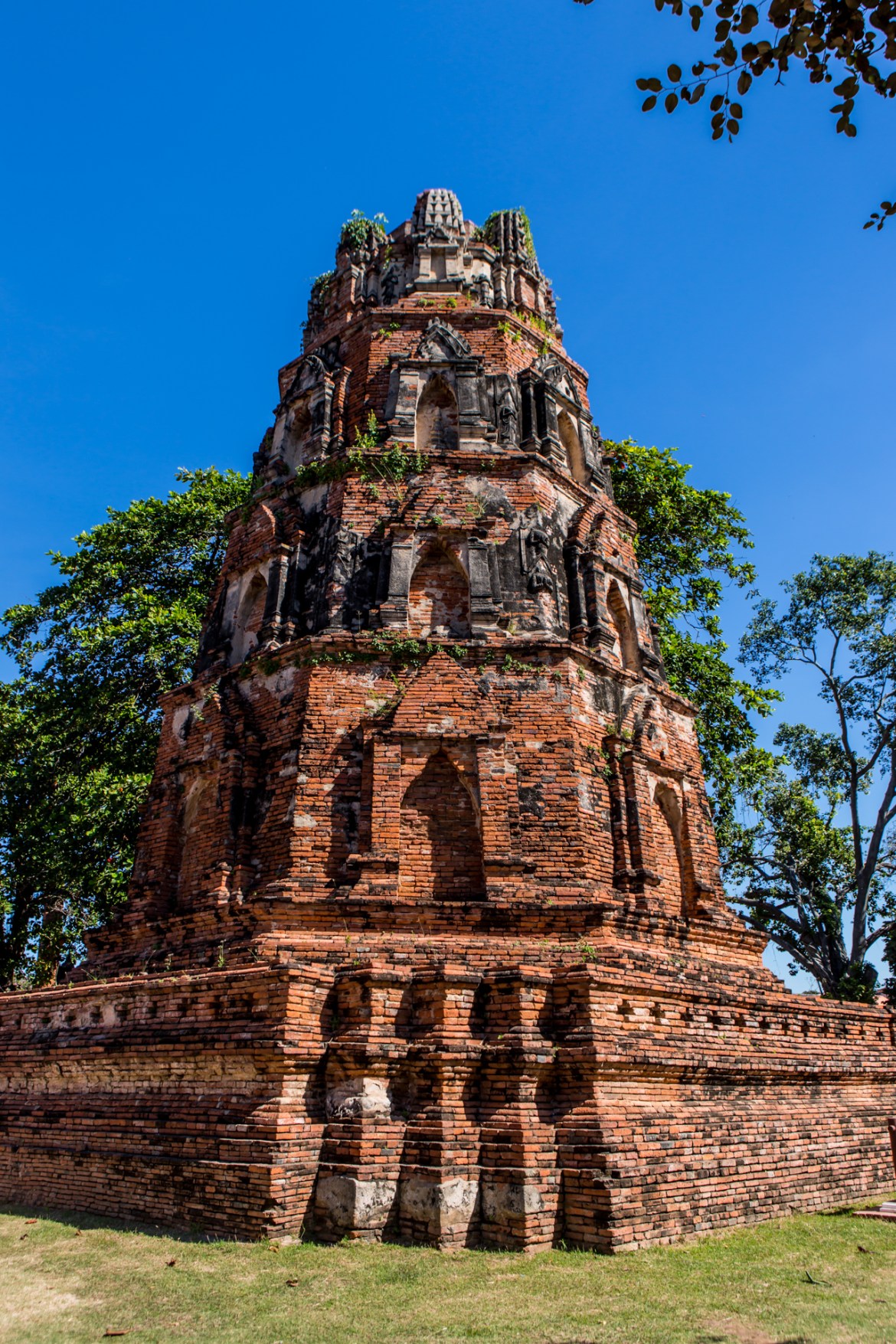
Tall ringed chedi on massive brick base under clear sky in Ayutthaya
A slender spire climbs cleanly from a weathered drum, banded like a riddle in stone. Moss and plants stitch green threads through the brick. The whole form stands poised against a flawless cobalt sky.
Tall central prang peeking above trees at Ayutthaya Historical Park
The park’s great tower plays peekaboo with the canopy. Stone geometry and green foliage make a classic Ayutthaya color pairing.
Close view of headless seated Buddha against brick and plaster wall in Ayutthaya
Fractured stone still holds the posture of meditation, hands resting where calm once gathered. The backdrop mixes flaking plaster with warm brick, a canvas of age and weather. Small weeds sprout at the base, the green punctuation on a sentence written in time.
Wide view of stepped brick pyramid and surrounding ruins at Ayutthaya under blue sky
The complex spreads like a red-brick city under a cobalt sky. Terraces, stairs, and crumbling edges stack toward a flattened summit. Sand patches and grassy bands break the geometry with natural textures.
Wide view of chedi, prangs, and brick platforms across open temple grounds in Ayutthaya
The complex stretches wide, a scatter of platforms, towers, and walkways under open sky. A ringed chedi anchors the left while sculpted prangs rise to the right. The empty spaces between ruins hint at courtyards that once buzzed with ceremony.

🍽️ Nearby Pairings & Pleasant Pauses

Ayutthaya’s best breathers are riverside and shaded. Between temple loops, slip into a café near Mahathat/Ratchaburana for iced Thai tea and ceiling-fan respite; your core cools, your eyes reset, and suddenly the brick’s color deepens again. Toward late afternoon, wander to the river lawns near Chaiwatthanaram where breezes stretch the day; the light softens, voices drop, and the skyline turns contemplative.

Food is gloriously simple and local: boat noodles, grilled pork skewers, sliced mango, coconut ice cream. The Chao Phrom market area works as a family base—restrooms, snacks, and covered aisles. If rain ambushes you (it happens), treat it like a gift: duck under an awning with a bowl of noodles, watch the bricks go auburn, then step back out for those post-storm reflections. For one last exhale, take a short boat loop at sunset—no logistics, just moving pictures and a cool breeze as the prang light up.

📸 In the Frame: My Journey in Thailand

Photographer seated near Buddha head in banyan roots at Wat Mahathat, Ayutthaya
I pause with my camera beside the low platform facing the famous Buddha head in the tree. Warm midday light bounces off the wood planks and the brick wall, giving the scene an earthy glow. The living roots behind me turn the background into a natural shrine.
Photographer portrait at Ayutthaya ruins with brick tiers and statue fragments in background
I’m on the temple steps with my long lens in hand, catching a breather between shots. The brick terraces and statue fragments behind me tell the quiet story of what I’ve been chasing all day. Reflections in my sunglasses pick up the cool greens around the courtyard, a calm counter to the warm stone.

🎥 Reels on the Road: Content Creators

Short video sings here when you let the setting breathe—think slow, steady moves, a touch of ambient sound, and sequences that build from wide to detail. Keep most clips between 5–8 seconds, lock your elbows or use a compact support, and let light changes (sunrise warmth, midday contrast, golden-hour glow, post-rain sheen) set your story beats. Mix POV walkthroughs, gentle pans/tilts, and a couple of locked-off moments so the place can speak without you chasing it. Capture texture sounds—footsteps on stone, bells, river lapping—then add subtle music later instead of recording over everything. Be courteous around worshippers, guards, and families; if someone drifts into frame, let them be your scale. For editing, string establishing → medium → detail → human moment → exit shot and keep the total reel under 30 seconds. When weather flips the script, celebrate it: wet surfaces and moving clouds make your B-roll look cinematic.

🎥 Sunrise wide establishing pan from a quiet vantage, 5–7 seconds
🎥 Mid-morning walkthrough POV along a main axis, slow and centered
🎥 Golden-hour silhouette reveal from shadow into light, one smooth tilt
🎥 Close-up textures (brick, carvings, fabric), 2–3 quick micro-clips
🎥 River/sky reflection timelapse or tripod-steady hold, late day
🎥 Night market or snack vignette for a human beat, 3–5 seconds

🧳 What to Pack for Picture-Perfect Memories

Ancient Brick, Golden Light, and Timeless Stillness Along the Chao Phraya

Ayutthaya is where serenity and ruin dance in the same frame—crumbling stupas glowing in sunrise mist, saffron-robed monks passing through ancient arches, and lotus ponds mirroring the past. Smart packing turns humid air and blinding sun into warm, cinematic light. Bring water, a wide-brimmed hat, and respectful, breathable clothing (shoulders and knees covered for temples); keep light socks for shoes-off moments in active shrines. Paths swing from cracked brick to polished stone and grassy fields, so grippy sandals or shoes beat anything fancy. A soft lens cloth is essential—humidity and dust cling to glass—and use low-key stabilization (pillars, railings, calm breath) where tripods are restricted. Plan for golden dawn at Wat Mahathat, reflective symmetry at Wat Phra Si Sanphet, and dusky silhouettes at Wat Chaiwatthanaram across the river.

👉 The Nomad’s Kit: Gear That Earns Its Miles

Canon RF 15–35mm f/2.8L — Ultra-wide for towering prangs, temple corridors, and Buddha niches where stepping back means “hello, relic wall.”
Canon RF 24–105mm f/2.8L — Your sunrise-to-sunset workhorse: portraits of monks in saffron, mid-tele carvings and reliefs, and quick market vignettes at Chao Phrom Market.
Canon RF 100–500mm f/4.5–7.1L IS USM — From riverside banks or temple platforms, compress brick spires into golden layers; isolate headless Buddhas and stupas framed by banyan roots.
Lowepro ProTactic BP 350 AW III — Slim, respectful, and dust-tough; keeps filters and gear tidy while moving between temple grounds and ferry crossings.
Peak Design Travel Tripod — Break it out for blue-hour reflections or long exposures across the river; keep folded inside temple zones where setups are restricted.
JOBY GorillaPod 3K Kit — Clamp to railings or low walls for silky water shots near Wat Chaiwatthanaram—tiny footprint, big stability when the evening breeze stirs the river.

Cut Glare. Shape Time. Make Every Frame Sing.
Ayutthaya’s palette glows warm—sun-baked brick, gilded roofs, and haze over the river. A circular polarizer tames glare on worn stone and gilded statues, enriching reds and greens; a variable ND lets you slow the rhythm—melt tour groups into motion blurs, soften water reflections, and sculpt the temple skyline against drifting clouds.

🌊 Control Reflections & Punch Up Color
Circular Polarizer Filter — Reduce glare on golden Buddha figures and lotus ponds, reveal texture in brickwork, and deepen the sky over ancient spires. Pro tip: rotate lightly—over-polarizing can make skies band and golden stone lose warmth.

⏱️ Drag the Shutter in Broad Daylight
Neutral Density Variable Filter — Drop 3–6 stops to blur monks’ movement, smooth the river by Wat Phanan Choeng, and turn cloud streaks into brushstrokes behind stupas. Pro tip: start around 1/4–1 s for people motion; go 2–10 s for dreamy water and sky.

Pack both for any trip: the polarizer reveals the scene; the ND sculpts time. Together, they’re a portable “wow” switch.

Photo Policy RemindersNo flash inside sanctuaries or active temples; tripods/stands are restricted on temple platforms unless permitted. Drones are only allowed with advance approval from Thai Fine Arts Department. Dress modestly (no bare shoulders, shorts, or tight clothing), remove shoes before entering sacred spaces, and always photograph monks with respect—Ayutthaya rewards quiet patience more than speed.

💰 On-Site Costs Snapshot

Most visitors spend modestly here: a handful of temple entries (or a combo), a tuk-tuk hour or two to stitch the highlights together, and a couple of cold drinks plus a simple sit-down meal. Adding a local guide for context or a sunset boat loop is the smartest upgrade—both elevate the day without bloating the budget. Save on souvenirs by choosing one light, packable keepsake and skip heavy items that fight your luggage. If you’re heat-sensitive, consider springing for a slightly longer tuk-tuk hire to reduce mid-afternoon walking.

Item Typical Cost (THB) Notes / What You Get
Single-site temple entry ~50 Major ruins like Wat Mahathat, Wat Phra Si Sanphet.
Multi-site combo ticket ~220–300 Good value if visiting 3–5 key sites the same day.
Local guide (2 hours) ~600–1,200 Context on history, symbols, and smart sequencing in the heat.
Tuk-tuk hourly hire ~200–300/hr Customize a loop between clusters; negotiate wait time.
Island boat loop (sunset) ~300–600 per boat River angles and silhouettes you can’t get on foot.
Cold drinks / snacks 20–60 Iced tea, water, coconut ice cream near gates and markets.
Sit-down meal (local) 120–250 Boat noodles, stir-fries, rice dishes—fast and filling.
Souvenir keepsake 100–300 Small textiles or magnets—light, packable, and budget-friendly.

🤝 Etiquette & Respectful Visiting

Ayutthaya is both ruin and living sanctuary, so dress modestly in temple zones (shoulders/knees covered) and speak softly—sound carries across brick courtyards. When prayers or alms rounds unfold, step to the side and let the moment breathe; photograph discreetly and skip the flash. Do not touch or climb Buddha images, and avoid sitting with your feet pointed toward shrines; remove hats in active worship areas. Give monks, elders, and families the right of way in narrow galleries and shaded cloisters, and keep tripods tidy so they don’t block paths. A little patience, water sharing, and smiles go a long way here—kindness is the best souvenir you’ll take home.


Scale model of Ayutthaya temple complex displayed in glass case with visitors
A miniature city of prangs and chedis lays out the lost geometry of an empire. Visitors lean over the glass, tracing routes their feet will soon follow outside. Clean white models highlight symmetry and ceremonial order, a helpful preview for first-time explorers.
Headless stone Buddha statues among ruins at Ayutthaya Historical Park
Limbs and torsos rest where kingdoms rose and fell, their stillness telling the story. Soft morning bokeh turns the background to a calm wash, letting the worn stone take center stage. These fragments feel tender rather than broken.
Wide scene of tiered brick pyramid with scattered statue fragments at Ayutthaya
A layered pyramid rises from a plain of brick and grass, rough-edged yet commanding. Fragments of statues keep watch in the foreground like sentries at rest. The sky is a clean blue canvas that makes every line stand out.

🕰️ Historical Timeline at a Glance

Ayutthaya’s timeline rewires what you notice in the ruins: early centuries plant brick cores and clean Khmer-style prang that set the capital’s vertical grammar. The high period adds stucco skins, bell-shaped chedi, and long gallery cloisters that choreograph ritual movement and shade. After the 1767 sack, wood vanishes and the brick bones stay—spaces open up, finishes thin out, and room purposes shift toward simpler use. Modern conservation stabilizes bases and clarifies processional axes, so you can still “walk” the old ceremonies with your eyes. Watch how light tracks those forms: dawn warms prang edges; late day slides along cloisters, telling you which way the city wanted you to move.

Quick Facts Details
Where Ayutthaya Historical Park, river island of Phra Nakhon Si Ayutthaya (~80 km north of Bangkok).
UNESCO Status Inscribed as the Historic City of Ayutthaya (1991).
Core Sights Wat Mahathat, Wat Ratchaburana, Wat Phra Si Sanphet, Wat Chaiwatthanaram, Wat Yai Chai Mongkhon.
Typical Hours Most ruins open roughly 08:00–18:00; arrive at opening for cooler temps and softer light.
Tickets About THB 50 per major site; combo options available. Bring small bills.
Getting There Train (1–2 hrs), minivan/bus (≈1–1.5 hrs), or a guided day trip with transport and river loop.
Best Time Nov–Feb cooler/drier; shoot sunrise in the center, sunset at Chaiwatthanaram.
Photographer portrait at Ayutthaya ruins with brick tiers and statue fragments in background

📓 Through My Lens: Field Notes from the Road

I came into Ayutthaya Historical Park with a small-group tour out of Bangkok, already excited from the ride and the promise of old brick under early light. The first steps inside felt like walking onto a living stage—UNESCO silhouettes everywhere and so many perfect angles that I had to physically slow my shutter finger and just breathe. Every turn revealed another frame: rooted Bodhi shade, weathered prang, soft voices drifting across open courts. I was grateful for our guide, who stitched centuries into simple, memorable threads—and then, kindly, became my photographer whenever I needed to trade the viewfinder for a smile. By late day we drifted back toward the city on the Chao Phraya, river wind in my face and memory cards full, the skyline of prang shrinking into gold. It was one of those days where the history sticks—and the photos feel like they still hum.

☀️ When to Go & Weather Sweet-Spots

Dawn to Dusk on the River-Island Ruins

Ayutthaya is a morning magic destination: cooler air slips through the island’s breezeways, the prang edges glow softly, and courtyards feel contemplative before tours arrive. By late morning the heat stacks—brick radiates warmth—so plan shade pauses and steady hydration; a hat and light long sleeves beat the sun better than sunscreen alone. Rains often pop fast and fade, leaving auburn bricks and mirror-gloss puddles that transform the ruins into a reflection playground—carry a compact support and embrace the sheen.

Sunrise treats you to quiet detail work around Wat Mahathat and Ratchaburana; golden hour belongs to river-bent silhouettes at Wat Chaiwatthanaram. Midday is best for scouting, snacks, and interior textures, then roll your keeper shots when the light softens again. Crowd rhythm: early calm → mid-morning swell → a hot-hour lull → sunset gather; use that to sequence your loops. Photographers: a 15–35mm + 24–105mm pair handles tight cloisters and compressed chedi lines; travelers: schedule a brief café stop each loop to reset in front of a fan and iced tea.

🌴 Winter (Nov–Feb) 🧘‍♂️ Vibe Check 🌦 Rain Factor 🏛 Tourist Traffic
Winter (Nov–Feb) Cool mornings; best walking weather. Low High (peak)
Spring (Mar–May) Hot, bright; fiery sunsets; festival energy in April. Low–Moderate High around holidays
Summer (Jun–Aug) Green after showers; moody clouds for drama. Moderate Moderate
Fall (Sep–Oct) Stormy pops; cooler evenings by late Oct. Moderate–High Moderate

🛡️ Practical & Safety Notes

On the island, the ruins reward unhurried movement. Brick and laterite can turn slick after a passing shower, and the shallow steps on prang bases invite slips—step deliberately and skip any climb that isn’t clearly open. Heat stacks off the masonry by late morning; carry a bottle every loop, add electrolytes in the afternoon, and time shade breaks under gallery edges or tree lines near Wat Mahathat and Ratchaburana. Keep your tripod slim and to the side; if a procession or prayer begins, fold it and step back. Inside active areas, dress modestly, remove hats, keep voices soft, and avoid sitting with your feet pointed toward images. A small cross-body bag keeps tickets, small bills, and phone handy without brushing other visitors in narrow passages.

Beyond the park walls, tuk-tuks are the easiest way to stitch sites—confirm the total for your loop (including waits at Wat Phra Si Sanphet and Wat Chaiwatthanaram) before you hop in. For river loops, secure your bag, use a wrist strap or clip for your camera, and expect a little spray near wakes; keep cleaners and a microfiber tucked in your pocket. Markets and kiosks favor small bills; ATMs line the main streets if you need cash. You’ll see stray dogs napping in shade—give them space and a calm path around; they usually ignore quiet passersby. After sunset, stick to lit routes back to your pickup or café, and call a known taxi or rideshare from a visible corner rather than wandering side lanes. If rain barrels through, shelter under an awning with a cold drink—ten minutes later the bricks go auburn, puddles glass over, and the crowds thin for some of the day’s best frames.

🗣️ Cheat Sheet for Friendly Encounters while in CITY

Thailand’s common language is Thai, and while basic English pops up around tours, cafés, and hotels, a few Thai words transform interactions—especially in markets and temple precincts. A warm “hello” or a quick “thank you” makes paying entry, ordering drinks, or asking directions smoother and more human. For photographers, simple Thai greetings often earn a nod of permission or a relaxed smile, which reads beautifully in portraits. Even imperfect pronunciation is appreciated; the effort signals respect in sacred spaces. Try these essentials and you’ll feel the day open up.

🇺🇸 English 🇹🇭 Thai 📖 Phonetic
Helloสวัสดีsa-wát-dee
Thank youขอบคุณkhòp-khun
Pleaseกรุณาga-rú-naa
Excuse meขอโทษkhǎw-tôot
How much?เท่าไหร่thâo-rài
Where is…?…อยู่ที่ไหน…yùu-thîi-nǎi
Yes / Noใช่ / ไม่ใช่châi / mâi-châi
Waterน้ำnám
Bathroomห้องน้ำhông-nám
Delicious!อร่อยa-ròi
Help!ช่วยด้วยchûai-dûai
Goodbyeลาก่อนlaa-gòn

Lens & Latitude – Chasing Peaks at Mount Rainier

Behind the Lens

I’m Steve—a retired Army vet who traded ruck sacks for camera bags and now chases light across every latitude I can reach. From 110 point & shoot film camera beginnings to a Canon R5 Mark II and Mavic Pro II drone, I’ve logged shots in 36 countries and all 50 states, squeezing solo photo runs between corporate flights and longer adventures with my wife. Shutter Nomadica is where I share the hits, misses, and field notes so fellow roamers can skip the guesswork and grab the shot!


Leave a Reply

Discover more from Shutter Nomadica

Subscribe now to keep reading and get access to the full archive.

Continue reading