Delhi’s Timeless Symmetry: Inside the Red and White Mughal Masterpiece
It’s hard not to feel time itself pause inside Humayun’s Tomb, where red sandstone blushes at sunrise and marble inlays catch Delhi’s dusty light like sequins of history. Standing within its walled garden, you sense you’re walking inside the blueprint that would later perfect itself at the Taj Mahal. The geometry feels almost musical — fountains align like verses, pathways divide like stanzas — and every arch hums a quiet ode to love, empire, and legacy.
Built in 1570 for Emperor Humayun by his grieving wife Bega Begum, this was India’s first garden-tomb and the architectural seed that germinated the Mughal obsession with symmetry. It sits in Nizamuddin East, a calm pocket of New Delhi where the drone of traffic fades into birdsong over marble domes. The best time to visit? Early morning in February or March, when the haze softens the domes and the lawns glow emerald after winter dew. Indira Gandhi International Airport is about 40 minutes away, and a solid two to three hours lets you photograph every corridor, fountain, and reflection pool without rush.
🏛️ Story & Significance: The Soul of Humayun’s Tomb
There’s something hauntingly human about Humayun’s Tomb — it isn’t just stone and symmetry; it’s the story of devotion carved into geometry. Commissioned by Empress Bega Begum (Haji Begum) after Emperor Humayun’s death in 1556, the monument was meant to enshrine both her grief and the grandeur of the Mughal dynasty’s rebirth. She personally oversaw its design, choosing a Persian architect, Mirak Mirza Ghiyas, to translate her vision into red sandstone and white marble perfection — a collaboration that fused Persian garden design with Indian craftsmanship, forever altering India’s architectural DNA.
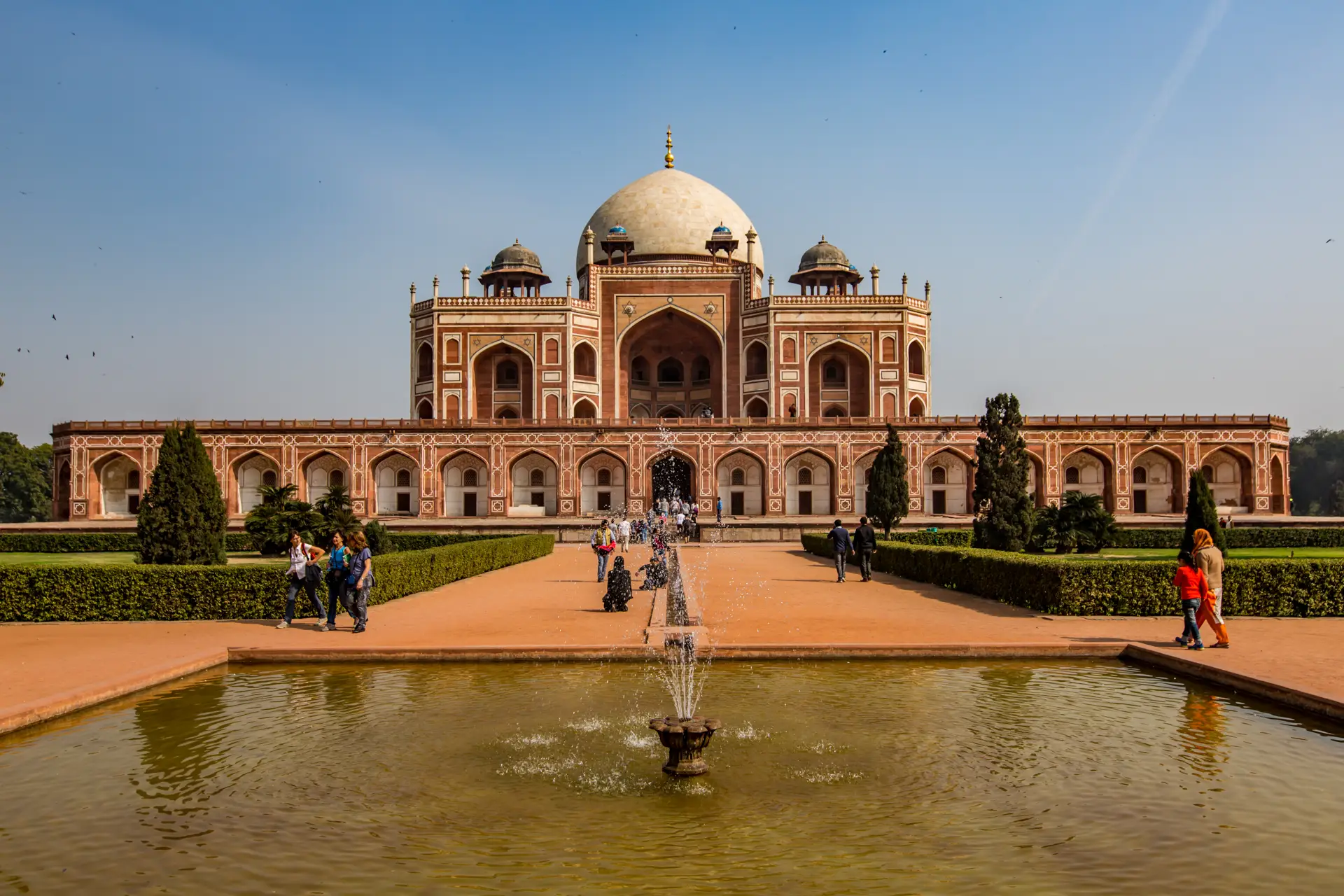
The tomb marked a turning point: the first to sit within a charbagh — a Persian-style quadrilateral garden symbolizing paradise — and the first to introduce the double dome and high plinth later immortalized at Agra. Inside, Humayun’s cenotaph rests under an octagonal chamber bathed in filtered light; outside, more than 150 Mughal nobles rest beneath smaller domes scattered like constellations across the grounds. Over time, the site became a sacred family necropolis, echoing with prayers from nearby Nizamuddin Dargah, linking saints, emperors, and wanderers in a single lineage of remembrance.
Restoration by the Aga Khan Trust for Culture has since revived its former glow — meticulously re-laying sandstone, reviving the fountains, and restoring the pathways that once defined Mughal paradise. Today, Delhiites picnic here on weekends, photographers chase reflections across marble pools, and every traveler who enters its gateways walks through the same silence that inspired the Taj Mahal’s architects a century later.
🧠 Fascinating Facts & Hidden Meanings
If the Taj Mahal is India’s love poem, Humayun’s Tomb is the rough draft that dared to dream in symmetry first. Every inch of this site tells a story — of ambition, faith, exile, and artistic resurrection. For travelers and photographers alike, it’s where patterns meet poetry, and where India’s architectural heartbeat began to sync with celestial design.
Five Did-You-Knows
First Garden-Tomb in the Indian Subcontinent – Humayun’s Tomb pioneered the charbagh (four-part garden) layout that symbolized the Qur’anic paradise of flowing rivers. Those fountains weren’t just ornamental — they represented divine order.
A Dynasty’s Resting Place – Over 150 Mughal family members lie here, making it one of the densest royal burial sites in the world. It’s essentially the Mughal family tree rendered in stone.
Persian Roots, Indian Soul – Designed by Mirak Mirza Ghiyas, who blended Safavid-era geometry with Indian red sandstone — a hybrid style later perfected in the Taj Mahal’s white marble.
British Bungalow Interlude – During colonial times, the complex was briefly converted into a British garden with flowerbeds and lawns, until independence-era restoration returned it to Mughal authenticity.
A Refuge of History – In 1857, the last Mughal emperor, Bahadur Shah Zafar, sought refuge here before his capture by the British — the tomb thus bookends the rise and fall of the empire it helped immortalize.
What Kids Love
Little explorers can run the labyrinth of arched corridors, echo their voices inside domed chambers, and chase parakeets across the charbagh gardens. It’s a surprisingly family-friendly heritage stop — shady, spacious, and photogenic from every angle.
A few links and ads here are affiliate portals. If you click through and snag something, you’ll be fueling my next photo-quest at no extra cost to you. Thanks for keeping the adventure rolling!
To trace Humayun’s legacy through Delhi’s evolving skylines, pair your visit with the Old & New Delhi Private Tour – Half or Full Day. It’s the perfect bridge from Mughal palaces to colonial avenues — all without rushing your shutter moments.
Or, if you’re ready to follow the architectural lineage south to its marble climax, the All Inclusive Day Trip to Taj Mahal, Agra Fort and Baby Taj from Delhi lets you see how Humayun’s design genius inspired the Taj’s timeless silhouette — complete with transport, entry, and an expert guide so you can focus on composition instead of logistics.
📌 Plan Your Visit: Hours, Tickets & What to Expect
Set your expectations like a pro: budget 2–3 unrushed hours to cover the main mausoleum, the arcaded terraces, and nearby Isa Khan’s enclosure, with breathing room for reflection-pool symmetry and long-lens patterns. Mornings are calmest; by late morning the charbagh paths fill with school groups and tour clusters, and guards begin gently steering interiors to a steady flow. Tickets are checked at the outer gate and again near the main plinth; small bags breeze through, but larger camera kits may invite a polite glance. Most areas are self-guided; only specialized conservation zones or museum spaces have staff-controlled access.
Ticketing Tips. Buy at the gate or via the ASI online portal to save time; current published bands are ₹40 (Indians) and ₹600 (foreigners), children under 15 free. Still photography is free, while non-commercial video at fee-charging ASI monuments carries a ₹25 fee; tripods typically need prior permission. Online listings may show ₹550 for foreigners, but the gate honors the day’s official rate.
Festival / Peak-Day Watch. Expect heavier crowds on spring weekends, public holidays, and evenings when nearby Nizamuddin Dargah draws devotees; aim for opening light to keep your frames clean and your shadow angles long. If pairing with the Humayun World Heritage Site Museum or Sunder Nursery, note the museum is closed Mondays and runs 10:00–21:00; plan your sequence so interiors come first, then gardens as the day brightens.
| Site | Humayun’s Tomb (Nizamuddin, New Delhi) |
| Hours | Daily, sunrise to sunset (gate teams begin clearing near dusk). |
| Best Light | Sunrise for soft sandstone; late afternoon–golden hour for warm façades and long shadows. |
| Entry (Indians) | ₹40; children under 15 free. |
| Entry (Foreigners) | ₹600 (some portals list ₹550 online); children under 15 free. |
| Photography | Stills: free. Video: ₹25 at fee-charging ASI sites; tripods generally require prior permission; drones prohibited at protected monuments. |
| Time Needed | 2–3 hours for main tomb, Isa Khan’s complex, arcades, and water channels. |
| Closest Metro | JLN Stadium (Violet Line) ~1–2 km; Jangpura (Violet) also close; Sarai Kale Khan–Nizamuddin (Pink) is a newer option in walking range. |
| Nearby Add-Ons | Humayun World Heritage Site Museum (Mon closed, 10:00–21:00) and Sunder Nursery (garden complex next door). |
| Good to Know | Limited shade by midday — carry water. Respect prayer times near Nizamuddin Dargah. No flash inside enclosed chambers. |
🚶 Getting There, Entry & Accessibility
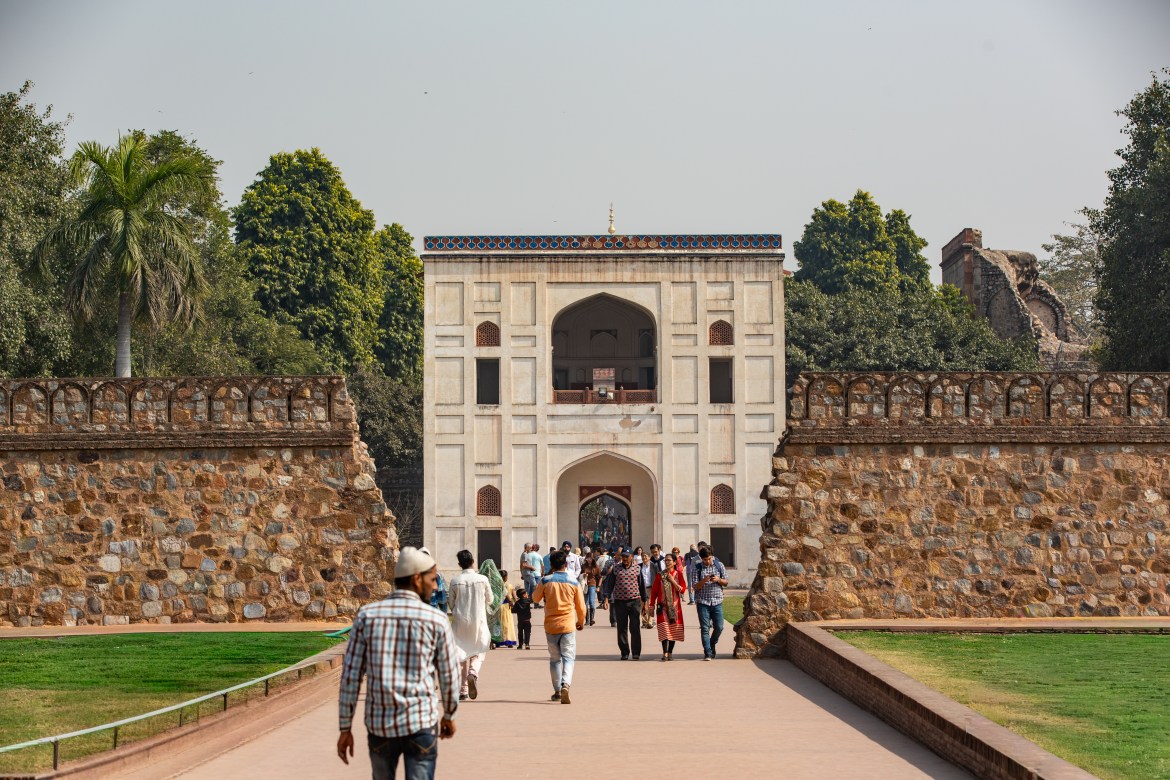
For a smooth arrival, aim for the West Gate — it’s the active tourist entrance aligned to the grand axial view of the tomb. JLN Stadium (Violet Line) is the closest Metro stop (about a 15–20 minute walk or a short auto/e-rickshaw ride), while Hazrat Nizamuddin rail hub sits just beyond the complex for longer-haul travelers. Ride-shares (Ola/Uber) can drop at the West Gate forecourt; if you’re driving, there’s a Humayun’s Tomb parking area near the Sabz Burj roundabout and additional parking at Sunder Nursery across the road. Expect a quick bag check at the outer gate, then ticket verification again as you approach the plinth.
Parking & Drop-offs. The simplest plan is drop-off at the West Gate, then have drivers loop back to Sabz Burj for short-term waits or park at the Humayun’s Tomb lot; overflow often defaults to Sunder Nursery’s managed lots with posted day rates. The approaches from Mathura Road are straightforward; if you’re pairing a visit with Sunder Nursery, park once and walk between gates in five minutes. Signage for the tourist entrance is clear from the roundabout; buses also stop near Neela/Subz Burj.
Accessibility Notes. Main charbagh paths and bridges have been improved over the years with ramped garden access, making the central axis and view lines broadly wheelchair-friendly; surfaces are mostly stone or compacted earth with some undulations. However, Isa Khan’s Tomb within the outer precinct remains step-dependent and has drawn recent criticism for lack of ramp access, so plan assistance if visiting that sub-site. Expect gentle threshold steps at certain doorways and no drone use anywhere on premises.
Wayfinding Inside. From ticket check, walk straight to the West Gate portal for the iconic first reveal, then continue up the axial path to the high plinth and double-dome silhouette — your best symmetry frames are on-axis at the water channels. Circle the plinth clockwise for alternating light on each façade; late afternoon paints the sandstone deep copper. If time allows, detour to Bu Halima’s Garden and the Afsarwala/Arab Serai precincts, then finish at Isa Khan’s octagonal garden for contrasting pre-Mughal geometry. UNESCO maps and on-site panels reinforce the axial layout; follow the water to stay oriented.
🧭 How to Explore: Smart Routes for Any Timeline
Visiting Humayun’s Tomb feels like walking through a cinematic sequence — each courtyard, terrace, and garden revealing a new act in the story of Mughal grandeur. The intro courtyard sets the mood with its sunlit gateways and echoes of morning parakeets. Step through, and the highlight halls pull you into a hush of sandstone corridors and marble latticework that feel more cathedral than crypt. Climb the steps to the terraced plinth, where the world widens into perfect quadrants of the charbagh — a living geometry of light and shadow that changes by the minute. Finally, stand on the far southern walkway for the finale vantage: the tomb mirrored in its water channel, dome haloed by Delhi’s ever-hazy sky. For photographers, it’s a study in rhythm — symmetry that hums like a metronome against the shifting tones of sunrise and dusk.
60-Minute Essentials (In-and-Out, No Regrets)
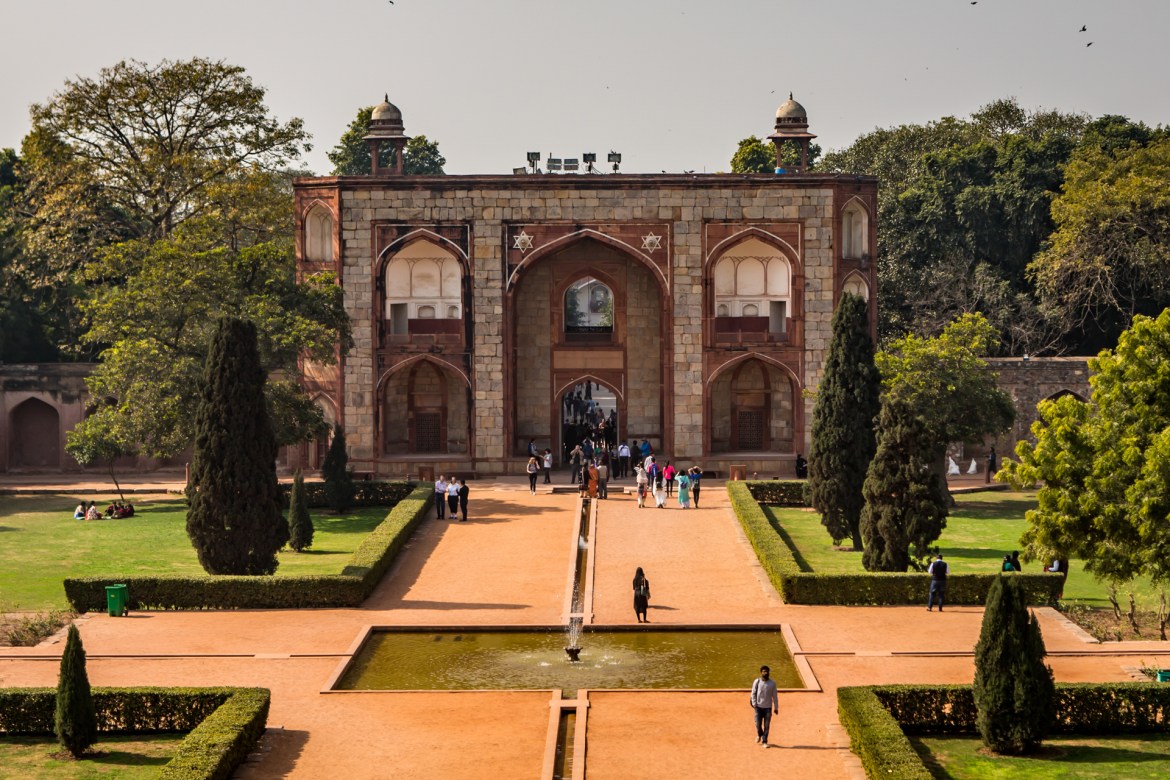
West Gate Reveal → Central Axis. Enter at opening light; that first doorway perfectly frames the white dome floating over red sandstone. Pause at each water channel for leading-line reflections and a centered portrait of the façade.
High Plinth Loop (Clockwise). Climb the broad steps and circle once; the morning sun rakes across inlaid marble and carves shadows into the arches — ideal for low-ISO, handheld detail shots.
Interior Octagon. Step inside for that hush of filtered daylight. Shoot verticals to emphasize height, then a few symmetrical horizontals braced against a pillar to keep horizons honest.
Exit via Garden Axis. Back on the main path, grab your final postcard composition with long lines, tiny people for scale, and a 35–50 mm frame that keeps perspective natural.
90–120 Minutes Deeper Look (Add Texture & Context)
Bu Halima’s Garden First. It’s usually quiet early; warm-up shots here help you lock exposure for sandstone + sky. Look for birds on finials and use negative space.
Afsarwala & Arab Serai Side Detour. Ten minutes each: weathered stone + plaster textures, great for abstracts and black-and-white studies. Hug the walls for repeating-arch patterns.
Main Tomb: Facade Studies. Work a short lens for symmetry, then switch to a short tele (85–135 mm) to compress arches and isolate calligraphy bands.
Interior + Balcony Niches. Meter for highlights; let shadows fall to keep mood. A slow, steady walk around the octagon yields varied light angles.
Isa Khan’s Octagonal Garden (Contrast Shot). Pre-Mughal geometry, lower scale, and lattice-work details — a perfect “before/after” pairing with Humayun’s grand dome.
Leisurely 2–3 Hour Circuit (Savor the Symmetry)
Sunrise Garden Walkabout. Start outside the main axis and drift inward with the light. I like mapping a gentle “S” through the charbagh so each pool gives you a new reflection and foreground.
Full Plinth Circuit with Mini-Studies. Treat each side like a different set: façade portrait, detail diptych (inlay + jali screen), and one human-scale frame (a doorway or stair for context).
Quiet Corners & Negative Space. Slip to shaded arcades when crowds build; shoot silhouettes under arches with the dome bright beyond. Patience pays — wait for clean gaps between groups.
Isa Khan Finish + Green Refuge. End at Isa Khan, then stroll to Sunder Nursery if you have time; its lakes and heritage pavilions add soft greens and calm water to your color story.
Bonus Lens Swap. Before you leave, mount a longer lens and pick off patterns: calligraphy bands, lotus finial, and repeating chhatris — graphic close-ups that edit beautifully alongside the wide hero shots.
🖼️ Spaces & Highlights You’ll Love
Think of Humayun’s Tomb as a trio of short stories told in red sandstone and white marble. Each chapter invites you to slow down: first the framing axis that stages a perfect reveal, then the high plinth where the world opens into four green quadrants, and finally the octagonal chamber where sound and light settle into reverence. What matters here is rhythm — symmetry that repeats just enough for meditation, yet shifts slightly with every step so your eye never gets bored. Look for water reflections, jali (lattice) shadows, and calligraphy bands catching warm sun; these are the little notes that make your photos sing. Enjoy it unhurried: linger at the pools, walk a full loop of the terraces, and give the interior a quiet lap to watch the light pivot across the floor.
Highlight 1 — West Gate Framing Axis
This is the monument’s overture: a dark portal that suddenly blooms into a white dome afloat on red sandstone — the classic Mughal “reveal shot.” Pause at each charbagh water channel and center your frame for clean leading lines; a few steps forward or back changes the reflection geometry dramatically. Early morning keeps the sky soft and crowds thin, letting you work symmetry without constant resets. If you like environmental portraits, wait for a single figure to cross the path for scale and story.
Highlight 2 — The High Plinth & Charbagh Vistas
Up on the broad terrace, the city hushes and the four-part garden reads like a living floor plan. Walk the perimeter slowly: every façade offers a new conversation between marble inlay, deep-shadowed arches, and the pale sky. This is where short telephoto lenses shine — compressing chhatri pavilions, calligraphy bands, and repeating alcoves into graphic layers. Wind is your friend; on breezy days, channels ripple just enough to turn reflections painterly.
Highlight 3 — The Octagonal Chamber & Radiating Galleries
Inside, the mood shifts from grand procession to intimate hush. Stand just off-center to keep the cenotaph dignified while showing the soaring drum of the double dome above; vertical frames emphasize height, horizontals capture symmetry. Drift into the side galleries for changing light angles and delicate jali shadows that skate across the floor. Lower ISO, steady stance, and a touch of underexposure preserve the chamber’s calm while keeping marble highlights honest.
🍃 Nearby Pairings & Pleasant Pauses
Keep the pace low and the lenses happy with easy add-ons a short walk or quick rickshaw away. Step next door into Sunder Nursery, a restored heritage garden where lakes, stone pavilions, and flower alleys make golden hour feel cinematic. Drift a few minutes farther to Lodhi Garden for domed tombs nestled under banyans — a mellow late-afternoon loop that doubles as a picnic stop. If you’re craving a view (and a breezy reset), ride five minutes to The Oberoi New Delhi’s rooftop lounge Cirrus 9 for blue-hour silhouettes of Humayun’s Tomb and the skyline. For culture with soul, circle into Nizamuddin Basti near Nizamuddin Dargah — artisan lanes, fragrant kebab stalls, and a living neighborhood cadence that’s lovely just after sunset (go modest, go mindful, and keep it unhurried).
Family-Friendly Stops. Sunder Nursery is the winner: wide lawns, lakeside benches, and café treats (think lemonade and gelato) with plenty of stroller-friendly paths. The main charbagh at Humayun’s Tomb works for prams too, though the plinth stairs require a quick carry or tag-team. Over at Lodhi Garden, shaded trails and resident parakeets keep kids engaged — pack a small picnic and let them roam within sightlines.
Rain/Heat Refuge. When Delhi bakes or a shower rolls through, duck into the Humayun World Heritage Site Museum (compact, air-conditioned, and nicely curated) or retreat to the airy arcades along the tomb’s lower terraces for a breezy pause. The Oberoi New Delhi offers cool-down lounges and cafés within minutes, while India Habitat Centre (a short ride) adds indoor galleries and quiet courtyards. On drier scorchers, time your walk under the leaf-tunnel paths of Sunder Nursery, then resurface for the soft light after 5 PM.
🎥 Reels on the Road
Short, soulful clips thrive here: symmetry, water ripples, and that hush of the octagonal chamber. Aim for 15–25 seconds per reel, keep camera moves slow, and let natural sound breathe (parakeets, footsteps on stone, a soft fountain burble). Work sunrise for clean lines and cool tones; return at late afternoon for warm sandstone and longer shadows. Think in sequences: reveal → detail → human scale so your edits feel like a mini-journey rather than a slideshow.
🎥 West Gate Reveal — One-Step Symphony
Start in the shadowed portal, then ease forward to unveil the dome centered on-axis. A gentle push-in or 3–5 step walk makes the geometry blossom; record natural sound for immersion. Shoot at opening light for thin crowds and soft contrast.
🎥 Charbagh Reflections — Liquid Symmetry
Kneel low by a water channel and tilt up slowly so the reflection becomes the façade. Wait for a single passerby to cross for scale; 24–35mm keeps lines honest without distortion. Perfect just after sunrise or before golden hour when ripples calm.
🎥 High Plinth Walk — Arches in Rhythm
Drift along the terrace, letting arches wipe across frame like scene transitions. Pause to rack focus from foreground lattice to the dome, then resume walking. Late afternoon paints marble inlays gold and deepens shadow texture.
🎥 Octagonal Chamber — Light, Quiet, Echo
Hold a steady, slow pan across the cenotaph, then tilt to the drum of the double dome. Keep exposure a touch under to preserve highlight detail; capture the soft hush of footsteps for atmosphere. Mid-morning light slants beautifully through side galleries.
🎥 Isa Khan Contrast — The Octagon’s Cousin
Frame the lower, octagonal tomb and pivot to reveal Humayun’s dome beyond, linking eras in one move. Use a 50–85mm to compress forms and keep the skyline tidy. Early evening gives warm stone and a gentle falloff across lawns.
🎥 Detail Medley — Jali, Calligraphy, Finial
Cut a 15-second trio: lattice shadow crawling over stone, a tight calligraphy band, then a slow tilt to the lotus finial. These textures stitch perfectly between your big reveals. Shoot in open shade to avoid harsh specular highlights.
🧳 What to Pack for Picture-Perfect Memories
Delhi’s sun can be unrelenting, so think comfort first: a wide-brimmed hat, refillable water bottle, and light, breathable clothing that still covers shoulders and knees to respect the sacred tone of the site. Keep a pair of thin socks handy since shoes come off near inner chambers, and pack wet wipes or sanitizer for quick refreshes after walking the charbagh. A soft microfiber cloth is worth its weight in gold for cleaning dust from lenses and sunglasses alike, and a lightweight foldable stool or monopod helps stabilize shots when tripods aren’t allowed. Most of all, travel light—Humayun’s symmetry rewards mobility, not baggage.
👉 The Nomad’s Kit: Gear That Earns Its Miles
Canon RF 15–35mm f/2.8L — Ultra-wide for framing the tomb’s grandeur and reflection pools in one sweep, tight marble corridors, and charbagh symmetry where “one more step back” means “hello, fountain.”
Canon RF 24–105mm f/2.8L — Your sunrise-to-sunset workhorse: portraits in arched walkways, mid-tele jali (lattice) details, and quick café vignettes near Nizamuddin.
Canon RF 100–500mm f/4.5–7.1L IS USM — From outer garden walls or upper terraces, compress dome and garden patterns; pick off architectural motifs, pigeons, or palm silhouettes without disturbing visitors.
Lowepro ProTactic BP 350 AW III — Compact, security-friendly, and dust-tough; keeps filters, scarf, and water organized through checkpoints.
Peak Design Travel Tripod — Allowed only outside the main precinct; use near entrance gardens or reflection pools for long exposures; keep legs short and unobtrusive.
JOBY GorillaPod 3K Kit — Clamp to fences or rest on low plinths for silky water reflections or long twilight exposures—tiny footprint, big stability.
Cut Glare. Shape Time. Make Every Frame Sing.
The light here shifts from gold to rose within minutes, bouncing off sandstone, marble, and lush greenery. A circular polarizer tames hotspots and brings out the intricate carvings and inlay work, while a variable ND lets you slow the rhythm—turn crowds into whispers, soften fountains into satin, and transform the reflection pools into glass mirrors under the dome.
🌿 Control Reflections & Punch Up Color
Circular Polarizer Filter — Reduce glare on marble and water surfaces, deepen sky tone behind the dome, and reveal warm stone texture in golden-hour light. Pro tip: rotate gently—over-polarizing can mute the subtle pink hues of sandstone and marble.
⏱️ Drag the Shutter by the Reflection Pools
Neutral Density Variable Filter — Knock 3–6 stops off to smooth water for perfect mirror symmetry, blur visitors around the tomb steps, and capture drifting clouds behind the dome. Pro tip: start around 1/4–1 s for people-motion; push to 2–10 s for silky water and sky streaks.
Pack both for any Mughal marvel: the polarizer reveals detail and warmth; the ND sculpts serenity. Together, they turn light into architecture.
Photo Policy Reminders — No flash in inner chambers or shrine areas. Tripods/stands require prior ASI permission inside the complex but are fine in outer gardens if used courteously. Drones are strictly prohibited. Dress modestly, respect prayer zones, and avoid leaning or sitting on structures. Visit near opening or closing hours for calm light and cooler air—Humayun’s Tomb rewards quiet footsteps and patient frames.
💰 On-Site Costs Snapshot
Most travelers spend just a handful of dollars at Humayun’s Tomb: the entry ticket, a cold drink, and maybe a short auto-rickshaw hop to or from the Metro. If you value context (and cleaner crowd navigation), upgrading to a licensed local guide for 60–90 minutes is the smartest splurge. Photographers should budget the small video fee and a little extra for a second visit at golden hour. If you have time, adding Sunder Nursery next door is a low-stress, low-cost bonus that pairs perfectly with the tomb’s symmetry.
| Item | Typical Cost | Notes |
| Entry – Indians | ₹40 (≈ $0.50) | Under 15 free; pay at gate or online. |
| Entry – Foreigners | ₹600 (≈ $7–8) | Some portals list ₹550; gate honors day rate. |
| Video Permit (ASI) | ₹25 (≈ $0.30) | For non-commercial handheld video at fee sites. |
| Licensed Local Guide (1–2 hrs) | ₹1,200–₹2,000 (≈ $14–24) | Worth it for history, pacing, and vantage tips. |
| Auto/E-Rickshaw Hop | ₹80–₹200 (≈ $1–2.50) | Typical for JLN Stadium Metro ⇄ West Gate. |
| Cold Drink / Water | ₹30–₹120 (≈ $0.35–1.50) | Kiosk/café pricing nearby or at Sunder Nursery. |
| Sunder Nursery Entry | ₹100–₹200 (≈ $1.20–2.40) | Lovely add-on gardens next door; easy stroll. |
| Parking (Car) | ₹50–₹100 (≈ $0.60–1.20) | Lots near Sabz Burj / Sunder Nursery area. |
🤝 Etiquette & Respectful Visiting
At Humayun’s Tomb, reverence is part of the experience — this isn’t just architecture, it’s a mausoleum where an emperor and generations of Mughals still rest in peace. Dress with quiet respect: covered shoulders and knees, light fabrics, and muted tones help you blend gracefully with local visitors and the site’s serene energy. Inside the octagonal chamber, lower your voice — the echo carries, and even a whisper can ripple through the calm like a shout. Step aside when others are praying or paying respects near the cenotaph, and never touch marble surfaces or lattice screens. Keep your flash off, your footprints light, and your curiosity kind. The locals who tend the grounds and offer stories are proud custodians — a warm namaste or quick thank-you in Hindi (“dhanyavaad”) goes further than any souvenir.
🕰️ Historical Timeline at a Glance
These milestones tune your eye to what’s in front of you: why the red sandstone glows against white marble, how Persian charbagh geometry steers your footsteps, and where colonial and modern restorations subtly changed surfaces, gardens, and room use. Read the sequence, then notice the motifs (calligraphy bands, jali patterns), materials (lime plaster, sandstone, marble), and the way water and light were engineered to guide mood as much as movement.
| Year | Milestone | What to Notice On-Site |
| 1547–1548 | Isa Khan’s Tomb completed (pre-Mughal contrast) | Lower octagonal layout and earlier ornament — compare its stonework and scale with Humayun’s later grand symmetry. |
| 1556 | Emperor Humayun dies | Sets the stage for a dynastic mausoleum; look for memorial pathways aligning movement with ritual approach. |
| 1565 | Commission by Empress Bega Begum; design by Mirak Mirza Ghiyas | Fusion of Persian planning with Indian craft — the charbagh grid and high plinth dictate today’s camera-friendly sightlines. |
| 1570 | Main tomb completed | Classic red sandstone with white marble inlay, double dome, and radiating galleries — the template future Mughal tombs riffed on. |
| 1857 | Bahadur Shah Zafar takes refuge here | Political echoes in a sacred space — plaques and panels connect architecture to the empire’s last chapter. |
| 1860s–1910s | Colonial-era garden alterations & early restorations | British lawn aesthetics soften Mughal geometry; later works begin returning water channels and axial clarity. |
| 1947 | Partition refugee camp within the complex | Wear on surfaces and gardens leads to post-independence conservation — subtle patchwork in stone and plaster tells the story. |
| 1993 | UNESCO World Heritage inscription | Conservation priorities shift to authenticity: lime mortars, accurate stone replacement, revived hydrology. |
| 1997–2019 | Aga Khan Trust–led conservation & Nizamuddin renewal | Reactivated fountains, re-laid pathways, and careful jali/plaster work — look for crisp water reflections and cleaner axial views. |
| 2019–present | World Heritage Site Museum & ongoing curation | Interpretive exhibits add context; pairing museum-first or museum-last changes how you read motifs and room uses on-site. |

📓 Through My Lens: Field Notes from the Road
My tuk-tuk driver greeted me outside the hotel, full of excitement and “helpful” suggestions about where I had to stop — which of course included a handful of carpet shops where he’d surely earn his commission. I laughed, thanked him, and clarified that today was purely about Delhi’s monuments, no carpets required. On the way to Humayun’s Tomb, he detoured past landmarks like the Lotus Temple, giving me a rolling city tour through his eyes — brief, unscripted, and perfect for a few drive-by photos. Arriving at the tomb felt like stepping into another world — the honks and bustle of Delhi replaced by birdsong and the steady rhythm of footsteps on old stone. The symmetry pulled me inward, camera ready, every archway framing light that felt centuries thick. Families picnicked under neem trees, children played tag along the fountains, and I moved quietly among them, grateful for the space to wander at my own pace. It was one of those travel days that strikes a balance between chaos and calm, when history feels alive and your lens simply follows where curiosity leads.
☀️ When to Go & Weather Sweet-Spots
Delhi rewards timing. Winter brings crisp air, pale blue skies, and the softest light for Humayun’s Tomb, though mornings can be cool and fog can drift through the charbagh like natural diffusion. Spring is glorious for color and comfort, with lighter crowds early and warm sandstone tones peaking from late afternoon to golden hour. Summer heat builds quickly; plan shade-to-shade routes along arcades, carry water, and shoot interiors or short sunrise sessions before the day scorches. The monsoon eases temperatures and washes the dust from marble, giving richer reflections between showers — just work under covered corridors when clouds burst, then step out for that freshly rinsed glow.
| 🌞 Season | 🧘♂️ Vibe Check | 🌦 Rain Factor | 🏛 Tourist Traffic |
| 🌴 Winter (Dec–Feb) | Cool, crisp air; soft light and occasional morning fog that flatters red sandstone. | Low rain; foggy dawns possible (beautiful diffusion). | Moderate to busy on weekends/holidays; arrive at opening. |
| 🌸 Spring (Mar–Apr) | Comfortable temps; gardens lush; golden hour pops on inlay and jali shadows. | Minimal showers; mostly dry and clear. | Rising crowds toward evenings; mornings stay calmest. |
| ☀️ Summer (May–Jun) | Very hot; plan sunrise interiors and shaded arcades; hydrate and rest often. | Pre-monsoon haze; storms begin late June. | Lighter in midday (heat); spike near sunset when it cools. |
| 🍂 Fall (Sep–Nov) | Pleasant post-monsoon clarity; colors vivid, reflections clean after rains. | Early Sept can see lingering showers; then drying. | Busy during festivals/long weekends; go early or late. |
🛡️ Practical & Safety Notes
Humayun’s Tomb is one of Delhi’s calmer UNESCO sites, but a little situational awareness keeps the day smooth. Watch your pockets and zippers at the main gate and ticket queue, where tour groups cluster and camera bags sometimes get nudged in tight space. After rain, the marble walkways and sandstone tiles can turn slick — take slower steps on the plinth and use the garden’s stone edging for grip. As the site nears closing, guards gently usher visitors toward the exits; if you’re with a group, regroup near the West Gate souvenir stall or Sunder Nursery café, both easy landmarks. Hydrate often, skip drone flights, and carry small cash for water or taxis — Delhi hospitality goes a long way, but a little preparedness makes it feel effortless.
🎞️ More Frames From the Road: Scenes Worth Stopping For
🗣️ Cheat Sheet for Friendly Encounters while in New Delhi
A few words in Hindi go a long way when exploring Delhi’s historic gems. Locals appreciate even a small effort — it earns smiles, smoother taxi rides, and easier permission for that perfect photo angle. Photographers especially benefit from quick, polite phrases: asking if you can shoot, thanking a caretaker, or greeting families relaxing in the gardens. The rhythm is warm and musical; say each word softly, and you’ll find Delhi feels even more welcoming through the lens.
| 🇺🇸 English | 🇮🇳 Hindi | 📖 Phonetic Spelling |
| Hello / Greetings | नमस्ते | Namaste |
| Thank you | धन्यवाद | Dhanyavaad |
| Please | कृपया | Krupaya |
| Yes / No | हाँ / नहीं | Haan / Nahin |
| How much is this? | यह कितने का है? | Yeh kitne ka hai? |
| Where is the entrance? | प्रवेश द्वार कहाँ है? | Pravesh dwar kahaan hai? |
| Can I take a photo? | क्या मैं फोटो ले सकता हूँ? | Kya main photo le sakta hoon? |
| Beautiful! | सुंदर! | Sundar! |
| Excuse me / Sorry | माफ कीजिए | Maaf kijiye |
| Where is the metro? | मेट्रो कहाँ है? | Metro kahaan hai? |
| Water, please | पानी दीजिए | Paani dijiye |
| Goodbye | अलविदा | Alvida |
| Very good / Excellent | बहुत अच्छा | Bahut accha |
| Peaceful place | शांत जगह | Shaant jagah |
| Thank you for your help | आपकी मदद के लिए धन्यवाद | Aapki madad ke liye dhanyavaad |

Behind the Lens
I’m Steve—a retired Army vet who traded ruck sacks for camera bags and now chases light across every latitude I can reach. From 110 point & shoot film camera beginnings to a Canon R5 Mark II and Mavic Pro II drone, I’ve logged shots in 36 countries and all 50 states, squeezing solo photo runs between corporate flights and longer adventures with my wife. Shutter Nomadica is where I share the hits, misses, and field notes so fellow roamers can skip the guesswork and grab the shot!